
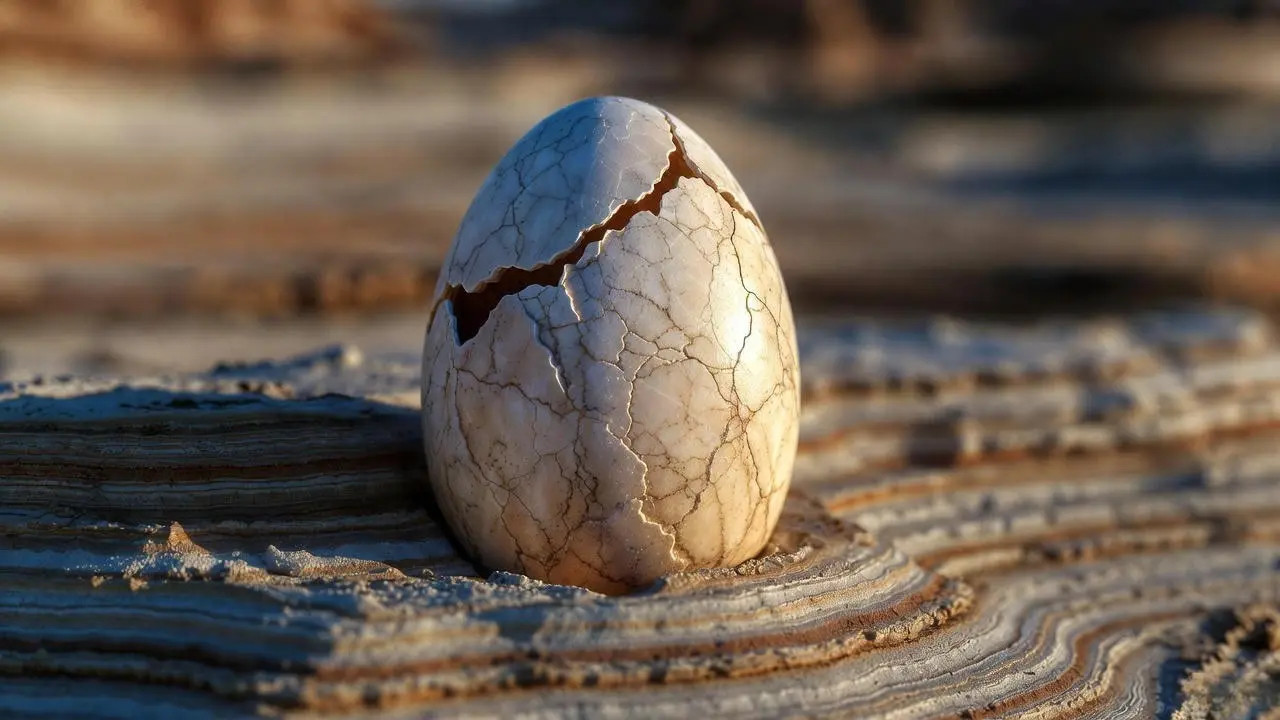
For decades, scientists have known where many dinosaurs lived but not exactly when. A newly published study changes that by showing fossil dinosaur eggs can act like natural clocks, locking in time with surprising accuracy. This discovery matters now because many of the world’s richest fossil sites lack reliable dates.
Discovery: Scientists found fossil dinosaur eggshells can be dated directly using their natural mineral chemistry. How: Tiny traces of uranium locked into the shell slowly turned into lead, acting like a built-in clock. Why It Matters: This method gives precise ages for fossil sites that lack volcanic ash, fixing long-standing timeline gaps. Impact: The technique successfully dated eggs from Utah and Mongolia, reshaping how researchers map dinosaur history and ancient ecosystems.
Researchers found that the mineral structure of fossil eggshells can preserve radioactive signals that reveal when the eggs were buried. These signals allow scientists to date fossils directly, rather than guessing their age from nearby rock layers. The result is a clearer timeline for dinosaur evolution and ancient ecosystems.
The study focused on eggshells made of calcite, a hard mineral similar to limestone. When the eggs were buried, tiny amounts of uranium entered the shell from surrounding sediment. Over millions of years, that uranium slowly changed into lead at a known rate. By measuring this change, scientists calculated the eggs’ burial age.
To test the method, the team first dated dinosaur eggs from Utah’s Cedar Mountain Formation in the United States. These eggs came from layers already dated by volcanic ash, which served as a reality check. The eggshell ages matched those known dates within about five percent, showing the method works .
The researchers then applied the same technique to fossil eggs from Mongolia’s Gobi Basin, a famous dinosaur region with poorly dated rocks. Using eggshell dating, they determined the nesting site formed about 75 million years ago. This is the first direct radioisotopic age ever measured for those deposits, resolving decades of debate .
To confirm accuracy, the team used laser-based tools that scan the eggshell layer by layer. These scans showed uranium spread evenly along the shell’s original growth lines. That pattern suggests the shells behaved like closed systems after burial, meaning the radioactive clock stayed reliable over time .
Researchers say this matters because many land-based fossil sites lack volcanic ash needed for standard dating. Eggshells are common, durable, and found worldwide. This turns a once-overlooked fossil into a powerful tool for building accurate timelines of life on Earth.
The discovery also connects to bigger questions. Precise fossil dates help scientists track how climate shifts shaped evolution, how ecosystems recovered after extinctions, and how animals adapted to changing environments. Better dates lead to better stories about how Earth became what it is today.
The authors caution that not every eggshell will work. Shells must be well preserved and carefully screened for chemical changes. Future studies will test more species, regions, and time periods to refine the method and define its limits .
In simple terms, this study shows that dinosaur eggs are no longer just signs of ancient life. They are timekeepers. By turning eggshells into geological clocks, scientists gain a clearer, more accurate view of Earth’s deep past.
Story Source:
Materials provided by Stellenbosch University. Content may be edited for style and length.
Journal Reference:
Ryan T. Tucker, Kira E. Venter, Cristiano Lana, Eric M. Roberts, Tsogtbaatar Chinzorig, Khishigjav Tsogtbaatar, Lindsay E. Zanno. U-Pb calcite age dating of fossil eggshell as an accurate deep time geochronometer. Communications Earth & Environment, 2025. 6(872). DOI: 10.1038/s43247-025-02895-w