
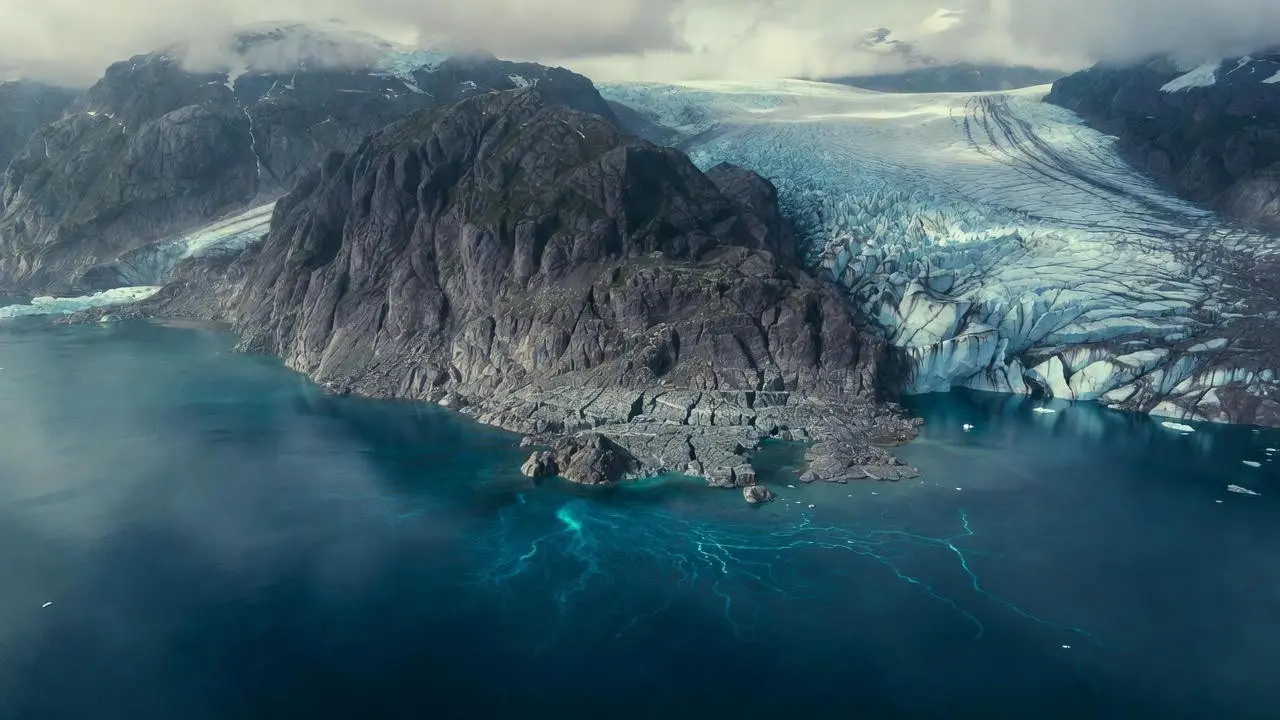
In a remote Alaskan fjord, scientists have detected thousands of tiny underground signals that may quietly reveal when a dangerous landslide environment is changing. The discovery matters now because this unstable slope could trigger a massive tsunami, and current warning systems struggle to see what is happening beneath ice and rock.
What Was Found: Scientists detected thousands of tiny seismic signals beneath a glacier near Alaska’s Barry Landslide. Why It Matters: These signals appear to track underground water freezing and thawing, a hidden process that affects slope stability. Key Insight: The signals are not earthquakes or landslides, but subtle cracks caused by seasonal freeze up below the surface. Big Picture: Monitoring these signals could improve landslide and tsunami risk assessment in glacier covered coastal regions.
The research focuses on the Barry Landslide in Prince William Sound, Alaska, one of the most closely watched landslide hazards in the United States. The slope holds an estimated 500 to 700 million cubic meters of rock. If it collapses into the fjord, it could send destructive waves toward nearby coastal communities. The new study shows that subtle seismic signals, once thought to be noise, may offer a new way to track hidden processes that influence this risk .
Researchers identified a specific type of short, sharp seismic pulse that lasts only one to four seconds. These signals occur tens of thousands of times over several years and follow a strong seasonal pattern. They increase from late summer through winter, then stop suddenly in late winter or early spring. This behavior sets them apart from earthquakes, rockfalls, or glacier calving, which follow different patterns.
To uncover this signal, the team analyzed three years of continuous seismic data from sensors placed on and across from the landslide. They combined this with weather records, glacier motion data, infrasound measurements, and radar that tracks millimeter-scale slope movement. Advanced detection algorithms helped isolate the short signals from the constant background rumble of glaciers and earthquakes. In simple terms, the scientists taught computers how to recognize a specific seismic fingerprint, then searched for it across years of data.
The results show that these signals do not come from the landslide moving itself. Instead, they likely originate beneath or near Cascade Glacier, just behind the unstable slope. The study suggests the signals are caused by tiny fractures in rock or ice when water-filled cracks freeze as winter sets in. When water freezes, it expands like ice in a cracked sidewalk. That expansion can create small breaks that send out sharp seismic clicks.
This matters because water plays a key role in landslide stability. Meltwater and rain can lubricate underground pathways, changing pressure inside the slope. By tracking these freeze and thaw signals, scientists may be able to monitor the hidden water system that feeds the landslide. That information could improve early hazard assessments, even if the signals do not directly predict a collapse.
The researchers stress caution. These seismic pulses are not reliable warning alarms on their own. They do not always coincide with visible slope movement, and they can continue even after surface motion stops. Still, the team believes they act like a vital sign, offering insight into underground conditions that were previously invisible.
The findings also connect to a larger climate story. As glaciers retreat and permafrost warms, steep slopes once supported by ice are becoming more unstable. Similar hidden processes may be occurring in other glaciated regions around the world. Understanding how water, ice, and rock interact beneath the surface could help communities prepare for growing landslide and tsunami risks in a warming climate.
Next, scientists plan to test whether these seismic patterns appear at other landslides influenced by glaciers. They also want to integrate this signal into broader monitoring systems that combine radar, satellite data, and real-time seismic analysis. The goal is not perfect prediction, but better awareness of when conditions beneath a slope are changing.
The key takeaway is simple. Tiny underground signals can reveal big truths. By listening carefully to the Earth’s quietest cracks, scientists may gain a new tool to understand and manage some of the most dangerous natural hazards.
Story Source:
Materials provided by Insert Institution Here. Content may be edited for style and length.
Journal Reference:
Gabrielle K. Davy, Michael E. West, Ezgi Karasözen, John J. Lyons. Searching for Seismic Precursors—The Barry Landslide Hazard. Seismological Research Letters, 2025. Volume XX(Issue XX). DOI: 10.1785/0220250205