Rajveer Meena Recited 70,000 Digits of Pi Blindfolded
Rajveer Meena recited 70,000 digits of pi blindfolded, earning Guinness recognition through years of visual memory training.

On March 21, 2015, Rajveer Meena sat blindfolded at VIT University in Vellore, India, and began reciting the digits of pi.
He continued until he had delivered 70,000 decimal places from memory.
The attempt took nearly ten hours and was later recognized by Guinness World Records. Meena had surpassed the 67,890-digit mark set by China's Lu Chao a decade earlier.
His performance combined an extreme memory system with physical endurance—and it began with a student who once struggled academically.
The Day Rajveer Meena Recalled 70,000 Digits
Meena's record attempt took place before witnesses and university observers on March 21, 2015.
He wore a blindfold throughout the recall. That made the nature of the challenge visually clear: the sequence had to come from memory, without written prompts.
Reports differ slightly on the exact duration, placing it at roughly nine and a half hours. The central facts are consistent: 70,000 decimal places, recalled blindfolded at VIT University, and recognized by Guinness.
70,000
Decimal places memorized
~9.5 hours
Duration of the recall
2015
Year Guinness recognized the feat
Source: Guinness World Records reporting, Hindustan Times and VIT coverage
The Hindustan Times reported that Meena received his Guinness certificate in October 2015.
From Academic Struggles to Memory Training
Meena came from Rajasthan and studied engineering at VIT.
According to contemporary reporting, his interest in memory techniques grew after he struggled in school. Rather than accepting that difficulty as a fixed limit, he began developing ways to make information easier to recall.
He learned to connect numbers with images of colors, people, events, and objects.
That strategy improved more than his ability to perform memory stunts. Reports said it also helped him in his studies.
This part of his story matters because the record can otherwise look disconnected from ordinary life.
The same basic principle used to memorize tens of thousands of digits—turning abstract information into meaningful cues—can also help someone remember names, concepts, dates, or study material.
How He Memorized Such a Long Sequence
Meena described working with pairs of digits and linking them to visual images.
Instead of treating 70,000 digits as 70,000 separate pieces, he compressed them into a system of associations.
A pair such as 21 or 47 could be assigned a stable image. Long sequences could then be translated into chains of visual scenes.
The method resembles systems used by competitive memory athletes around the world.
It does not make the task easy. The memorizer still needs to build thousands of accurate links, rehearse them repeatedly, and retrieve them in the correct order under pressure.
Meena reportedly spent years preparing for the feat. One later account described a training period of roughly six and a half years.
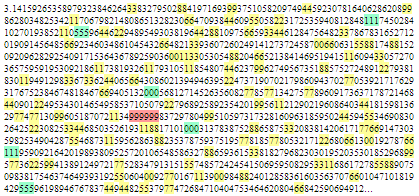
The distribution of pi's digits hints at the scale of the abstract sequence Meena reorganized into memorable visual pairs. Source: Wikimedia Commons.
The Blindfold Was Only One Part of the Challenge
The blindfold attracted attention, but memory was not the only demand.
Meena also had to sit and speak for hours, maintain a steady pace, avoid losing his place, and continue after fatigue set in.
Extreme recall is partly an endurance discipline.
The longer the sequence, the greater the chance that a momentary lapse will break the chain. The performer must manage concentration and physical discomfort while officials check accuracy.
Meena's result therefore combined preparation, a mnemonic code, repeated rehearsal, and the ability to perform under observation.
The Record He Broke
Before Meena, the Guinness-recognized record belonged to Lu Chao.
Lu had recited 67,890 decimal places in 2005 during an attempt lasting more than 24 hours. His method used images and long stories to organize digits.
Meena increased the recognized total to 70,000.
2005
Lu Chao recites 67,890 digits
March 21, 2015
Rajveer Meena recalls 70,000 digits blindfolded
October 2015
Meena receives Guinness recognition
Other longer or slightly higher recitations have been reported under different verification systems. That is why record claims should name the organization involved. Meena's 70,000-digit achievement is specifically associated with Guinness World Records.
He Had Already Built a Reputation for Recall
The pi attempt was not Meena's first public memory feat.
Earlier reporting said he had earned a place in India's Limca Book of Records by recalling 1,125 random mobile numbers.
That achievement showed the same general strength: converting large amounts of abstract information into retrievable structure.
Pi offered a larger and more internationally recognizable stage.
Because almost everyone encounters 3.14 in school, people can understand the starting point. The shock comes from realizing how far beyond that familiar beginning Meena traveled.
What Rajveer Meena's Story Teaches About Memory
Rajveer Meena's record is extraordinary because of its scale.
But the most useful lesson is smaller.
Memory improves when information stops being anonymous. A number becomes an image. An image becomes part of a sequence. The sequence becomes a route the mind can follow.
Meena used that principle until it carried him through 70,000 decimal places of pi.
His story also challenges the belief that early academic difficulty defines a person's potential. The student who struggled with memory built a system strong enough to earn Guinness recognition.
For most people, the goal will never be a ten-hour recitation.
But the principle remains: structure, imagination, and deliberate practice can change what the mind is able to hold.
Featured image: Rajveer Meena during his blindfolded pi recitation, via Guinness World Records.
The weekly question
From obsession to clarity — one original question every week.
We answer one noisy topic at a time, in full. No daily roundup, no thread bait — just the question, the principles, and the system.