
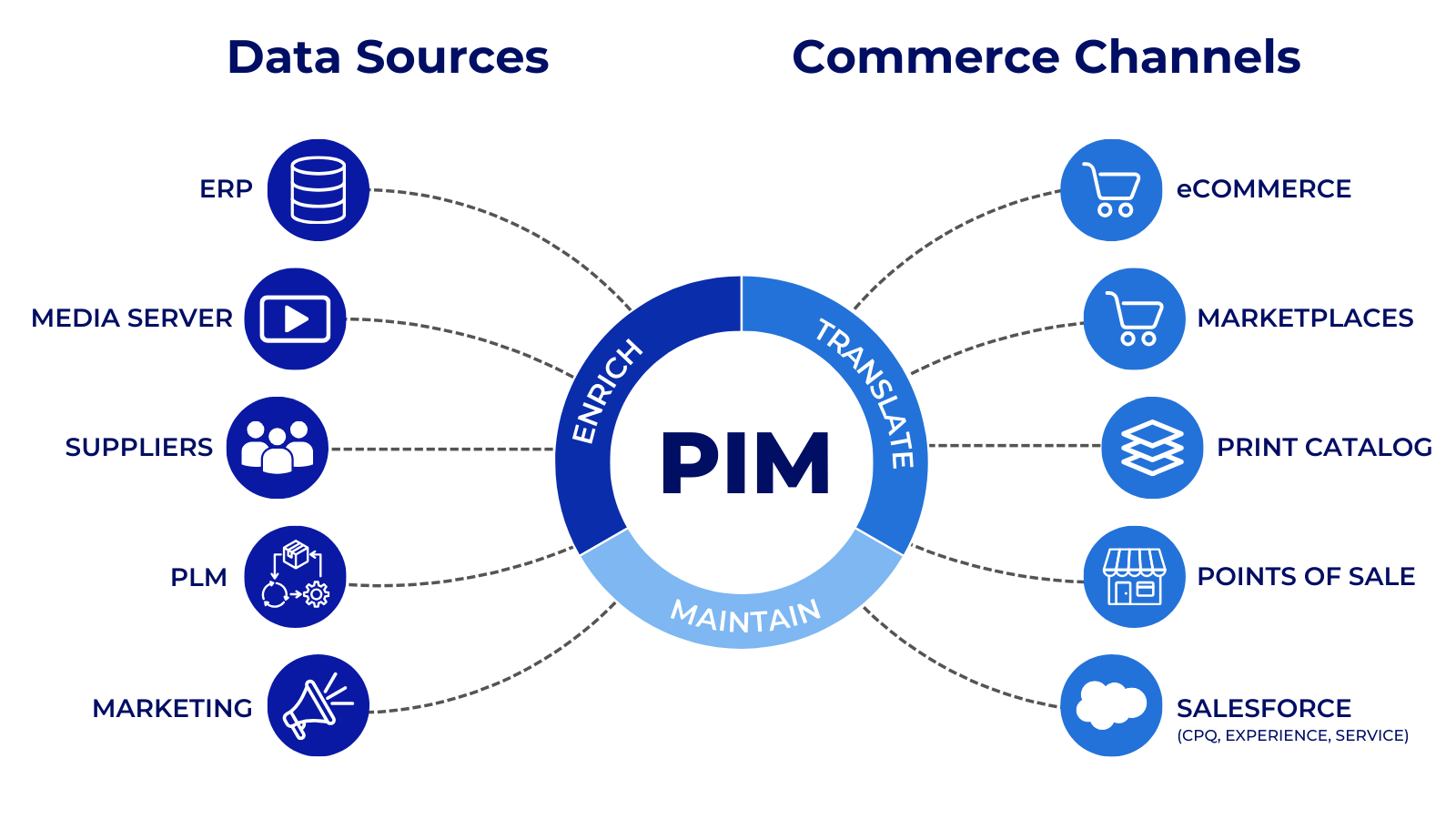
It is Monday morning. Your marketing team finds out that half of your product descriptions are old. The sales team scrambles because they cannot find the latest pricing sheets. At the same time, your e-commerce manager sees that Amazon shows competitor prices again. The data sync failed overnight. If any of this sounds familiar, you are not alone. Many businesses have this kind of product data chaos. Spreadsheets increase too much, consistency goes away, and managing everything feels impossible.
I spend over 20 years helping companies control their product information. I see how the right PIM system can change everything. But many options exist, and finding the right one for your business is not simple.
Why Your Business Desperately Needs a PIM System
Let’s cut through the marketing fluff and talk reality. Managing product information with Excel sheets, shared drives, and prayer isn’t just inefficient—it’s business suicide in today’s hyper-competitive marketplace.
Consider these sobering statistics: 87% of consumers abandon purchases due to incomplete or inaccurate product information. Meanwhile, companies leveraging robust PIM solutions see conversion rates jump by 25% and return rates plummet by 15%. The math is simple—accurate, consistent product data directly translates to revenue growth.
Modern businesses juggle product information across countless touchpoints. Your website needs SEO-optimized descriptions, Amazon demands specific formatting, social media requires engaging content, and your sales team craves technical specifications. Without centralized management, you’re playing a losing game of telephone where every message gets distorted.
Who Actually Uses PIM Systems?
The beauty of today’s PIM tools lies in their versatility. These aren’t just enterprise-level solutions anymore—they’re democratizing product data management across industries.
E-commerce Pioneers leverage PIM platforms to maintain consistency across multiple marketplaces. Whether you’re selling handcrafted jewelry or industrial equipment, your Shopify store, Amazon listings, and eBay auctions need synchronized information.
Manufacturing Giants utilize PIM systems to manage complex product hierarchies, technical specifications, and compliance requirements across global markets. Imagine coordinating product data for widgets available in twelve colors, five sizes, and varying specifications across different countries—without a PIM solution, you’d need a small army.
B2B Specialists rely on PIM capabilities to provide detailed technical documentation, configure complex products, and maintain accurate pricing across customer segments. When your buyers need comprehensive specifications for purchasing decisions, organized data becomes your competitive edge.
Retail Champions harness PIM software to create compelling product experiences while managing supplier relationships and maintaining brand consistency across channels.
Top 10 Best Product Information Management Software Solutions
After evaluating dozens of PIM providers, analyzing customer reviews, and conducting extensive market research, here are the cream-of-the-crop solutions transforming businesses worldwide.
1. Akeneo – The Enterprise Powerhouse
Akeneo dominates the enterprise PIM landscape with sophisticated functionality that handles the most complex product catalogs. This open-source platform serves fortune 500 companies requiring military-grade organization.
Why it shines: Advanced attribute management, AI-powered content generation, and workflow capabilities that would make NASA jealous. Their collaboration tools enable granular user permissions and role management across massive teams.
Perfect for: Large enterprises (500+ employees) with complex product hierarchies and deep pockets Investment: Starting at $25,000 annually Reality check: 6-month implementation timeline—not for the impatient
2. Pimcore – The Swiss Army Knife
This Austrian-engineered solution combines PIM functionality with Digital Asset Management and content management in one comprehensive platform. Think of it as the Swiss Army knife of product information management tools.
Why it rocks: Headless architecture, extensive customization options, and integrated Translation Management System supporting multiple languages automatically. Plus, it handles 220+ file types in its DAM system.
Ideal for: Large enterprises with strong technical teams and complex digital asset requirements Investment: From $1,550/month Timeline: 6 months to full deployment
3. Bluestone PIM – The Future-Forward Choice
Built on MACH principles (Microservices, API-first, Cloud-native SaaS, Headless), Bluestone represents next-generation PIM platforms designed for digital commerce evolution.
Why it excels: Extreme flexibility in channel connections, growing app marketplace, and microservices architecture preventing vendor lock-in. This Nordic solution scales beautifully with modern business needs.
Best suited for: Mid-market to enterprise businesses planning aggressive growth Investment: Custom pricing based on requirements Timeline: 3-4 months to launch
4. Plytix – The SMB Champion
Plytix democratizes enterprise-level PIM tools for small and mid-sized businesses without the complexity or astronomical costs. This cloud-based solution strikes the perfect balance between power and simplicity.
Why it wins: Combines PIM, DAM, and syndication capabilities affordably. AI-powered features include automatic product description generation and image enhancement. Their computed attributes functionality enables dynamic data transformation.
Perfect for: Small to medium businesses seeking comprehensive functionality without enterprise headaches
Investment: From €699/month
Setup time: Under 30 days—seriously
Bonus: 9.8/10 customer support rating on G2
5. PIMinto – The User Experience Revolution
PIMinto emerges as a game-changing solution for businesses seeking modern, intuitive product information management without sacrificing enterprise-grade functionality. This innovative platform combines powerful automation with refreshingly simple design.
Why it’s different: Simplifies complex product data workflows while maintaining robust capabilities. Intelligent data enrichment and seamless channel syndication make omnichannel expansion feel effortless rather than overwhelming.
Ideal for: Growing businesses needing serious PIM capabilities with emphasis on user experience and team adoption
Investment: Starting at $300/month—exceptional value proposition
Key differentiators: Advanced automation, intuitive interface, comprehensive integration ecosystem
PIMinto’s philosophy reflects modern understanding that effective PIM software should empower teams rather than burden them with complexity.
6. Syndigo – The Content Distribution Giant
Syndigo positions itself beyond traditional PIM as an “Active Content Engine” powering modern commerce through comprehensive content management and syndication networks.
Why it dominates: Serves 12,000+ manufacturers and 1,750+ retailers globally with the largest two-sided content distribution network. Built-in analytics and vendor health scores ensure data quality across all touchpoints.
Best for: Large enterprises with complex distribution networks requiring extensive reach Investment: Custom enterprise pricing—expect significant investment
Timeline: 4-month implementation process
7. Salsify – The Comprehensive Platform
Salsify builds a complete Product Experience Management (PXM) platform combining traditional PIM functionality with advanced commerce capabilities and deep analytics.
Why it stands out: Automated workflow management with no-code builder, AI-powered data quality enforcement, and built-in analytics tracking content performance across sales channels.
Perfect for: Large enterprises requiring extensive feature sets and comprehensive analytics Investment: From $2,000/month and climbing
Timeline: 4-month deployment cycle
8. inRiver – The Marketing-Focused Solution
inRiver specializes as the PIM solution designed specifically for marketers, offering campaign planning functionality and comprehensive analytics alongside traditional PIM capabilities.
Why marketers love it: Channel Insights with Digital Shelf Analytics (DSA) providing weekly updates on product visibility, pricing, and stock status across e-commerce sites. The Evaluate tool offers real-time product listing audits.
Ideal for: Mid-sized to enterprise businesses with marketing-driven product strategies Investment: Custom pricing—demo required
Reality check: 9-month implementation timeline—patience required
9. Sales Layer – The B2B Specialist
Sales Layer builds its reputation as the leading PIM solution tailored specifically for B2B companies, featuring capabilities that handle complex product relationships and channel requirements with finesse.
Why B2B loves it: Excels in instant catalog generation matching specific sales channel requirements, with plug-and-play integrations and comprehensive reporting tools. Product enrichment supports translation into 156 languages.
Perfect for: Mid-sized to enterprise B2B businesses with complex product hierarchies Investment: Custom pricing (demo required for quotes)
Timeline: 3-month implementation
10. Catsy – The Visual Content Master
Catsy rounds out our list with its unique approach emphasizing visual content and digital asset organization alongside traditional PIM functionality.
Why it’s unique: Combines robust PIM capabilities with advanced DAM features, particularly suitable for businesses where visual content drives product presentation and sales success.
Best for: Businesses with extensive visual content requirements and creative teams Investment: Tiered pricing based on features and usage requirements
Timeline: 2-3 months to full deployment
How to Choose the Perfect PIM System for Your Business
Selecting the optimal PIM solution requires more than comparing feature lists—it demands understanding your business DNA and growth trajectory.
Start with Your Pain Points
What keeps you awake at night? Inconsistent product data across channels? Manual processes eating your team’s productivity? Slow product launches missing market opportunities? Let your biggest challenges drive feature requirements rather than getting dazzled by impressive capabilities you’ll never use.
Assess Your Team’s Technical Appetite
Without dedicated IT resources, prioritize cloud-based PIM platforms with intuitive interfaces and stellar support. With strong technical teams and customization needs, open-source solutions like Pimcore or Akeneo merit the additional complexity investment.
Plan for Tomorrow, Not Yesterday
Choose PIM systems accommodating your business three years from now. Consider current product catalog size, expansion plans, new channel strategies, and evolving team structure. Growing into your system beats outgrowing it within two years.
Integration Reality Check
Your PIM system must play nicely with existing ERP, e-commerce platforms, marketing automation tools, and business systems. Prioritize solutions offering robust APIs and pre-built connectors for your current tech stack.
Calculate True Investment
While free PIM software seems attractive, consider implementation costs, training requirements, ongoing support, and customization needs. Higher upfront investments in comprehensive solutions often save significant money long-term.
The Bottom Line on Best Product Information Management Software
The PIM landscape has evolved dramatically. Modern solutions offer capabilities that seemed impossible just five years ago. AI-powered content generation, automated data quality checks, and intelligent syndication have become standard expectations rather than luxury features.
Whether organizing your first 100 SKUs or managing millions of product variations across global markets, there’s a PIM solution designed for your specific needs. Success requires thorough evaluation and choosing platforms that grow with your business rather than constraining it.
Remember: implementing a PIM system represents a strategic business investment touching every aspect of product-related operations. Choose wisely, and you’ll wonder how you survived without it. Choose poorly, and you’ll be shopping for replacements within two years—trust me, I’ve seen this movie too many times.
The future belongs to businesses delivering consistent, compelling product experiences across every channel. With the right PIM system as your foundation, you’ll transform product data from a liability into your secret weapon for competitive advantage.