
Polygons Shark Tank Update: The $1M Kickstarter That Took 10 Years to Reach the Tank
Polygons raised $1.02M on Kickstarter in 2016, then spent a decade fulfilling it. Here's the Shark Tank deal, the real cost of capital, and what the backlog actually costs now.
Polygons: from a 2016 Kickstarter to a Season 18 deal. Graphic: Geeks Around Globe
Most Shark Tank founders walk in with a product and a pitch. Rahul Agarwal walked into Season 18, Episode 4 with a product, a pitch, a patent, 24 design awards — and a 2016 Kickstarter he was still shipping. That last detail is the real story, and it is the one most recaps skip.
Quick Answer
Polygons is a fold-flat measuring spoon: two 2.8 mm strips that pinch into six measures (¼ tsp to 2 tbsp) and stick to the fridge with hidden magnets. Founder Rahul Agarwal asked for $350,000 for 7% and left with $350,000 for 8% equity plus 2% advisory shares and a $500,000 line of credit from Lori Greiner and guest Shark Mindy Kaling. The company reported roughly $4 million in lifetime sales, $1.25 million in the last year, and 200,000+ units shipped to 110+ countries. It is still fulfilling a $1,022,120 Kickstarter from October 2016.
Polygons at a glance
| Detail | Polygons |
|---|---|
| Product | Fold-flat 6-in-1 measuring spoon set (two pieces) |
| Founder | Rahul Agarwal (National Institute of Design, Ahmedabad) |
| Episode | Season 18, Episode 4 — aired October 14, 2026 |
| Ask | $350,000 for 7% ($5M valuation) |
| Deal | $350,000 for 8% + 2% advisory, plus $500,000 credit line |
| Sharks | Lori Greiner and Mindy Kaling |
| Lifetime sales | ~$4 million; ~$1.25 million last 12 months |
| Retail price | $29.99 for a two-spoon set (getpolygons.com, Amazon, MoMA Design Store) |
| Kickstarter | $1,022,120 from 36,863 backers, Oct–Nov 2016 |
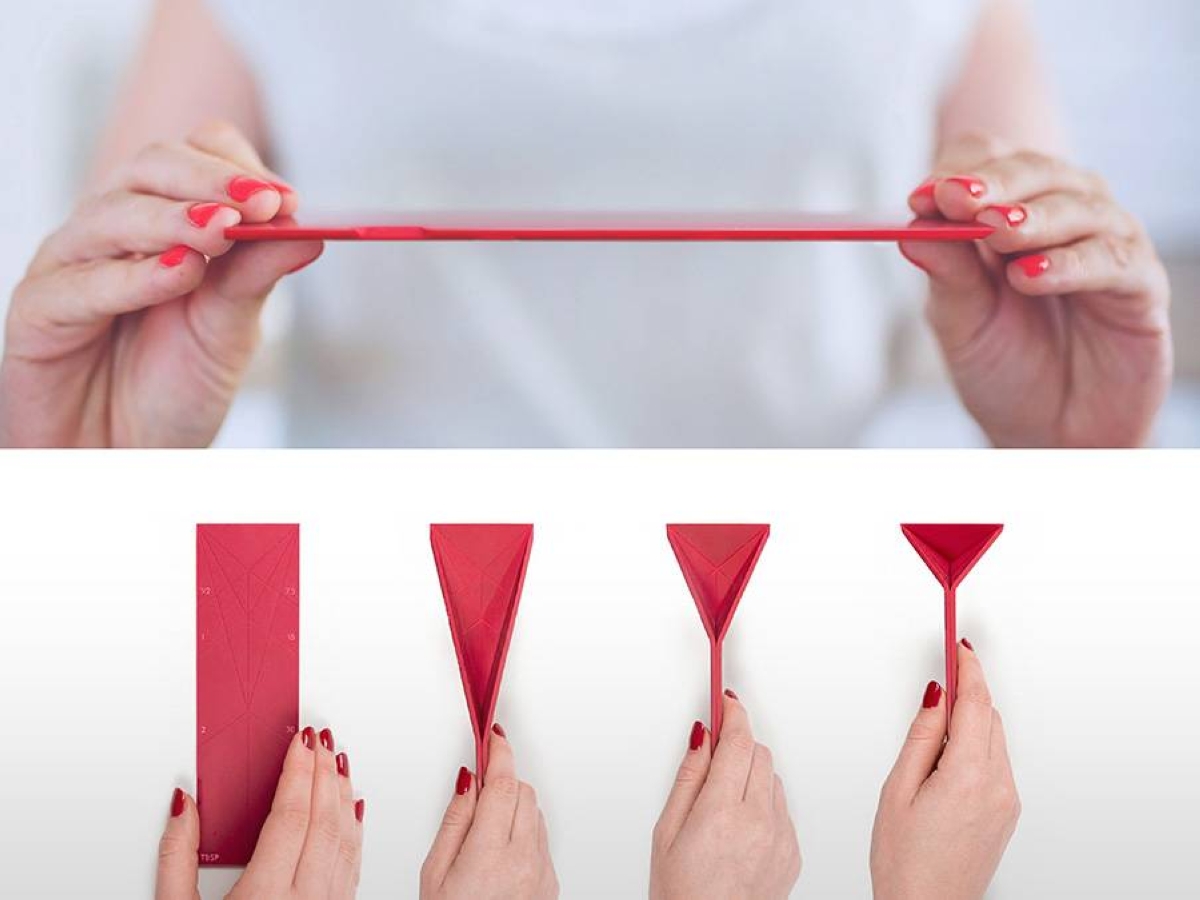
Polygons lies flat until you pinch it into a measure. Photo: Polygons Design Inc. via GlobeNewswire
What is Polygons?
Polygons replaces a six-piece measuring spoon set with two flat strips. Pinch the large one at different points and it becomes ½, 1 or 2 tablespoons; the small one becomes ¼, ½ or 1 teaspoon. Flat, it doubles as a spreader and wipes clean in one pass. The hinges are food-grade silicone rated for 100,000+ folds, the body is food-grade thermoplastic, and embedded neodymium magnets hold it to a fridge door. The design is covered by U.S. Patent 10,175,084.
The company's own sustainability math is part of the pitch: about 70% less material than a conventional plastic set, 87% less shipping volume, and roughly 80% lower freight emissions per set.
Who founded Polygons?
Agarwal designed the first Polygons in 2014 as a student project at India's National Institute of Design, after a senior told him not to bother with objects that had already "reached perfection" — like a spoon. He had a working concept in three days. The finished product took about three years, more than 1,000 prototypes and seven manufacturers.
Polygons Design Inc. is a U.S. company that designs in India and manufactures in China. The founder told the Sharks he still pays himself $500 a month.
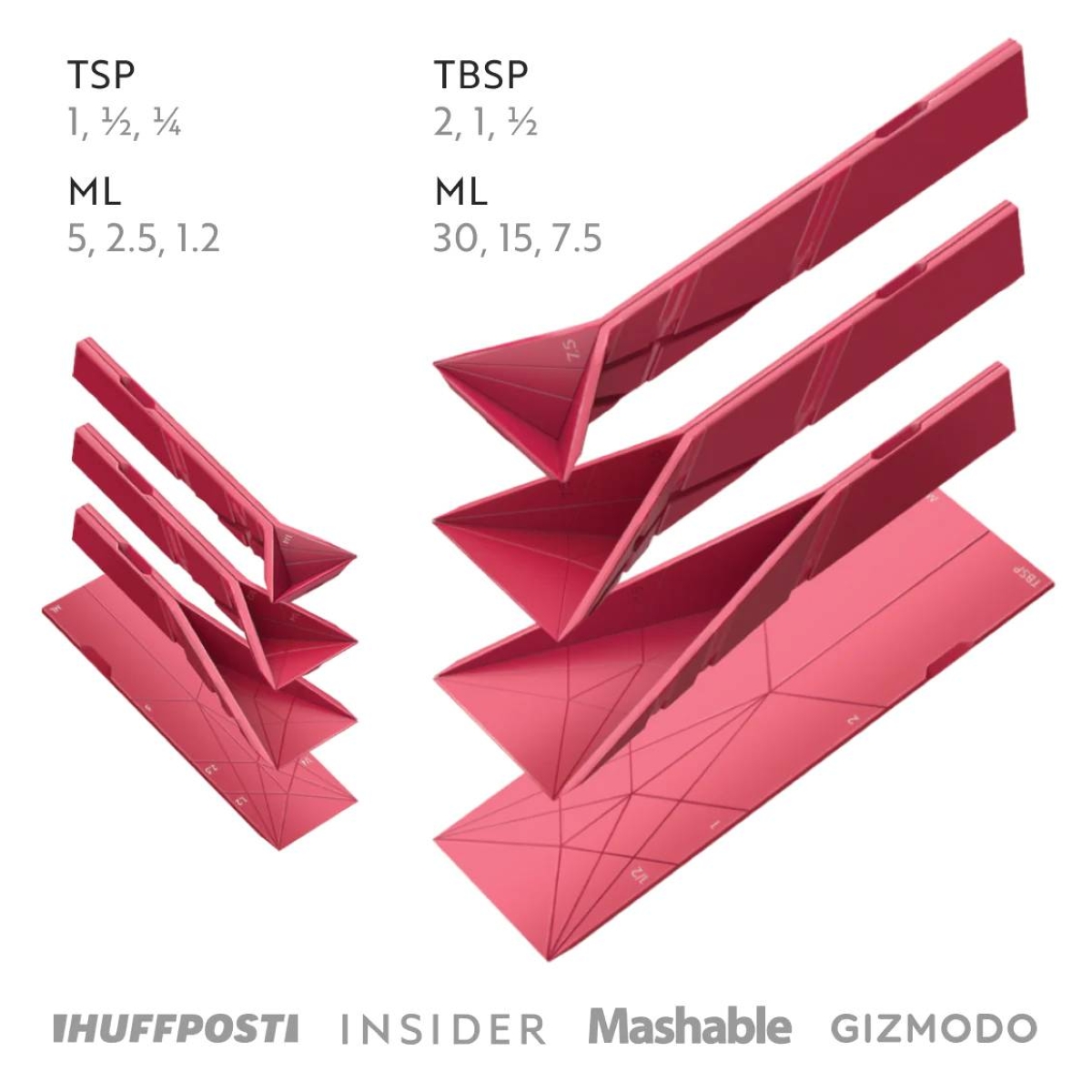
Where you pinch decides the measure: one strip, three sizes. Photo: Polygons Design Inc. via GlobeNewswire
What happened on Shark Tank?
Agarwal demonstrated the fold, the magnets and the wipe-clean trick, then walked through the numbers: ~$4M lifetime sales, $1.25M in the trailing year, about $210,000 in profit with $40,000 reinvested, a ~$7 unit cost against a $24–29 retail price, and a $7.50 customer acquisition cost.
Kevin O'Leary opened at 15% and came down to 10%. Lori Greiner and Mindy Kaling teamed up and landed the deal.
Deal snapshot
| Term | Ask | Final |
|---|---|---|
| Cash | $350,000 | $350,000 |
| Equity | 7% | 8% + 2% advisory shares |
| Implied valuation | $5.0M | $3.5M |
| Extras | — | $500,000 line of credit |
| Investors | — | Lori Greiner + Mindy Kaling |
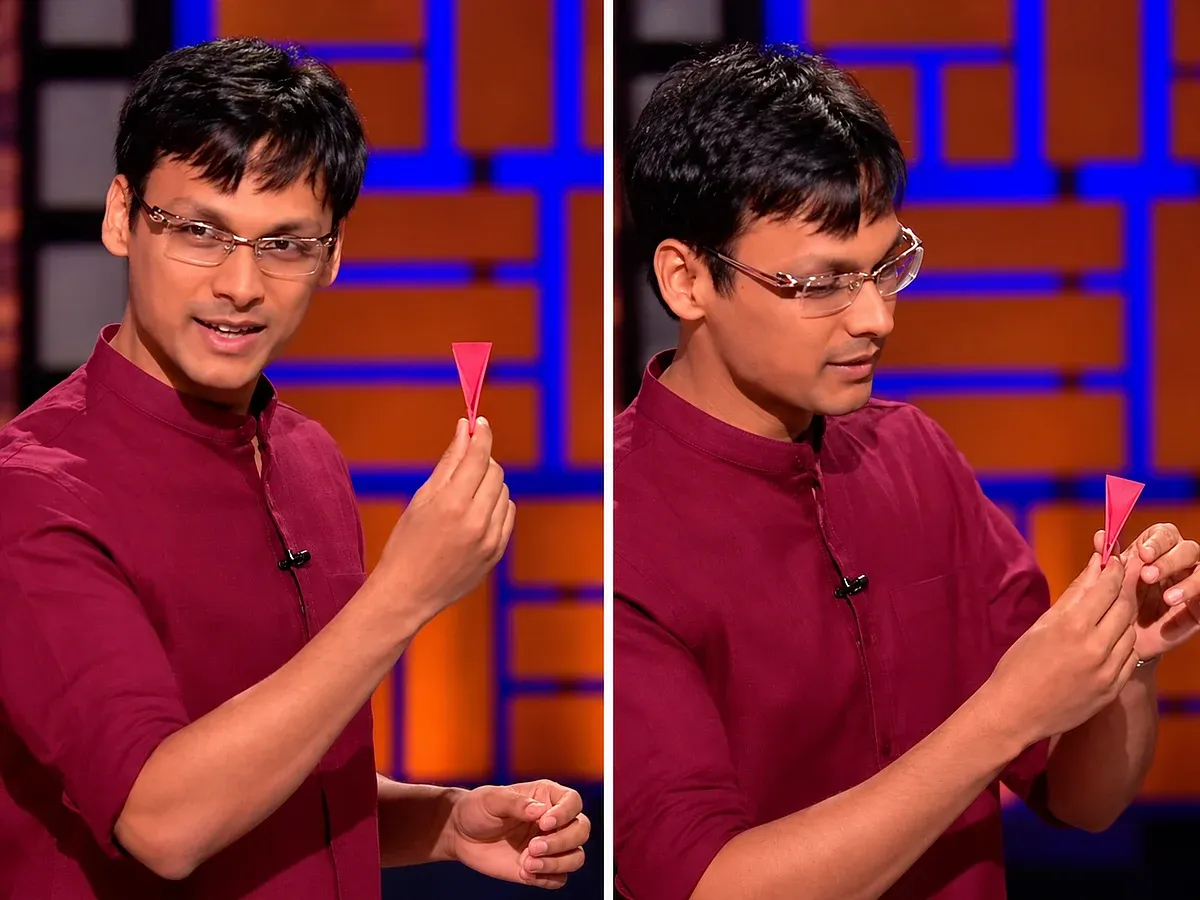
Rahul Agarwal pitches Polygons in Season 18, Episode 4. Photo: ABC/Disney
Only on GAG: what the Kickstarter actually cost — and what it costs to finish
Every recap mentions that Polygons "started on Kickstarter." None of them do the arithmetic. We did.
25%
Of lifetime revenue from one 40-day campaign in 2016
$27.73
Average pledge across 36,863 backers
+150%
Price rise since the Kickstarter
$12 early set to $29.99 today
3,686
Max backers still waiting
Brand says more than nine in ten have sets
$26K
Product cost to clear the whole backlog
At the on-air $7 unit cost
Source: GAG analysis of on-air figures, Kickstarter records and getpolygons.com
Connect the dots:
- The Kickstarter was a quarter of the business — ever. $1,022,120 against ~$4M lifetime sales means one 2016 campaign still represents roughly 25% of every dollar Polygons has taken in across ten years.
- Backers paid 2016 prices for a 2026 product. The early-bird set was $12; today's set is $29.99. The brand even made a backer-only colour, "Origin Orange," for people still waiting.
- The backlog is now financially tiny. If 10% of backers are outstanding (the brand's own upper bound), that is at most ~3,686 sets. At the ~$7 unit cost Agarwal gave on air, finishing every one costs about $26,000 — around 2% of last year's revenue, or 12% of last year's profit. The ten-year wait was a cash-flow problem of 2017–2021, not of 2026.
- The credit line is half the Kickstarter. The $500,000 facility from Greiner and Kaling is roughly half the entire crowdfund — but it arrives as working capital with the product already proven, instead of as pre-orders that had to be engineered, tooled and shipped.
- The price of the Sharks. Agarwal gave up 3 extra points versus his ask. At his own $5M valuation those 3 points are worth $150,000 — the effective fee for the credit line, Lori's QVC machine, and Mindy Kaling's audience.
| Polygons, in dollars | |
|---|---|
| 2016 Kickstarter | $1,022,120 |
| Last-12-month revenue | $1,250,000 |
| Shark Tank cash | $350,000 |
| Credit line | $500,000 |
| Backlog cost (GAG est.) | $26,000 |
Source: On-air figures; Kickstarter; GAG estimate
From a $10,000 goal to the Tank
2014
Concept designed
A student project at NID Ahmedabad, conceived in three days.
Oct 11, 2016
Kickstarter launches
$10,000 goal, funded in about an hour.
Nov 21, 2016
Campaign closes
$1,022,120 from 36,863 backers.
Dec 2019
First backer deliveries
Three years after the campaign ended.
Mar 2022
Shipping resumes
After pandemic supply-chain delays; direct sales fund backer orders.
Q4 2024
TikTok breakout
No. 1 kitchen gadget on TikTok Shop; 500M+ organic views.
2025–2026
Awards season
Red Dot, iF, IDSA Sustainability Impact, European Product Design.
Oct 14, 2026
Shark Tank airs
Season 18, Episode 4; deal with Greiner and Kaling.
How does Polygons make money?
Direct-to-consumer. The set sells for $29.99 in eight colours on getpolygons.com and the official Amazon store, and is stocked by the MoMA Design Store. TikTok Shop drove the breakout: the brand says it was the platform's top kitchen gadget in Q4 2024. With a ~$7 unit cost and a $7.50 acquisition cost, each set clears roughly $15 before overhead — healthy for a kitchen gadget, and the reason the business can fund its own backlog.
Counterfeits are the drag. The company reports removing more than 4,600 knock-off listings and asks buyers to stick to its two official stores.
Polygons after Shark Tank
The episode aired October 14, 2026, and the deal is a handshake until due diligence closes. What we can verify today:
| Signal | Status |
|---|---|
| Product in stock | Yes, eight colours at $29.99 |
| Backer programme | Live page with a 2-day reply / 7-day ship promise |
| Reviews | 4.8 stars across 5,000+ reviews (brand-reported); Trustpilot dominated by unfulfilled 2016 backers |
| Awards | 24 across 20 competitions, including two Red Dots |
| Retail | getpolygons.com, Amazon, MoMA Design Store |
Open question: whether Greiner's QVC/HSN channel appears in the next year. If it does, expect the $1.25M run-rate to move quickly — Lori's kitchen deals historically scale fastest on live shopping.
Lessons for founders
- A viral crowdfund is a liability until it ships. Polygons raised 102× its goal and then spent three years learning to manufacture it. Set the goal you can fulfil, not the goal that trends.
- Finish the old promise before the new spotlight. The Trustpilot page is almost entirely 2016 backers. The product is excellent; the unresolved pledges are what people write about.
- Unit economics beat valuation. A $7 cost, $7.50 CAC and $30 price is why two Sharks fought for a kitchen spoon.
Final take
Polygons is the rare Shark Tank product with a decade of proof behind it: a patent, real awards, real sales, and a founder who stayed on a $500 salary to keep it alive. The 2016 backlog is the asterisk — but by our math it is now a $26,000 problem on a $1.25M business. Clearing it before the Greiner–Kaling money lands would turn the company's weakest search result into its best redemption story.
FAQ
Did Polygons get a deal on Shark Tank? Yes. Lori Greiner and Mindy Kaling invested $350,000 for 8% equity plus 2% advisory shares, with a $500,000 line of credit.
How much is Polygons worth? The deal implies about $3.5 million; the founder had asked at a $5 million valuation.
Is Polygons still fulfilling its Kickstarter? Yes. The brand says more than nine in ten of its 36,863 backers have received sets and runs a backer page for the rest.
Where can I buy Polygons? getpolygons.com, the official Polygons store on Amazon, and the MoMA Design Store. The set costs $29.99.
Which episode was Polygons on? Season 18, Episode 4, aired October 14, 2026, alongside Loli-Med, Bye Bye Button and Sunday Club.
More Shark Tank Season 18 updates
- Shark Tank Season 18 episode guide and every product so far
- Loli-Med Shark Tank update — the other Episode 4 deal
- Donna's Pickle Beer Shark Tank update
- ZALT Shark Tank update
Sources
- Polygons Design Inc. press release via GlobeNewswire / The Manila Times, Oct 12, 2026
- Polygons, "To our Kickstarter backers" page, getpolygons.com
- Gulf News, "Indian designer wins $350,000 Shark Tank deal," Oct 21, 2026
- Indiegogo/Kickstarter campaign records: $1,022,120 from 36,863 backers
- Crowdfund Insider, Dezeen, Gigazine (Oct–Nov 2016 campaign coverage)
- Dealroom company profile; Trustpilot reviews of getpolygons.com
- On-air figures as stated in ABC's Shark Tank, Season 18, Episode 4
The weekly question
From obsession to clarity — one original question every week.
We answer one noisy topic at a time, in full. No daily roundup, no thread bait — just the question, the principles, and the system.
More from shark-tank-usa-season-18
All season pitches
Shark Tank USA
Bye Bye Button Shark Tank Update: The $25,000 Deal That Pays the Sharks Back Twice
Shark Tank USA
HeroCovers Shark Tank Update: Kevin O'Leary Paid Full Price — Then Added a $50-a-Cover Royalty
Shark Tank USA