
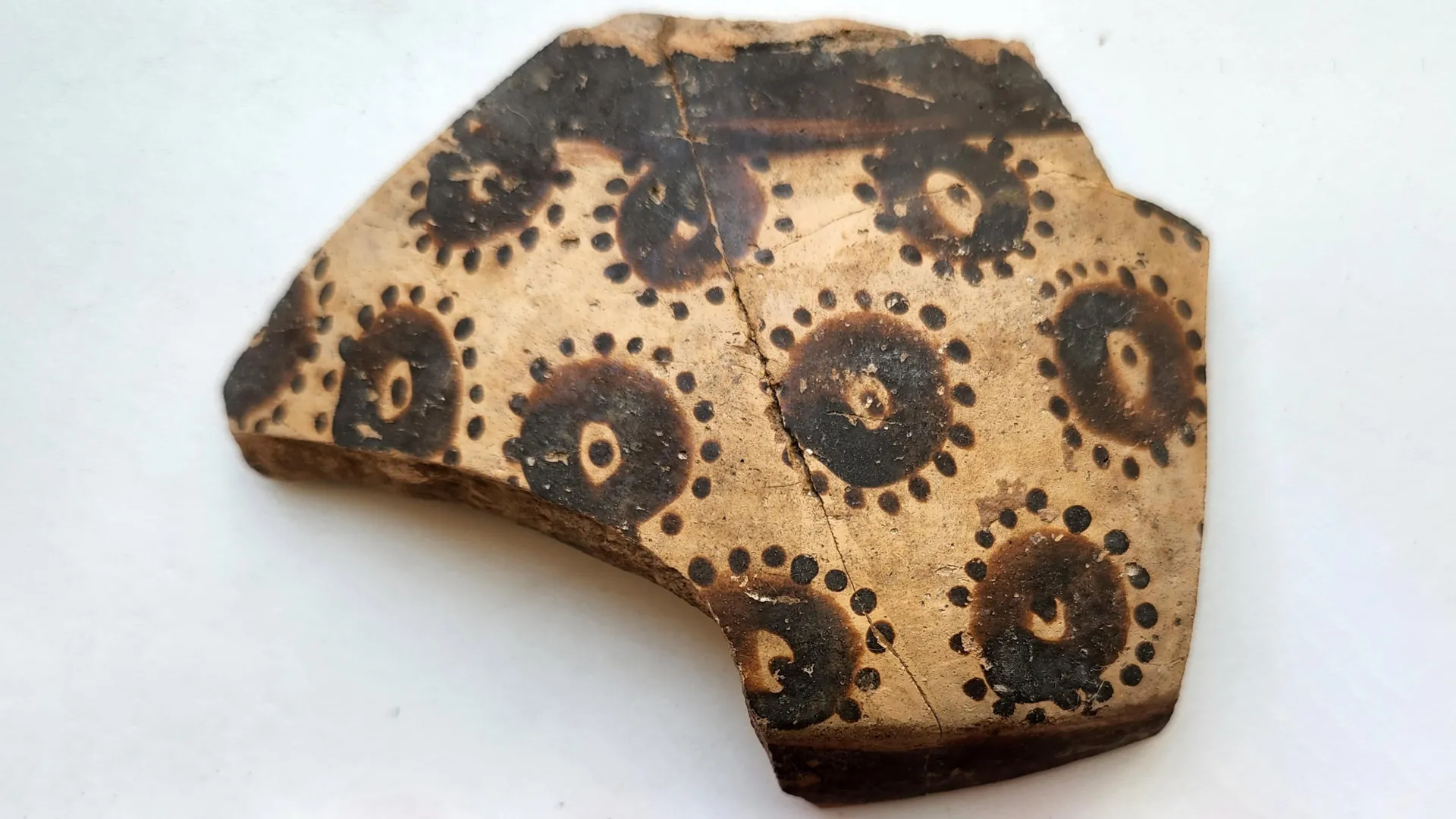
The first drawings of plants did not appear in books or walls. They appeared on bowls. A newly published study shows that people living in northern Mesopotamia more than 7,000 years ago painted flowers and trees on pottery using precise patterns that reveal early mathematical thinking and a new way of seeing nature .
Discovery: Researchers found the world’s earliest known plant drawings on pottery made over 7,000 years ago. Where: Northern Mesopotamia, across 29 Halafian archaeological sites. Key Insight: Flowers and trees were painted using exact patterns like 4, 8, 16, and 32 petals. Why It Matters: These designs suggest early humans already understood counting, symmetry, and fair division. Bigger Picture: Art may have been an early tool for sharing resources and organizing village life.
Researchers found that these ancient artists did more than decorate everyday objects. They carefully divided space into equal parts and repeated shapes in exact number sequences. This suggests that early village communities already understood counting, symmetry, and fair division long before written numbers existed.
The study focuses on the Halafian culture, which lived between about 6200 and 5500 BC in what is now parts of Iraq, Syria, and Turkey. Scientists examined painted pottery from 29 archaeological sites. They discovered the earliest known systematic images of plants in prehistoric art. These included flowers, branches, shrubs, and even tall trees.
What makes this discovery new is not just the plant imagery. It is how the plants were drawn. Many flowers were painted with exactly four, eight, sixteen, or thirty two petals. In one case, artists arranged sixty four flowers in a precise grid. These numbers form a clear doubling pattern. It is the same logic used today when we split land, food, or resources evenly.
To reach these conclusions, the researchers analyzed thousands of pottery fragments. They compared shapes, patterns, and placement across sites. They looked closely at how artists divided circular bowls into equal sections. No writing or measuring tools were found. Instead, the pottery itself acts like a record of thinking, much like footprints preserved in mud.
This matters because it changes how we understand early human intelligence. For years, experts believed advanced math thinking appeared much later. This study suggests that the need to share crops, manage land, and live cooperatively pushed people to develop mental math skills. Art became a way to practice and display that knowledge.
One of the authors from the Hebrew University of Jerusalem explained that these designs were likely not religious symbols or farming rituals. The pottery does not show crops or harvest scenes. Instead, it shows beauty, balance, and order. Flowers may have been chosen because humans naturally respond to symmetry and patterns, which feel pleasing and meaningful.
The finding also connects to modern life in surprising ways. Today, math helps divide property, manage resources, and design cities. This study suggests those needs existed even in early villages. The same mental skills that guide modern planning may have first grown out of shared farming and daily cooperation.
Researchers caution that this does not mean ancient people used formal math like we do today. There were no equations or symbols. But the repeated patterns strongly suggest intentional counting and planning. Future studies will examine whether similar designs appear in other early cultures around the world.
The big takeaway is simple but powerful. Long before numbers were written down, humans were already thinking mathematically. They expressed that thinking through art, using flowers and trees to organize the world around them. What looks like decoration today was once a quiet breakthrough in human thought.
Story Source:
Materials provided by The Hebrew University of Jerusalem. Content may be edited for style and length.
Journal Reference:
Yosef Garfinkel, Sarah Krulwich. The Earliest Vegetal Motifs in Prehistoric Art: Painted Halafian Pottery of Mesopotamia and Prehistoric Mathematical Thinking. Journal of World Prehistory, 2025. 38(14). DOI: 10.1007/s10963-025-09200-9