
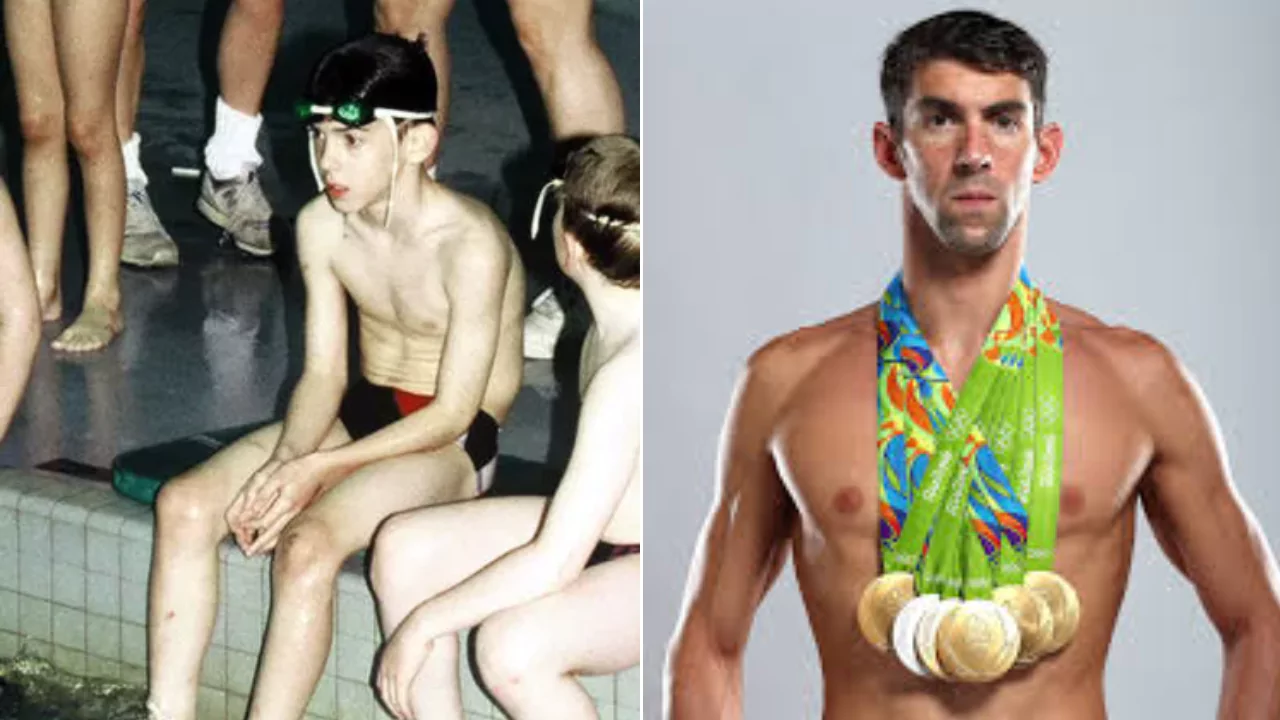
Michael Phelps is ten years old. Practice is over. The pool is quiet. Most of the kids are already toweling off, chattering about dinner or homework. But Michael? He is still in the water, gliding back and forth, eyes locked on the black line at the bottom of the pool. He is working on his underwater dolphin kick, repeating the same motion again and again, perfecting each movement by feel and instinct. His coach calls out that it’s time to stop. Michael shakes his head and begs for just one more lap.
This is not about beating someone else. This is not about medals. It is about something much deeper: a fire inside, the kind only true obsession can light.
Michael Phelps wasn’t just a talented swimmer. He was obsessed. He studied swimming the way others might study astronomy or dinosaurs. For him, the water was more than a sport. It was a language, and he was determined to speak it fluently.
That brings us to the question that drives this story: Did that early obsession shape the icon he became? And is that same geek still swimming inside him today?
Fast Facts
- Subject: Michael Phelps
- Early Passion: Swimming as a tool to manage ADHD
- Major Achievement: 23 Olympic gold medals, 39 world records
- Current Role: Mental health advocate, mentor, and foundation leader
- Still Geeky? Yes, swimming remains his emotional and professional focus
What Michael Phelps Geeked On Back Then
Michael’s love for swimming started with a challenge. At age 9, he was diagnosed with Attention Deficit Hyperactivity Disorder (ADHD). He found it hard to sit still, focus on tasks, or follow instructions in the classroom. His mom, Deborah Phelps, who was a school principal, knew he needed an outlet to help manage his energy and improve focus. So she introduced him to swimming.
What started as a treatment soon became an obsession. Michael felt calm in the water. The structure of swimming lanes, the rhythm of strokes, and the clear goals helped him find control in a world that often felt overwhelming.
Deborah later shared in interviews how the water gave her son a sense of safety and routine.
“Swimming gave him a clear path, with lines and rules. It calmed him,” she said.
(Source: Stephanie Sarkis interview with Debbie Phelps)
Michael didn’t just swim; he studied swimming. He would watch hours of footage of Olympic races, not just to admire his heroes but to break down every detail. He took mental notes on how many strokes each swimmer took per lap, how they turned, and how long they stayed underwater after a dive.
By age 10, he had already broken a national record for his age group in the 100-meter butterfly. That same year, he wrote down a goal in a notebook: to become an Olympic champion.
His coach, Bob Bowman, remembers the early days clearly.
“He was relentless. Michael kept logs, timed everything, obsessed over technique,”
Bowman said. (Source: ESPN interview)
Michael swam seven days a week. He often trained twice a day, even before school. When other kids were playing video games or going to the mall, Michael was at the pool, working on his stroke count or perfecting his start off the block. His childhood bedroom walls were filled with swimming posters, Olympic flags, and goal sheets. He treated his dream like a mission, serious, detailed, and personal.
It was not just about being good. It was about mastery. He wanted to understand swimming inside and out.
Connecting That Geek Habit to His Success
Most athletes dream of gold medals. Michael Phelps did not just dream, he designed his path to them.
He took his geek-like focus from childhood and used it to dominate his sport. He became a scientist of swimming. Every stroke, every turn, every breath was studied, practiced, and perfected.
His unique mental ability to visualize races helped him stand out. Before big events, Michael would lie down, close his eyes, and mentally rehearse every moment of the race. He would picture his dive, his underwater kick, the first breakout stroke, each turn, and the final sprint. He would even imagine how the water would feel at each stage. When he stepped onto the starting block, he had already “swum” the race in his mind dozens of times.
This level of preparation helped him perform under pressure. During the 2008 Beijing Olympics, in the 200-meter butterfly, his goggles filled with water mid-race. He could barely see. But he had practiced counting his strokes so precisely that he finished the race perfectly and won gold.
Coach Bob Bowman later explained that this mental training was part of what made Phelps unbeatable. His early obsession with the technical side of swimming gave him tools that no one else had.
By age 15, Michael became the youngest male swimmer on the U.S. Olympic team in nearly 70 years. He went on to compete in five Olympic Games and retired with 23 gold medals and 39 world records, making him the most decorated Olympian in history.
This was not just talent. This was the result of years of intense study, trial and error, and discipline. He used his childhood obsession, that geeky passion, as the foundation for a career unlike any other.
Is He Still Geek’ing About Swimming Today?
Michael Phelps may have retired from competition in 2016, but he has never left swimming behind. In fact, his connection to the sport may be stronger than ever, just in a different way.
He now runs the Michael Phelps Foundation, a nonprofit that teaches swimming skills, water safety, and healthy living to children and families. He is deeply involved in creating lesson plans, visiting swim camps, and sharing personal stories about motivation and mental health.
He also works as a swimming commentator for NBC Sports. During the 2024 Olympics, Phelps broke down races in real-time, discussing stroke rates, start angles, and split times with the same sharp eye he used as a competitor. Fans noticed that he still talks about swimming like a true analyst, often catching things that even trained coaches miss.
In an interview with NBC, Phelps admitted that his love for the sport has not faded.
I still love the sport. I watch races like I used to swim them, with a stopwatch in my head.
Beyond the pool, Phelps has become an outspoken advocate for mental health awareness. After struggling with depression and anxiety, he now shares openly about his journey and encourages others to seek help. He often speaks about how swimming remains part of his therapy. Instead of training for medals, he swims now to stay grounded and mentally balanced.
“Swimming became my safe place again,” he said on the Calm podcast. “I’m not training for medals anymore, but for peace of mind.”
He also spends time mentoring young athletes, helping them navigate the pressure and expectation that come with chasing greatness. In doing so, he passes along not only tips about racing but the mindset that once made him the best in the world.
So, is he still the same geek?
Yes, but in a way that has evolved. The obsession is still there. It has simply shifted from winning races to helping others find their way in the water.
The Takeaway
Michael Phelps never stopped being a swimming geek. The difference is that his passion no longer points inward. It points outward toward teaching, healing, and mentoring.
As a child, he geeked out on strokes, times, and underwater kicks. As a young adult, he used that obsession to dominate the Olympic stage. And today, he uses that same mindset to lift others up, helping kids build confidence, helping athletes manage their minds, and helping the world fall in love with swimming the way he did.
If you have ever been told to grow out of your passion, think of Michael Phelps. He did not grow out of swimming. He grew through it. His obsession was never a weakness. It was his greatest strength.
And maybe yours is too.
FAQs
Is Michael Phelps still involved in swimming?
Yes, Michael Phelps is still active in swimming as a commentator, mentor, and through his foundation that teaches swim safety and mental health.
What made Michael Phelps successful?
His early obsession with swimming, intense mental focus, and visualization techniques helped him become the most decorated Olympian in history.
How did Michael Phelps start swimming?
He began swimming at age 7 as a way to manage his ADHD. It quickly turned into a deep passion that shaped his life and career.
Does Michael Phelps still swim?
Yes, Michael Phelps still swims regularly for peace of mind and as part of his mental health routine, though not competitively.
What is Michael Phelps doing now?
He runs a foundation, promotes mental health awareness, mentors young athletes, and works as a TV analyst during major swim events.