
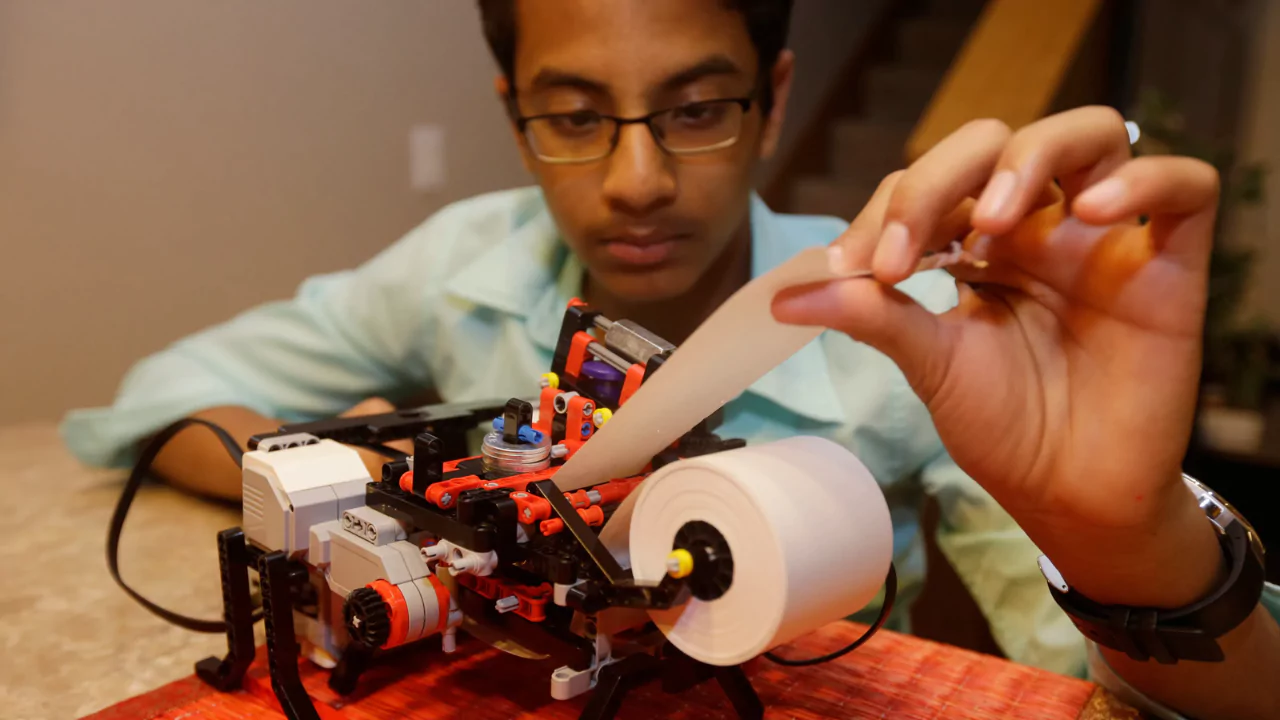
In 2014, a California middle school student named Shubham Banerjee took on a challenge that most adults never think about. He wanted to help people who are blind read more easily and at a lower cost. His solution was something few could have imagined: a working Braille printer built from LEGO.
Fast Facts
- Project: Low-cost Braille printer built with LEGO Mindstorms EV3
- Creator: Shubham Banerjee, age 13, California
- Goal: Make Braille printing affordable for blind and visually impaired people
- Cost: About $350 compared to $2,000+ for typical devices
- Went viral: 2014 on maker forums and mainstream media
Who Is Shubham Banerjee
Shubham was only 13 years old when this story began. He lived in Santa Clara, California, and loved tinkering with robotics. One day, he read that Braille printers, which help blind people read by creating raised dots on paper, can cost over $2,000. That price makes them unaffordable for many schools and families.
Instead of just feeling bad about it, he decided to do something. Using a LEGO Mindstorms EV3 robotics kit and a few extra parts, Shubham started building what would become known as BRAIGO, a low-cost Braille printer.
What Is BRAIGO and How It Works
BRAIGO is a printer that embosses Braille dots on paper. It takes letters from a computer and converts them into patterns of raised dots. Then, small motors press those patterns onto paper, creating text that blind and visually impaired readers can feel.
The LEGO Mindstorms EV3 kit gave Shubham a ready set of motors, sensors, and a programmable “brick” that acted like the brain of the printer. He added some inexpensive hardware to guide and feed the paper. The total cost was around $350, which is nearly 80 percent cheaper than most commercial Braille printers.
According to the statista.com, there are at least 43 million blind people worldwide, and more than 295 million with moderate to severe vision impairment. Affordable tools like BRAIGO could make education more accessible for millions.
From School Project to Internet Sensation
Shubham first presented BRAIGO as part of a school science fair project. He posted the design online, and it was quickly picked up by Hackaday, a popular maker community. Local TV stations, like NBC Bay Area, ran segments on his work. Within days, major media outlets were covering the story.
As the project gained attention, people from around the world began to share the news. Educators, engineers, and accessibility advocates praised the idea for its creativity and potential impact.
Read more : Meet Kairan Quazi, the 16-year-old Elon Musk hired for Starlink who is now inspiring a new wave of geeks
The Big Break with Intel
In September 2014, Shubham was invited to present an updated version, called BRAIGO 2.0, at the Intel Developer Forum. This version used an Intel Edison chip to make the printer smaller, lighter, and quieter.
Not long after, Intel Capital invested in his company, Braigo Labs Inc., making Shubham their youngest-ever funded entrepreneur.
“I did not think such a big company would invest in my idea. That was pretty amazing.”
Shubham told Business Insider in 2014.
Why BRAIGO Mattered
The heart of BRAIGO was not just the engineering, but the social impact. By bringing the cost down to a fraction of the standard price, it opened the door for more schools, libraries, and individuals to access Braille printing.
It also sent a powerful message. Innovation is not limited to big companies or experienced engineers. It can come from anyone with curiosity, empathy, and the will to solve a problem.
Can You Build One Too
Yes, but you will need some experience with robotics. The LEGO Mindstorms EV3 kit is beginner-friendly for programming, but assembling BRAIGO requires following detailed instructions. Shubham has shared build guides on YouTube, and the original project is featured on Make magazine’s website.
If you are part of a school STEM club or a maker space, this could be a great group project. It teaches both engineering skills and the value of creating technology that helps people.
The Challenges of Going from Prototype to Product
While BRAIGO impressed the world, turning it into a widely sold consumer product proved harder. Manufacturing costs, durability testing, and customer support are all big hurdles in assistive technology. As of recent public updates, Braigo Labs continues its mission, but no official commercial release has been announced.
This gap between an inspiring prototype and a market-ready product is common in the tech world. It highlights how complex it is to scale hardware, especially for specialized devices.
Where Is Shubham Now
Shubham has continued his education in technology and engineering while keeping his focus on accessibility solutions. His early success made him a role model for young inventors and a reminder that age is not a barrier to innovation.
Takeaway
Shubham Banerjee’s story is more than just a tale of a clever gadget. It is proof that sometimes the best solutions are also the simplest ones. With curiosity, creativity, and a little bit of LEGO, a teenager made the world stop and think about how we can make life better for others.