Maryam Mirzakhani Became the First Woman to Win the Fields Medal
Maryam Mirzakhani transformed the study of curved surfaces and became the first woman to receive the Fields Medal in 2014.
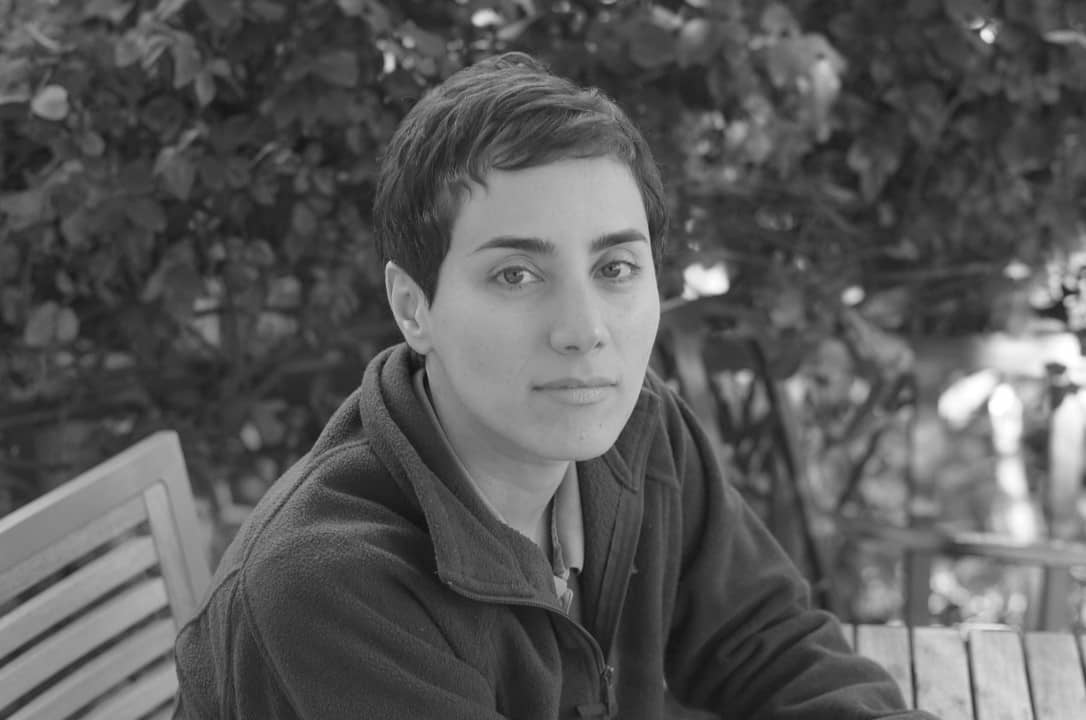
Maryam Mirzakhani approached mathematics as if she were exploring an unknown landscape. She drew large, looping diagrams, followed ideas for years, and became the first woman to receive the Fields Medal.
From stories to mathematics
Born in Tehran in 1977, Mirzakhani initially imagined becoming a writer. What changed was not a sudden talent contest but the discovery that difficult mathematical problems could unfold like stories: a beginning, unexpected turns, and a resolution that only became visible after sustained exploration.
As a teenager, she represented Iran at the International Mathematical Olympiad. She won gold medals in 1994 and 1995, earning a perfect score in the second competition. Those victories announced her ability, but her later work showed something deeper: patience with problems that could not be solved in a single clever step.
2
International Mathematical Olympiad gold medals
2004
Harvard PhD completed
2014
Fields Medal awarded
1st
Woman to receive the Fields Medal
The geometry of curved surfaces
Mirzakhani studied Riemann surfaces—shapes that can be locally described with complex numbers—and the moduli spaces that organize all the different geometric structures those surfaces can carry.
This is abstract mathematics, but the guiding questions are vivid. How many closed curves of a certain length can exist on a curved surface? How do paths behave when the surface stretches or changes? Can the vast collection of possible shapes be measured and understood?
Her work connected hyperbolic geometry, topology, dynamical systems, and algebraic geometry. Rather than staying inside one mathematical specialty, she built bridges between them.
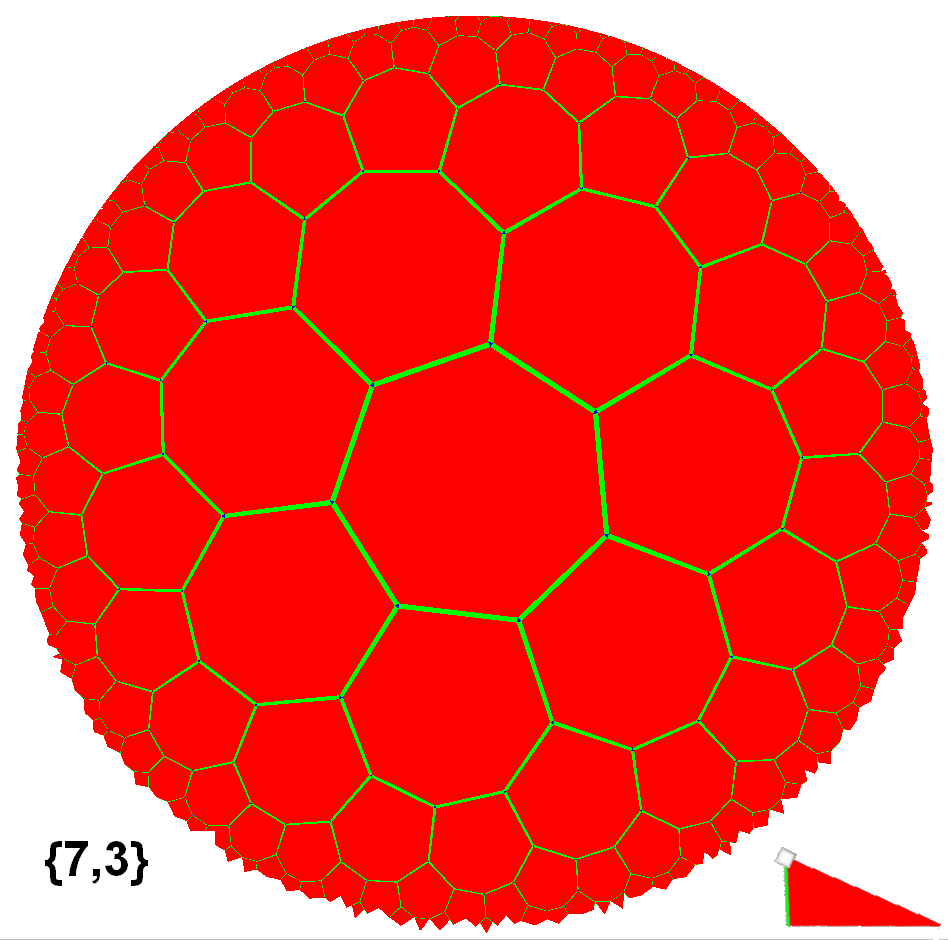
A hyperbolic tiling illustrates geometry on curved spaces. Wikimedia Commons.
She solved problems by drawing
Mirzakhani was famous among colleagues for covering large sheets of paper with diagrams. Her daughter called this process “painting.” The drawings were not decorative. They gave her a space to move between geometric intuition and formal proof.
She also described research as being lost in a jungle and gradually gathering knowledge to find a way out. That metaphor captures her method: she was willing to spend years circling a hard question, learning the terrain before forcing an answer.
The 2014 Fields Medal
At the International Congress of Mathematicians in Seoul, Mirzakhani received the 2014 Fields Medal “for her outstanding contributions to the dynamics and geometry of Riemann surfaces and their moduli spaces.”
She was the first woman, and the first Iranian, to win the award. The milestone mattered because the Fields Medal had been awarded since 1936 without recognizing a woman. Yet the award was not merely symbolic. It honored a body of work that had reshaped several areas of modern geometry.
1977
Born in Tehran
Mirzakhani grows up in Iran and first dreams of becoming a writer.
1994–95
Olympiad golds
She wins two International Mathematical Olympiad gold medals.
2004
Harvard doctorate
She completes her PhD under Fields Medalist Curtis McMullen.
2008
Stanford professor
She joins Stanford University’s mathematics faculty.
2014
Fields Medal
She becomes the first woman to receive mathematics’ most famous medal.
2017
A lasting legacy
Mirzakhani dies at age 40, leaving work that continues to influence geometry.
A legacy larger than one medal
Mirzakhani died from breast cancer in 2017 at age 40. Her death brought an extraordinary career to an early end, but it did not stop the influence of her ideas.
Her birthday, May 12, is now celebrated as the International Women in Mathematics Day. The date is a reminder that mathematical talent is universal, while access, encouragement, and recognition have not always been.
Mirzakhani’s example also resists the stereotype of genius as instant speed. Her greatness came from imagination, endurance, and the ability to hold a complex problem in view for a long time.
The geek lesson
Mirzakhani treated mathematics as a creative practice. She did not separate rigorous proof from sketches, intuition, or storytelling; each helped her see what the others could not.
Her career shows that exploration is not wasted time. On the hardest problems, wandering carefully through the landscape may be exactly how a new path is found.
The weekly question
From obsession to clarity — one original question every week.
We answer one noisy topic at a time, in full. No daily roundup, no thread bait — just the question, the principles, and the system.