Lu Chao Turned 67,890 Digits of Pi Into a 60-Chapter Story
Lu Chao recited 67,890 digits of pi over 24 hours by transforming number pairs into images and a vast mental story.
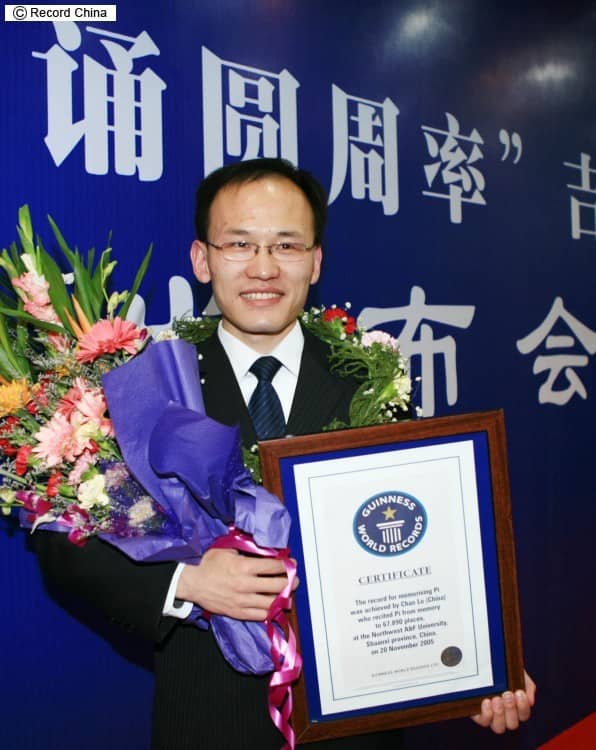
On November 20, 2005, Chinese student Lu Chao began reciting the digits of pi from memory.
He continued for more than 24 hours before making an error at the 67,891st decimal place. The 67,890 digits before it were accepted as a Guinness World Record.
The number is impressive. The method behind it is even more revealing.
Lu did not remember pi as one endless chain of isolated digits. He transformed pairs of numbers into images, then connected those images into stories long enough to occupy more than 60 mental chapters.
The 24-Hour Recitation That Set a Record
Lu was a 23-year-old chemistry student when he completed the attempt in China.
His performance lasted about 24 hours and four minutes and was documented on 26 videotapes. Witnesses and officials monitored the recitation as he worked through tens of thousands of decimal places.
67,890
Correct decimal places
24h 4m
Approximate duration
26
Videotapes documenting the attempt
Source: Guinness reporting and Science News
The feat gave Lu the recognized record for the most decimal places of pi memorized at the time.
A single mistake ended the run. That detail captures the unforgiving nature of the challenge: after an entire day of accurate recall, one incorrect digit fixed the final total.
Why Memorizing Pi Is So Difficult
Pi begins 3.1415926535 and continues without ending or falling into a repeating decimal pattern.
That means a memorizer cannot rely on a simple cycle. At the scale Lu attempted, repetition alone would be a fragile strategy.
For perspective, NASA's Jet Propulsion Laboratory has explained that only a small number of pi's digits are required for extraordinarily precise real-world calculations. Memory competitors go far beyond practical mathematical need.
The point is not calculation. It is the construction and testing of memory.
Lu's achievement turned a familiar classroom constant into an endurance event involving attention, retrieval, pacing, and error control.
How Lu Chao Turned Digits Into Stories
Researchers later studied Lu's technique to understand how someone with a normal basic digit span could recall such an enormous sequence.
He associated pairs of digits with images of people and objects. Those images became scenes. The scenes joined into stories representing blocks of roughly 500 to 1,000 digits.
A Science News account reported that a narrative containing more than 60 chapters ran through his mind during the record recitation.
This matters because it changes the nature of the task.
The brain is not being asked to retain 67,890 disconnected items. It is following a highly practiced route through a structured world of cues.
When one scene leads naturally to the next, the story provides an order. The images provide distinctiveness. Repeated rehearsal strengthens the links.

A pi visualization echoes the structured mental world Lu built from number pairs, images, and stories. Source: Wikimedia Commons.
Scientists Found Skill, Not a Magical Digit Span
Lu's memory later became the subject of cognitive research.
The paper “Memorization and recall of very long lists accounted for within the Long-Term Working Memory framework” examined how his performance could be explained through extensive practice and organized retrieval structures.
Researchers found that his ordinary short-term digit span was not unusually large enough to explain the record.
His advantage emerged when he could use his trained system.
That difference is important. It suggests that elite memory performance may be highly specialized. A person can become extraordinary at one practiced task without possessing perfect memory in every part of daily life.
Lu's achievement was therefore not simply a test of storage capacity. It was evidence of what the brain can do when information is encoded through a durable system.
How the Record Changed
Lu's 67,890-digit result remained the recognized Guinness mark for about a decade.
In March 2015, India's Rajveer Meena recited 70,000 decimal places of pi while blindfolded. Guinness later recognized Meena's achievement, moving the official record beyond Lu's total.
November 2005
Lu Chao recites 67,890 digits
2005–2015
His Guinness-recognized mark stands for roughly a decade
March 2015
Rajveer Meena recites 70,000 digits
Being surpassed did not reduce the scientific value of Lu's performance. His method became one of the clearest documented examples of how narrative encoding can support extreme recall.
What Lu Chao's Story Teaches About Memory
Lu Chao spent an entire day reciting a number that never ends.
Yet the deepest lesson is not about pi.
It is about transformation.
Pairs of digits became images. Images became scenes. Scenes became chapters. And those chapters gave his mind a path through 67,890 decimal places.
His record eventually fell, but the technique behind it remains memorable.
Lu's story shows that elite recall is not necessarily a mysterious gift. It can be a carefully engineered skill—built through association, structure, storytelling, and years of deliberate practice.
Featured image: Lu Chao at a ceremony recognizing his pi-memory achievement, via Record China.
The weekly question
From obsession to clarity — one original question every week.
We answer one noisy topic at a time, in full. No daily roundup, no thread bait — just the question, the principles, and the system.