John von Neumann Helped Build Game Theory and the Modern Computer
John von Neumann helped create game theory, advanced the stored-program computer, and connected mathematics to physics, economics, and computing.
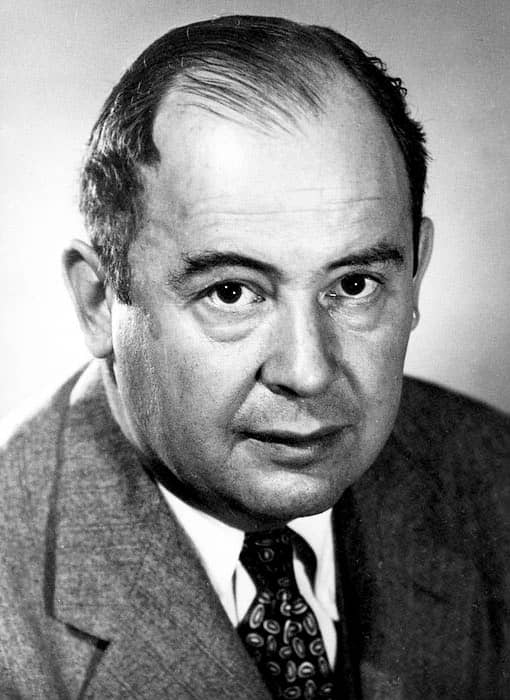
John von Neumann could move from pure mathematics to economics, physics, weapons research, weather prediction, and computer design with startling ease. Few thinkers did more to shape the mathematical machinery of the twentieth century.
A prodigy who never stopped ranging
Born in Budapest in 1903, von Neumann showed an exceptional memory and ability with numbers as a child. Stories about him mentally dividing eight-digit numbers and reciting pages from a telephone directory became part of his legend.
The more important fact is what followed. He earned a doctorate in mathematics while also studying chemical engineering, then produced major work across set theory, quantum mechanics, operator theory, and mathematical logic. In 1933, at age 29, he became one of the first permanent professors at the Institute for Advanced Study in Princeton.
1903
Born in Budapest
1928
Minimax theorem published
1944
Theory of Games released
1945
EDVAC report circulated
He gave strategy a mathematical language
Von Neumann’s 1928 minimax theorem established a rigorous foundation for analyzing two-player, zero-sum games. With economist Oskar Morgenstern, he expanded those ideas in the 1944 book Theory of Games and Economic Behavior.
Game theory was not about entertainment. It was a framework for decisions in which each participant’s best move depends on what others might do. The field later transformed economics and influenced political science, evolutionary biology, military strategy, and computer science.
Von Neumann’s role was foundational, though the subject grew through the work of many later researchers. His talent lay in seeing that strategic conflict could be studied with the same precision as geometry or mechanics.
The stored-program computer
During the Second World War, von Neumann worked on the Manhattan Project and encountered the need for vast numerical calculations. He became closely involved with early electronic computing, including discussions around ENIAC and its successor, EDVAC.
His 1945 draft report on EDVAC described a stored-program design in which instructions and data share an electronic memory. The model became enormously influential and is often called the von Neumann architecture.
That name can hide the collaborative history. Engineers including J. Presper Eckert and John Mauchly, along with many programmers and researchers, were already developing crucial ideas. Von Neumann’s report powerfully organized and circulated the design; he did not invent the modern computer alone.
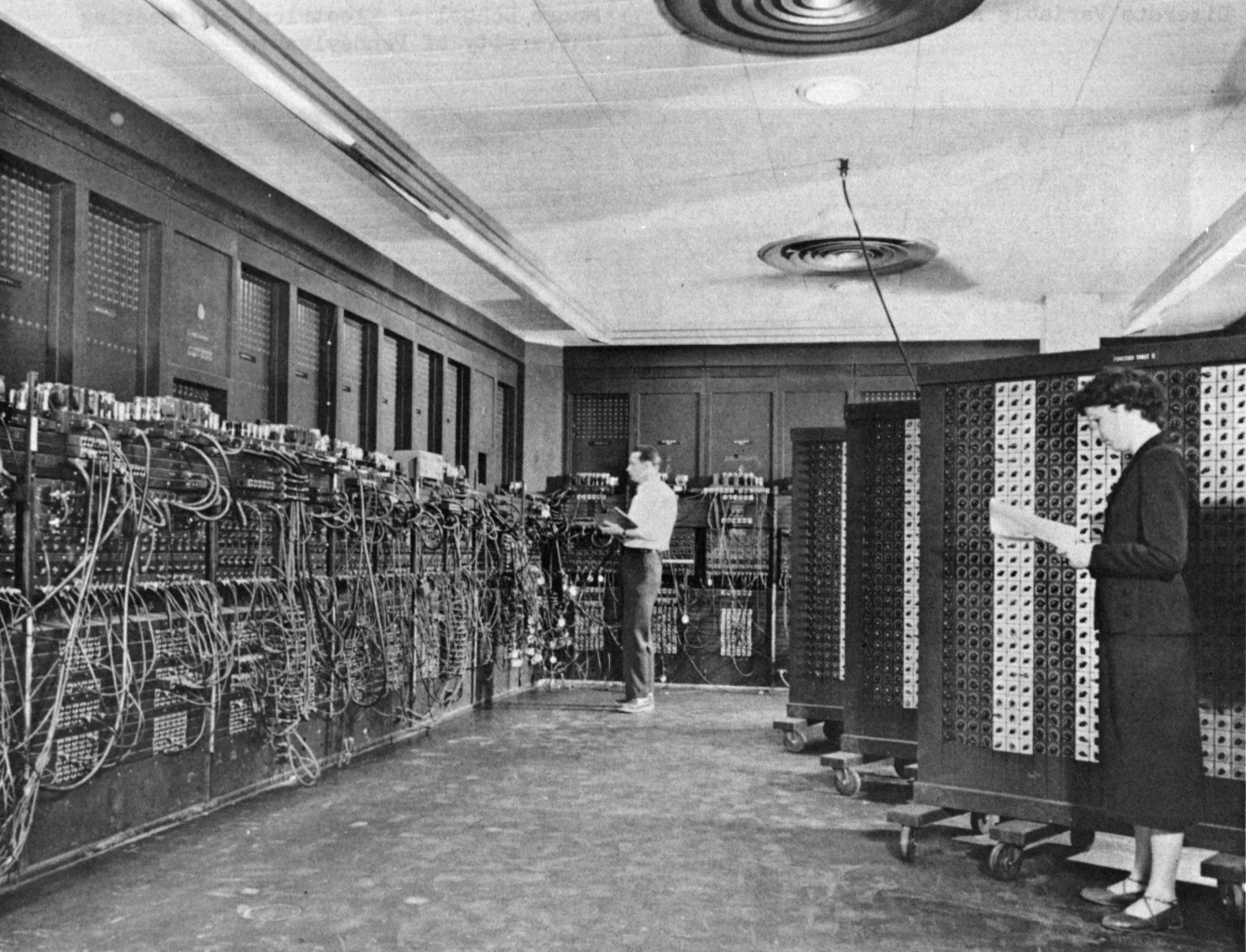
ENIAC, an early general-purpose electronic computer. U.S. Army photo via Wikimedia Commons.
The IAS machine multiplied the impact
At the Institute for Advanced Study, von Neumann led a project to build a stored-program computer. The IAS machine became operational in the early 1950s, and its design influenced a family of machines built elsewhere.
He viewed computers as more than fast calculators. They could simulate nuclear reactions, model weather, explore numerical mathematics, and test systems too complicated for hand calculation.
Von Neumann also helped develop the Monte Carlo method, which uses repeated random sampling to approximate difficult calculations. That approach remains essential in science, finance, engineering, and modern computing.
1926
Doctorate completed
Von Neumann earns his mathematics doctorate in Budapest.
1928
Minimax theorem
He gives zero-sum game strategy a rigorous mathematical foundation.
1933
Institute for Advanced Study
He joins the new institute in Princeton as a permanent professor.
1944
Game theory book
His book with Oskar Morgenstern launches a new mathematical approach to economics.
1945
EDVAC report
The stored-program design is described and widely circulated.
1950s
Computing and simulation
The IAS computer supports scientific calculation, weather modeling, and numerical research.
A mind built for connection
Von Neumann did not merely collect specialties. He transferred ideas between them. Mathematical logic informed computing; computation changed physics and meteorology; strategic mathematics became economics.
That range made him a model of the polymath, but it also reflected a particular obsession: turning hard problems into clear formal structures that could be calculated, tested, and used.
He died in 1957, only 53 years old. By then, his ideas had helped create entire fields and institutions whose influence would expand for decades.
The geek lesson
Von Neumann’s career shows the power of crossing boundaries. He did not wait for a problem to fit neatly inside one discipline. He learned the language needed to attack it, then carried useful methods into the next domain.
The modern computer was a collective achievement, and game theory has many architects. Von Neumann’s distinctive contribution was synthesis: he saw connections early, expressed them mathematically, and helped turn them into working systems.
The weekly question
From obsession to clarity — one original question every week.
We answer one noisy topic at a time, in full. No daily roundup, no thread bait — just the question, the principles, and the system.