
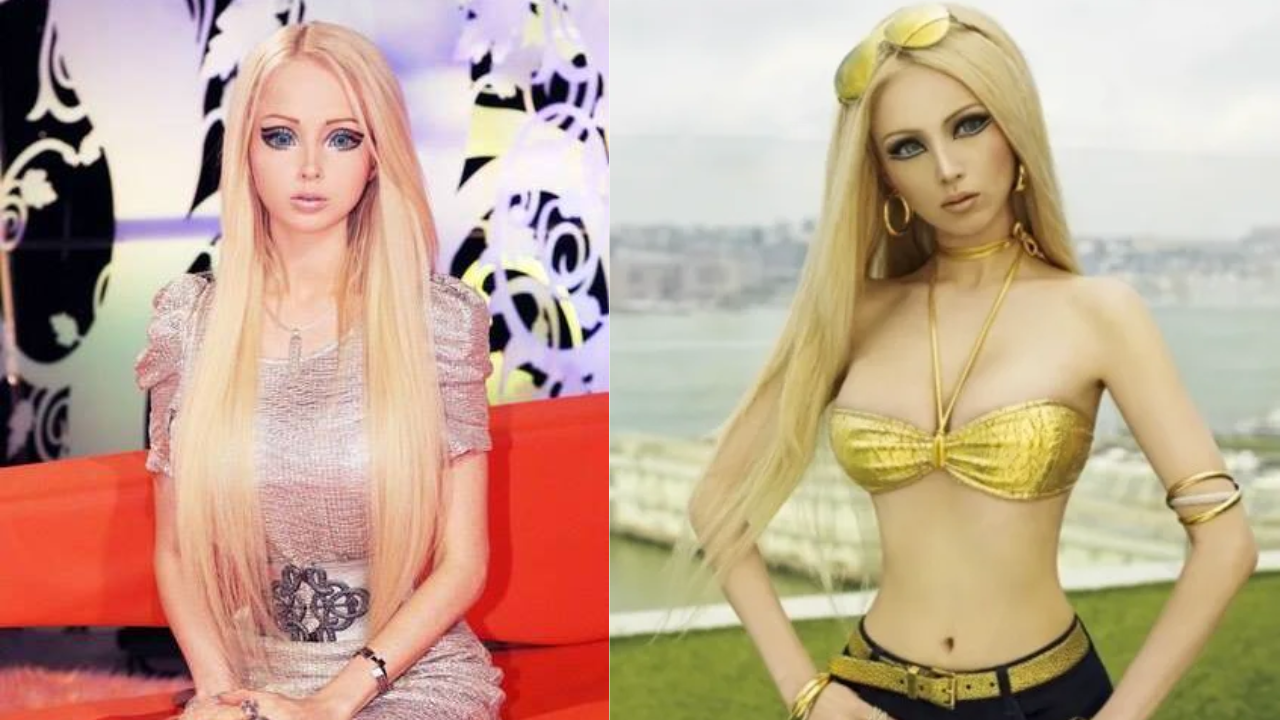
When the internet first saw Valeria Lukyanova, many thought she was not real. Her waist looked impossibly tiny, her eyes wide and glassy, her features almost plastic. She was soon nicknamed the “Human Barbie.” Images of her spread across YouTube, Facebook, and later TikTok. Millions shared the photos, argued about whether they were fake, and wondered: how could someone look this much like a doll in real life?
This is not only a story about beauty or controversy. It is also about how one woman turned herself into a living meme, long before TikTok filters and AI avatars made it normal to reshape identity online. Her story still sparks conversations today because it reflects our culture’s obsession with reinvention and perfection.
Fast Facts
- Name: Valeria Lukyanova, also known as the “Human Barbie”
- Born: August 23, 1985, in Tiraspol, Ukraine (then Soviet Union)
- Claim to Fame: Viral for her extreme doll-like transformation
- Approach: Makeup artistry, fitness, waist training, and diet
- Current Role: Model, singer, and self-described spiritual teacher
Who Is Valeria Lukyanova?
Valeria Lukyanova was born on August 23, 1985, in Tiraspol, a city that was once part of the Soviet Union and is now in Moldova. She grew up in Ukraine and pursued a career in modeling, but it was not until the early 2010s that she became a household name on the internet. When her photos began circulating worldwide, people were stunned by her doll-like appearance. Unlike costume-based cosplayers who dress up occasionally, Valeria had transformed her everyday self into a character.
She is not only a model but also calls herself a singer and spiritual teacher. Valeria often talks about metaphysical topics such as reincarnation, energy, and meditation. In interviews, she has claimed to connect with higher consciousness and sometimes describes herself as having out-of-body experiences. This unusual combination of fashion and philosophy has made her more than just a viral image. To some, she is a curiosity. To others, she is an artist who treats her body as both a canvas and a statement.
How Did She Transform Into a Human Barbie?
Many people assume Valeria’s look is only the result of heavy cosmetic surgery. She admits to breast implants but claims the rest is a product of extreme discipline. She often credits her transformation to years of waist training, which gave her the appearance of an exaggerated hourglass figure. She follows a strict diet and avoids processed foods to keep her body weight extremely low. Her fitness routine, she says, is designed not only to stay slim but also to sculpt her frame closer to what she sees as doll-like proportions.
Makeup plays a major role. Through advanced contouring techniques, she reshapes her face to highlight sharper cheekbones and a narrow nose. She also uses special contact lenses that make her eyes look bigger and brighter, giving the impression of animated, wide-eyed innocence. Combined with carefully chosen wigs, outfits, and poses, the result is startlingly close to a Barbie doll brought to life.
In a 2014 interview with GQ, Valeria said:
“I use makeup and exercise to achieve my look. People think it is all surgery, but discipline is more powerful than that.”
GQ Magazine, 2014
However, not everyone agrees. Dr. Anthony Youn, a U.S. plastic surgeon, suggested that her facial structure likely reflects cosmetic intervention, especially around her nose and jawline, in addition to makeup.
Why Did She Go Viral?
Valeria first gained international attention around 2012 when her images began circulating on Facebook and YouTube. News outlets like the Huffington Post and ABC quickly picked up the story, fascinated by her transformation. Her look sparked debates across forums and blogs. Some people admired her commitment and creativity. Others criticized her for promoting unrealistic and unhealthy beauty standards.
Her story went viral again years later as TikTok and Reddit communities rediscovered her. Younger users, unfamiliar with her original fame, shared her photos as if they had found something new. This recycling of internet culture is common, but in Valeria’s case, it felt even more powerful because her look was so extreme.
Her relevance today ties closely to modern trends. Social media platforms are filled with filters that slim faces, enlarge eyes, and create a “perfect” version of reality. Virtual influencers and AI-generated models are also becoming popular. In many ways, Valeria predicted this culture. She turned herself into a “living filter” before it became normal.
According to Statista, 48 percent of social media users in 2023 admitted they had used filters to alter their appearance. This explains why her story still resonates. She embodies both the fascination and the unease surrounding digital beauty culture.
The Controversy Around the Human Barbie
Valeria’s fame came with strong backlash. Many critics accused her of lying about surgery, insisting that no amount of diet and makeup could produce her look. Others argued that her appearance set harmful standards, especially for young women who might try to copy her. Photos of her became material for memes, and she was often mocked as much as she was admired.
At the same time, she built a loyal following who saw her as a pioneer. Fans described her as an artist who used her body as an experimental project. To them, she was not promoting beauty standards but challenging ideas of identity and self-presentation.
This split between admiration and criticism has kept her story alive. Valeria is both a cultural icon and a cautionary tale, depending on who you ask. The internet thrives on extremes, and she became a perfect example of how polarizing a viral figure can be.
What Is She Doing Now?
Valeria is no longer in the global spotlight as she was in 2012, but she remains active in certain communities. She continues to share her spiritual beliefs, often posting about meditation, energy practices, and out-of-body travel. She still does modeling and occasionally appears in interviews or features that revisit her Barbie persona.
Her story highlights one of the challenges of viral fame. Once the world names you the “Human Barbie,” it is difficult to escape that label. Even as she focuses on spiritual teaching, her doll-like image defines her identity in the public eye.
Final Reflection
Valeria Lukyanova is more than a viral headline. She represents the extreme edge of self-reinvention, showing how far someone can go to become a living idea. Her Human Barbie look is shocking, but it also mirrors the digital age where filters, avatars, and curated images dominate identity.
The bigger question her story raises is not just about beauty. It is about reality itself. When the line between natural and artificial blurs, what does authenticity mean? For Valeria, becoming Barbie was not only a transformation of her body. It was a transformation of culture, pushing us to think about how we shape ourselves in the digital mirror.
Disclosure: We may earn a commission when you make a purchase through the ads.