How Close Are We to Becoming "Artificially Intelligent"? Brain Chips & AI in 2026
Brain chips are no longer just science fiction: researchers can already decode speech, influence memory and connect human thought with AI, raising a fascinating question—how close are we to becoming artificially intelligent ourselves?

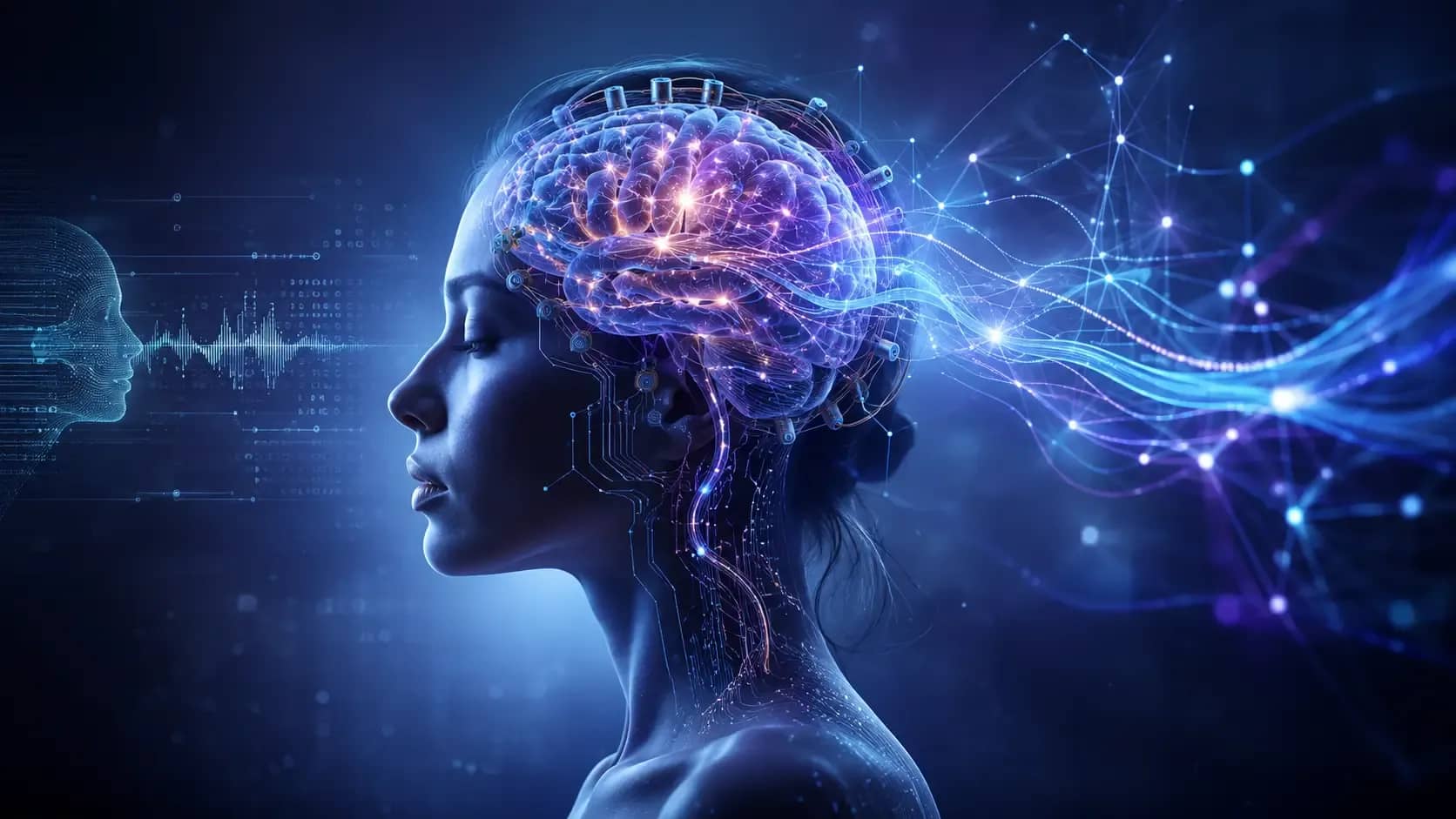
For most of human history, intelligence has been limited by the biological brain we are born with.
We can educate it. Train it. Exercise our memory. Learn new ways of thinking. Use books, calculators, computers and, more recently, artificial intelligence to extend what we can accomplish.
But all of those tools remain outside us.
That boundary is beginning to become less clear.
Scientists can now record electrical activity directly from the human brain, use artificial intelligence to interpret it, translate thoughts of movement into computer commands, reconstruct attempted speech and, experimentally, stimulate memory-related circuits at precisely chosen moments.
Researchers have even begun experimenting with systems that identify neural patterns associated with successfully remembering information and then feed related signals back into the brain.
Not artificial intelligence in the traditional sense, but biological intelligence augmented by electronics, algorithms, external memory and AI.
The answer in 2026 is fascinating.
We are much closer than we were twenty years ago—but still very far from downloading knowledge into the brain or installing a chip that makes someone a genius.
Where Things Stand in 2026
Here is a simple way to separate what is actually possible from what remains science fiction.
| Brain Function | What Technology Can Currently Do | Status |
|---|---|---|
| Memory formation / recall | Detect memory-related activity and stimulate hippocampal networks to influence certain memories. | Human experimental research |
| Speech | Decode attempted speech from brain activity into text or synthesized speech. | Working in human trials |
| Computer control | Move cursors and operate computers using neural signals. | Working in human trials |
| Movement | Brain signals can control robotic devices and other assistive systems. | Human experimental systems |
| Touch / sensation | Electrical stimulation can create useful artificial sensory feedback. | Human research |
| Vision | Experimental stimulation of visual pathways and the visual cortex. | Early research |
| Attention / working memory | Brain stimulation sometimes produces limited improvements. | Inconsistent |
| Analytical reasoning | No reliable technology substantially increases reasoning ability. | Not achieved |
| General intelligence | No brain implant has been shown to meaningfully increase IQ or general intelligence. | Not achieved |
| Instant learning | We cannot upload mathematics, languages or other knowledge directly into the brain. | Not achieved |
| Perfect memory | No technology currently provides photographic or computer-like memory. | Not achieved |
The important distinction is between restoring a damaged ability and giving a healthy brain abilities beyond its natural limits.
We are becoming surprisingly good at the first.
We are only beginning to understand the second.
The Old “Memory Chip” Idea Is Becoming Real
Around two decades ago, researchers including Theodore Berger began developing what was often described in the media as an “artificial hippocampus” or “memory chip.”
At the time, it sounded like science fiction.
The hippocampus plays an important role in converting experiences into memories. Berger's idea was not to store memories inside a computer chip like files on a hard drive.
Instead, the goal was to understand something more fundamental:
If scientists could mathematically reproduce that transformation, perhaps electronics could assist a damaged hippocampus.
That research eventually progressed from mathematical models to animal experiments and then to humans.
In 2024, researchers from Wake Forest University School of Medicine and USC reported experiments involving a hippocampal neural prosthesis in humans. Their system analyzed a person's own patterns of hippocampal activity associated with memory and generated electrical stimulation patterns based on those neural codes. View the research.
The results were not magically successful in every participant.
Some stimulation conditions improved memory performance while others decreased it. However, improvements were considerably more common in participants who already had impaired memory and received bilateral stimulation.
It is evidence that a computer can read something about the neural code of memory and then write information back into the memory system in a way that changes performance.
Twenty years ago, that was largely a theoretical idea.
Today it has been demonstrated experimentally in humans.
The Next Breakthrough May Be Timing, Not More Powerful Chips
A computer becomes more powerful when we increase things such as processing speed, memory and computing capacity.
The brain doesn't necessarily work that way.
One increasingly important discovery is that when a signal arrives may be as important as how strong that signal is.
The brain operates through rhythmic electrical activity. One important rhythm associated with memory is called the theta rhythm.
A 2025 Nature Communications study monitored theta activity in the human hippocampus in real time.
Instead of continuously stimulating the brain, researchers waited until a particular phase of the person's natural theta rhythm and then delivered stimulation to a connected cortical area. Read the study.
You can push extremely hard at the wrong moment and accomplish very little. Or you can apply a smaller push at exactly the right moment and make the swing travel higher.
The researchers found that stimulation synchronized with hippocampal theta influenced neural activity and connectivity differently from stimulation that was not synchronized to the person's ongoing rhythm.
This points toward an important future architecture:
This is known as a closed-loop system.
And it may ultimately be much more important than simply placing more electrodes into the brain.
From Brain–Computer Interface to Brain–AI Interface
Most people associate brain implants today with companies such as Neuralink.
But current brain-computer interfaces are primarily trying to restore communication and control, not increase intelligence.
For example, Neuralink's PRIME research uses an implanted device to record neural signals associated with intended movement and translate those signals into computer control.
That is already extraordinary.
But a true cognitive enhancement system would require something more sophisticated:
The double arrow changes everything.
The system would not simply listen to the brain. It would both read and communicate back.
Speech BCIs Show How Powerful AI + Brain Signals Can Become
Some of the most impressive progress has occurred in speech rather than memory.
People with paralysis can remain mentally capable of speaking even when their muscles can no longer produce speech.
Researchers discovered that the brain still generates recognizable patterns when a person attempts to speak.
Machine-learning systems can learn those patterns.
NIH has described human speech-neuroprosthesis research in which AI algorithms decode patterns of brain activity into words, with systems becoming increasingly fast and accurate.
This is important beyond medical communication.
What About Thinking Without Speaking at All?
This is where some extremely interesting—and much more speculative—research begins.
Several recent studies submitted to arXiv explore decoding imagined or internal speech.
Experimental Idea #1: A “Large Brain Language Model”
A 2025 arXiv paper introduced what its authors call a Large Brain Language Model (LBLM).
Instead of training a language model on text, researchers trained a model to recognize patterns from EEG brain recordings associated with silent speech.
Their dataset contained more than 120 hours of EEG recordings from 12 participants thinking about a limited set of words.
The model improved classification compared with the researchers' baselines, although accuracy remained nowhere near the point where someone's unrestricted thoughts could simply be read.
Experimental Idea #2: MindSpeech
Another arXiv project called MindSpeech explored continuous imagined-speech decoding using high-density functional near-infrared spectroscopy, or fNIRS.
Instead of implanted electrodes, fNIRS measures changes related to blood oxygenation in the brain.
Researchers combined these signals with a large language model.
The study involved only a small number of participants, so it should not be interpreted as a machine capable of freely reading someone's thoughts.
Experimental Idea #3: Brain-to-Text With Modern AI Models
A late-2025 arXiv preprint proposed an end-to-end system called BIT — Brain-to-Text.
Instead of having multiple separate processing stages, its neural network attempted to translate neural activity toward text while integrating modern audio-language-model technology.
The researchers reported improvements on the datasets they tested and explored both attempted and imagined speech.
And in 2026: Decoding the Meaning Behind Inner Speech
A June 2026 arXiv preprint called MindAlign explored something closer to semantic thought decoding.
Researchers used fMRI activity generated while participants silently described images.
Rather than trying to decode every individual word, the system attempted to recover a kind of semantic representation—the general meaning of what the person was thinking about—and then allow a language model to generate text from it.
That approach may ultimately make more sense than trying to identify individual words inside the brain.
Future brain–AI systems may decode meaning first and language second.
Can We Increase Analytical Ability?
This is probably the question that matters most if we are talking about becoming genuinely “artificially intelligent.”
Could technology eventually make someone:
- - reason faster?
- - understand complicated problems more easily?
- - hold more information in working memory?
- - recognize relationships they normally miss?
- - perform mathematics better?
- - maintain concentration longer?
- - access knowledge instantly?
Right now, there is no convincing brain chip that accomplishes those things generally.
Researchers have experimented with technologies including:
Transcranial magnetic stimulation
Transcranial direct-current stimulation
Transcranial alternating-current stimulation
These can alter activity in particular brain networks without surgery.
Some studies have reported improvements in memory, executive function or other cognitive functions, particularly among people with cognitive impairment.
But that is very different from increasing general intelligence in a healthy person.
Intelligence is probably too distributed and complicated for such a simple intervention.
Perhaps We Are Thinking About Enhancement the Wrong Way
We often imagine brain enhancement as increasing the raw computing power of the brain.
But perhaps we don't need to.
Consider what happened with smartphones.
Your biological memory did not become larger when smartphones appeared.
Instead, you gained almost instantaneous access to:
Your effective cognitive ability increased even though your biological brain remained essentially unchanged.
A future brain interface could take the same idea much further.
The Three Stages of Artificially Enhanced Intelligence
Restore
Technology replaces an ability lost through disease or injury—such as movement, communication or impaired memory.
Optimize
AI monitors brain activity and helps the biological brain operate more effectively through precisely timed stimulation or feedback.
Augment
Technology gives humans capabilities beyond ordinary biological limits, such as expanded memory, AI-assisted reasoning or direct access to external knowledge.
Level 1 — Restore
Technology replaces an ability lost through disease or injury.
We are already entering this stage.
Level 2 — Optimize
Instead of replacing a lost ability, AI constantly monitors the brain and helps it operate more effectively.
A carefully designed stimulation signal could then be delivered.
Or perhaps the system detects that attention is deteriorating and responds with stimulation or an external cue.
The closed-loop experiments happening today represent very early steps toward this kind of architecture.
Level 3 — Augment
This is where things become truly transformative.
Instead of merely repairing or optimizing the biological brain, technology would give humans capabilities they naturally do not possess.
But we can already see individual pieces of the architecture being developed.
The Future “Memory Chip” May Not Store Memories at All
This may be the most interesting conclusion.
Twenty years ago, it was natural to imagine a memory implant like a computer hard drive:
But a future cognitive system might instead look like this:
Imagine meeting someone at an event.
Years later, you see the person's face and think:
Your biological brain struggles.
But your neural interface recognizes that you are attempting recall.
Your personal AI searches your recorded memories.
It finds the relevant event, date and context.
Rather than displaying this on a phone, a sufficiently advanced system could theoretically provide an appropriate neural or perceptual cue.
Suddenly your effective memory is no longer limited entirely by biological storage.
The information doesn't necessarily need to be stored inside your neurons.
Your brain simply needs a sufficiently fast interface to an external cognitive system.
Human + AI May Be More Important Than Human vs AI
Much of today's discussion about artificial intelligence asks whether machines will eventually surpass humans.
But another possibility deserves equal attention.
vs
Human + AI
Today we already augment ourselves externally.
A smartphone extends our memory. Google extends our access to knowledge. GPS extends navigation. Calculators extend mathematical processing. Generative AI extends writing, reasoning, research and problem-solving.
Brain-computer interfaces could eventually remove the slowest part of that system:
So, How Close Are We to Becoming “Artificially Intelligent”?
If by artificially intelligent we mean installing a chip that instantly gives us genius-level intelligence, perfect memory and downloadable knowledge, then we are still very far away.
There is no technology in 2026 capable of doing this.
But if we mean connecting biological intelligence with artificial systems so computers can read certain neural states, interpret them with AI and communicate information back into the nervous system, something remarkable has happened.
We can decode intended movement. We can experimentally decode speech. AI can reconstruct increasingly complex information from neural signals. Researchers can stimulate memory-related networks based on a person's own neural patterns. Closed-loop systems can monitor ongoing brain activity and respond at carefully selected moments. Experimental systems are beginning to combine neural decoding with large language models.
None of these individually creates a superhuman mind.
But put the direction of research together:
The concept of augmented human intelligence begins to look considerably less like science fiction.
The first generation of brain chips is being designed primarily to help people recover abilities they have lost.
The second generation may help biological brains operate more effectively.
And perhaps much later, a third generation could allow human intelligence to operate together with artificial intelligence so closely that separating the two becomes increasingly difficult.
We spent decades asking when machines would become intelligent like us.
When will we begin becoming intelligent like our machines?
References
-
Hampson, R. E., et al. (2024).
Developing a hippocampal neural prosthetic to facilitate human memory encoding and recall of stimulus features and categories.
PubMed → -
Wake Forest University School of Medicine. (2024).
Neural prosthetic device can help humans restore memory.
Wake Forest Newsroom → -
Hampson, R. E., Song, D., Robinson, B. S., et al. (2018).
Developing a hippocampal neural prosthetic to facilitate human memory encoding and recall.
Journal of Neural Engineering, 15(3).
Full Text → - Hampson, R. E., Song, D., Chan, R. H. M., et al. (2012). A nonlinear model for hippocampal cognitive prosthesis: memory facilitation by hippocampal ensemble stimulation.
-
Berger, T. W., Hampson, R. E., Song, D., Goonawardena, A., Marmarelis, V. Z., & Deadwyler, S. A. (2011).
A cortical neural prosthesis for restoring and enhancing memory.
Journal of Neural Engineering, 8(4), 046017.
PubMed → Full Text → -
USC / Theodore Berger artificial hippocampus research. (2003).
Early reports describing a silicon neural prosthesis designed to reproduce the signal-processing functions of the hippocampus.
EurekAlert → -
Closed-loop hippocampal theta stimulation study. (2025).
Research examining stimulation timed to ongoing hippocampal theta activity.
Nature Communications.
Nature Communications → -
Closed-loop stimulation during sleep and memory consolidation. (2023).
Human research examining precisely timed stimulation of brain rhythms during sleep.
Full Text → -
Neuralink.
PRIME Study — Precise Robotically Implanted Brain-Computer Interface.
PRIME Study Brochure → -
Neuralink.
Clinical and research updates.
Neuralink Updates → -
National Institutes of Health. (2025–2026).
Research reports on brain-computer interfaces capable of decoding attempted speech from neural activity.
NIH Research Matters → -
Nature Reviews Neurology. (2025).
Review of developments and challenges surrounding non-invasive brain stimulation, including TMS, tDCS and tACS.
Nature Reviews Neurology → -
Review of cognitive-enhancement interventions. (2025).
Review examining evidence for methods claimed to enhance cognitive performance and general intelligence.
PubMed →
Emerging Research and Preprints
-
Large Brain Language Model — LBLM. (2025).
Experimental work applying large-model architectures to EEG signals associated with silent or imagined speech.
arXiv → -
MindSpeech. (2024).
Experimental continuous imagined-speech decoding using high-density fNIRS measurements combined with modern language-model techniques.
arXiv → -
BIT — Brain-to-Text. (2025).
Experimental end-to-end neural decoding architecture exploring translation of brain activity into textual representations.
arXiv → -
MindAlign. (2026).
Experimental research examining whether semantic representations derived from fMRI activity during internal thought can be aligned with language-model representations and translated into text.
arXiv →
At present, no credible research demonstrates the ability to upload knowledge, create perfect memory, substantially increase general intelligence or give a healthy person computer-like analytical abilities through a brain implant.
The weekly question
From obsession to clarity — one original question every week.
We answer one noisy topic at a time, in full. No daily roundup, no thread bait — just the question, the principles, and the system.