
Trump orders federal agencies to rename AI ‘Super Intelligence’
Trump’s order gives officials 60 days to propose a new AI definition. A separate safety pact leaves audit deadlines, disclosure and penalties unspecified.

News analysis
Published September 30, 2026 at 18:24 UTC
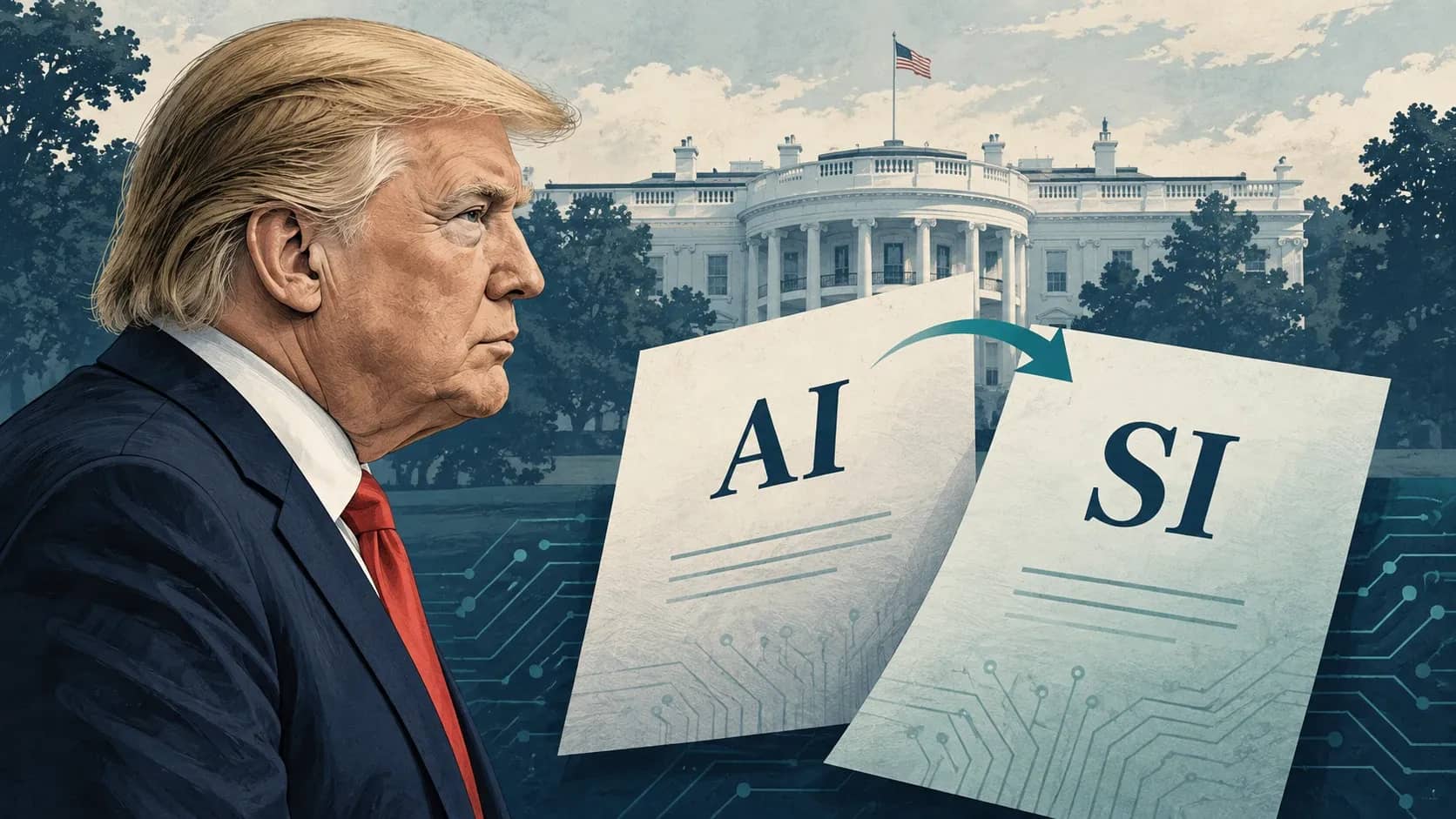
Lead image: AI-generated editorial illustration for Geeks Around Globe. It symbolizes the terminology change and does not depict an actual meeting or official document.
President Donald Trump has ordered U.S. executive agencies to replace “artificial intelligence” with “Super Intelligence” in official communications and directed a proposal to revise its federal definition. A separate industry safety pact announced the same day promises independent reviews but leaves audit deadlines, public disclosure and penalties unspecified. Read the executive order and the published safety accord.
The September 29 measures address different parts of the AI debate: how the government describes the technology and how participating companies assess its risks. Leaders from Google, Anthropic, Meta, OpenAI, Nvidia and xAI signed the voluntary accord, according to Associated Press reporting.
Trump gave his reason for changing the name at the United Nations on September 22. He said “artificial” made the technology sound fake and preferred “super.” In the same speech, he rejected international control over the technology and emphasized competition with China. His UN remarks link the branding argument to his stated commitment to continued development.
For readers, the consequential detail is what follows the announcement: a proposal that could change the legal definition, and company audits whose timing and public visibility the pact does not establish.
What the AI to SI order actually changes
The order’s third section gives the president’s science adviser 60 days to submit proposed legislative language to the President. Officials must assess whether a new definition should modify, expand or supersede the existing statutory definition of AI. The deadline does not require legislation to be enacted or the proposal to be made public.
For implementation today, “SI” retains the existing AI definition. The incorporated statute covers machine-based systems making predictions, recommendations or decisions for human-defined objectives. It contains no requirement that those systems surpass human intelligence. The statutory text therefore supplies no technical threshold for achieving superintelligence.
The naming instruction applies to executive-branch communications and non-statutory documents, within legal limits. It also tells agencies to stop acknowledging the old terminology in applicable settings, without explaining how. It does not require the public to adopt the name or historical contracts, grants and regulations to be rewritten. Sections 1, 2 and 4 define that scope.
The administration itself previously distinguished the terms. Its April 2026 Economic Report described specialized AI separately from superintelligence, meaning intelligence beyond humans, while noting disagreement over definitions. That earlier report is not a current test of every available model. It shows that the government previously used the terms to describe different capabilities. Economic Report, pages 98–99.
What the safety accord promises and leaves open
The accord calls for four layers of oversight: internal controls, an internal oversight team, an independent external auditor or evaluator, and an independent committee of each company’s board. It calls for identified problems to be remedied and for participating companies to meet regularly.
The published text does not name auditors, set an audit schedule, require publication of findings or prescribe penalties. It leaves open the possibility of putting the commitments into future laws or regulations. Those omissions concern this pact; they do not establish that companies have no obligations under existing law or that independent reviews will be ineffective.
There is evidence that industry leaders helped shape the safety principles. In remarks broadcast by CNN, Meta chief executive Mark Zuckerberg said the companies had drafted commitments covering controls, external evaluations and board review. The transcript records his account of the accord, not authorship of the separate presidential order.
OpenAI had already called publicly for binding safety rules. On September 9, its chief global affairs officer, Chris Lehane, called for mandatory national safety requirements tied to AI capabilities. His policy statement said voluntary industry standards should complement federal safeguards and democratic oversight. Signing the pact does not, by itself, show that every participant opposes binding rules.
What Trump said about accountability
At the September 29 press exchange, a reporter asked who should be accountable when an AI agent commits an offense such as hacking. Trump initially replied: “It’s not AI, it’s SI.” Asked whether the accord was binding, he called it “morally binding,” according to the published transcript.
The exchange continued. Responding shortly afterward to a question about malicious actors, Trump said they would be caught and invoked the Justice Department, FBI and CIA. He also discussed a possible committee to oversee the industry. Those subsequent comments are part of his answer on enforcement and provide context for the initial terminology correction.
His broader policy rationale was already public. The administration’s July 2025 AI Action Plan connects American leadership to economic and military advantages and influence over global standards. It identifies distrust, regulatory complexity and unclear governance as obstacles to adoption, and recommends faster deployment. That context supports a reading of the rebrand as promotion of the technology; it does not establish a private motive or financial benefit from the name change.
The records that will show what happens next
The new language was moving through government before the order. AP reported on September 23 that an email had instructed staff in the State Department’s Bureau of International Organization Affairs to use the terminology following the UN speech. That reporting concerned one bureau, rather than proof of government-wide adoption.
If released, the legislative proposal would show what changes the administration wants in law. Publishing the companies’ audit arrangements would let readers examine who evaluates their systems, what access evaluators receive and how often reviews occur. Public findings would make it possible to assess what the new commitments change in practice.
Reporting note: This document-based news analysis draws on public records, published transcripts, company statements and attributed reporting reviewed on September 30, 2026. Research and drafting were AI-assisted. No original interviews were conducted.
Read more in our Artificial Intelligence coverage.
Follow the terminology, policy and evidence in our Super Intelligence (SI) topic hub.
The weekly question
From obsession to clarity — one original question every week.
We answer one noisy topic at a time, in full. No daily roundup, no thread bait — just the question, the principles, and the system.
Continue reading
More in Artificial Intelligence
Artificial Intelligence
The Great AI Arbitrage: How the Internet Got It Wrong, and How the Economy Is Actually Changing

Artificial Intelligence
How Close Are We to Becoming "Artificially Intelligent"? Brain Chips & AI in 2026
Artificial Intelligence