
Hoo Haa Headphones Net Worth Update: The $100 Shark Tank Deal That Never Launched
“Capital M” pitched Hoo Haa Headphones on Shark Tank Australia in 2017, asking $20 for 20% — a $100 valuation, the lowest in the show’s history. Andrew Banks and Naomi Simson countered $30 for 30%. No product ever launched and there is no public business activity. Here is the full net worth update.
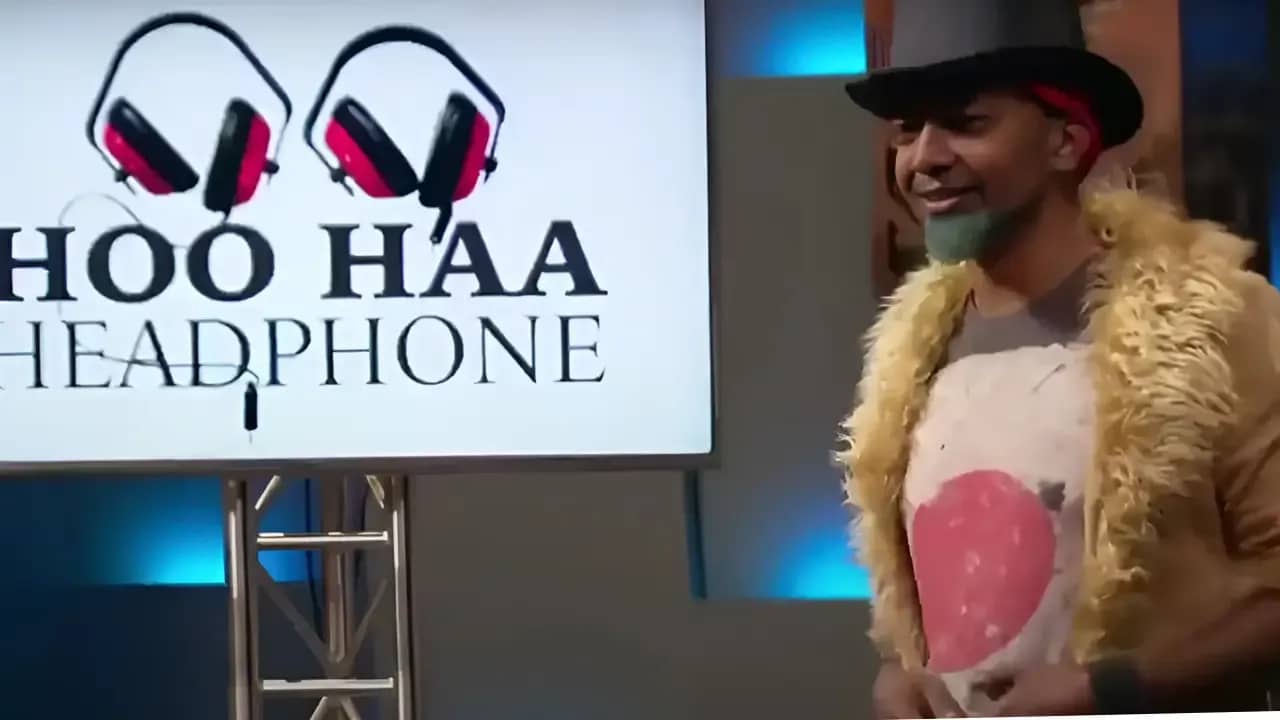
Quick answer: Hoo Haa Headphones never became a real business. A drummer known only as “Capital M” pitched it on Shark Tank Australia in 2017, asking $20 for 20% — a $100 valuation, the lowest in Shark Tank history. Andrew Banks and Naomi Simson countered $30 for 30% and he accepted on air. But no product ever launched, there is no website or store listing, and there is no sign the deal closed. Its net worth today is effectively $0 — the $100 was only an on-show number, never realized worth.
| Company | Hoo Haa Headphones (retractable-cord headphones — concept only) |
| Founder | “Capital M” (a drummer; full name never given on the show) |
| Show | Shark Tank Australia, Season 3, Episode 2 (2017) |
| The ask | $20 for 20% (~$100 valuation — lowest in Shark Tank history) |
| Deal | $30 for 30% — Andrew Banks & Naomi Simson (15% each), accepted on air |
| Did the deal close? | No evidence it ever completed off-camera |
| Product launched? | No — never manufactured or sold |
| Current status | Never operated — no website, store listing, or business records |
| Net worth today | ~$0 — no operating company to value |
What is Hoo Haa Headphones’ net worth?
Effectively $0. Hoo Haa Headphones never operated as a company. There is no product, no revenue, no website, and no public business activity to value. The famous $100 figure was only the valuation implied by the pitch ($20 for 20%) — it was never realized net worth, and even the $30 deal that followed shows no sign of closing.
Treat the $100 as a piece of Shark Tank trivia, not a real company value. With no launch and no sales, there is nothing to grow from.
Is Hoo Haa Headphones still in business?
No — and it arguably never was. Every public signal points to a venture that never started: no product reached the market, there is no Amazon or retailer listing, no working website, no active social accounts, and no public company record. Years after the episode, no one appears to have ever received a pair.
The Hoo Haa Headphones Shark Tank pitch
In the last pitch of Season 3, Episode 2, a performer calling himself Capital M walked in and asked the Sharks for $20 in exchange for 20% of his company — valuing Hoo Haa Headphones at just $100. The product idea was simple: headphones with a retractable cord that pulls back in at the press of a button to stop tangling.
The Sharks were drawn in more by the spectacle than the spreadsheet. Andrew Banks offered the $20, Naomi Simson asked to split it, and the negotiation ended with a $30-for-30% counter — 15% each for Banks and Simson. Capital M accepted. It remains the lowest valuation ever seen on Shark Tank.
Did the Hoo Haa Headphones deal actually close?
There is no evidence it did. Like many Shark Tank handshakes, the on-air agreement is not the same as a completed investment. No trademark follow-through, no funded launch, and no public update ever surfaced. For Shark Tank Australia deals that did close, compare QPay, which completed a rare two-shark deal and kept growing.
Who is Capital M, the founder?
The founder gave only the stage name “Capital M.” He presented himself as a professional drummer and said he had little idea how to take the product to market. Many viewers concluded the pitch was less about building a headphone brand and more about exposure — using one of the country’s most-watched shows as a stage. There is no verified public company or founder profile tied to a working Hoo Haa Headphones business.
Can you buy Hoo Haa Headphones?
No. The headphones were never produced or sold. There is no Amazon listing, no retailer, no product reviews, and no demo units in circulation. It remained a concept pitched with confidence, never an item you could purchase.
Why the pitch became a Shark Tank legend
Despite producing nothing, Hoo Haa Headphones became cult-famous in Shark Tank communities. The combination of a $100 valuation, a theatrical one-name founder, and a deal that made no commercial sense turned it into a recurring “strangest pitch ever” talking point. The clip keeps getting views from people trying to work out whether it was real — which is exactly the attention a publicity-driven appearance would want.
Hoo Haa Headphones timeline
| Date | Milestone |
|---|---|
| 2017 | Capital M pitches Hoo Haa Headphones on Shark Tank Australia (S3, E2) |
| On air | Asks $20 for 20% ($100 valuation); accepts $30 for 30% from Banks & Simson |
| After the show | No product, no website, no store listing, no public business activity |
| 2026 (today) | Never operated; net worth effectively $0 |
Frequently asked questions
What is Hoo Haa Headphones’ net worth?
Effectively $0. The company never launched a product or generated revenue. The $100 figure was only the valuation implied by the Shark Tank pitch, never realized net worth.
Did Hoo Haa Headphones get a deal on Shark Tank?
On air, yes — Andrew Banks and Naomi Simson offered $30 for 30% and Capital M accepted. But there is no evidence the deal closed after filming.
Is Hoo Haa Headphones still in business?
No. There is no product, website, store listing, or public company record. It never operated as a real business.
Who is the founder of Hoo Haa Headphones?
A drummer who used only the stage name “Capital M.” He never gave a full name on the show, and no verified business profile is tied to the brand.
Can you still buy Hoo Haa Headphones?
No. The headphones were never manufactured or sold anywhere.
Why is the Hoo Haa Headphones pitch famous?
It featured the lowest valuation in Shark Tank history ($100) and a theatrical founder, making it a long-running “strangest pitch ever” favourite among fans.
The bottom line
Hoo Haa Headphones is a Shark Tank Australia curiosity, not a company. It got the lowest deal in the show’s history, then produced nothing — no product, no sales, no business. For anyone searching its net worth, the honest answer is effectively $0: the $100 was a TV moment, never real value.
How we verified this update
This update is based on the Hoo Haa Headphones pitch on Shark Tank Australia (Season 3, Episode 2, 2017), where “Capital M” asked $20 for 20% and accepted a $30-for-30% counter from Andrew Banks and Naomi Simson — the lowest valuation in the show’s history. The defunct/never-launched status is supported by the absence of any product, website, retailer or Amazon listing, trademark follow-through, or public business records, and by years of fan discussion noting no one ever received a pair. We state net worth as effectively $0 because there is no operating entity to value; the $100 figure was only the on-show valuation. We refresh this page when new verified facts emerge.
RELATED: QPay net worth update (Shark Tank Australia) · Zeppee net worth update · Bodywalking Massage net worth update · Biggest Shark Tank deals ever
The weekly question
From obsession to clarity — one original question every week.
We answer one noisy topic at a time, in full. No daily roundup, no thread bait — just the question, the principles, and the system.
More from Shark Tank Australia Season 03
All season pitches
Shark Tank Australia
Zeppee Net Worth Update: The Shark Tank Australia Pet App That Shut Down
Shark Tank Australia
TracTag’s Shark Tank Appearance & Outcome: How a Live Hack Turned Into Global Growth
Shark Tank Australia