QPay Net Worth Update: From Shark Tank Australia to the $10M Rubric Rebrand
QPay landed a $380,000 Shark Tank Australia deal from Steve Baxter and Naomi Simson in 2018 — and it actually closed. The student fintech expanded internationally, hit ~$10.5M revenue in 2021, and rebranded to Rubric in 2024. Here is the full net worth update.
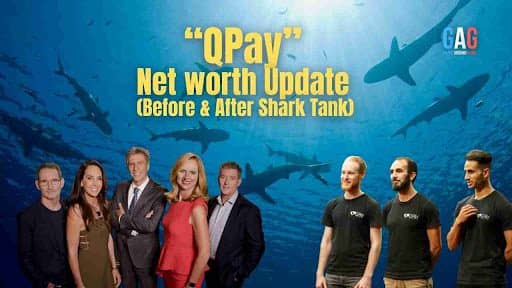
Quick answer: QPay is still operating in 2026 as a student-campus fintech that rebranded core club tooling to Rubric in 2024. Founders Andrew Clapham, Zakaria Bouguettaya, and Moe Satti closed a rare two-shark deal on Shark Tank Australia in 2018 — $380,000 for 8.4% from Steve Baxter and Naomi Simson — and unlike many TV handshakes, the deal actually completed. QPay’s estimated valuation in 2026 is about $10 million, with reported revenue of roughly $10.5 million in 2021.
| Company | QPay (club platform now branded Rubric) — student payments & campus club management |
| Founders | Andrew Clapham, Zakaria Bouguettaya (Zaki), Moe Satti |
| Founded | 2015, Australian National University (ANU), Sydney |
| Show | Shark Tank Australia, Season 4 finale (2018) |
| The ask | $380,000 for 8.4% (~$4.5M implied valuation) |
| Deal | $380,000 for 8.4% — Steve Baxter & Naomi Simson ($190k / 4.2% each) |
| Did the deal complete? | Yes — signed after due diligence |
| 2024 pivot | Rebranded club-management platform to Rubric |
| Net worth (2026) | ~$10 million (estimated valuation) |
QPay net worth: the quick answer
QPay is one of Shark Tank Australia’s genuine success stories — not a pitch that looked good on TV and vanished afterward.
- Valuation today: approximately $10 million in 2026.
- Revenue benchmark: roughly $10.5 million in 2021 (latest widely cited revenue figure).
- Shark money landed: Baxter and Simson’s $380,000 investment closed after due diligence, alongside Sydney Angels, American Express, and other investors in a broader round.
- Scale signal: 150,000+ Australian students at the time of the pitch; 2,000+ clubs on the Rubric platform post-rebrand.
How we frame the $10M figure
QPay is private, so there is no public market cap. The ~$10 million valuation comes from post-Shark growth markers: international expansion, the 2021 Birchal equity crowdfunding raise ($1.15 million), reported $10.5M revenue that year, and the 2024 Rubric rebrand positioning the company inside university club infrastructure. We treat $10M as the best-supported editorial estimate for 2026, not an audited number.
What happened to QPay on Shark Tank Australia?
Clapham, Bouguettaya, and Satti entered the Tank on the Season 4 finale in 2018 pitching QPay as a student financial platform — payments, ticketing, merchandise, and campus commerce in one app. They had already processed about $10 million in transactions, raised roughly $620,000 in prior venture funding, and signed up more than 150,000 Australian students.
They asked for exactly what they wanted: $380,000 for 8.4%. After Janine Allis, Andrew Banks, and Glen Richards passed, Steve Baxter and Naomi Simson both offered the full amount. In a Shark Tank Australia first, the two sharks split the deal: $190,000 each for 4.2%, totaling $380,000 for 8.4%.
The founders celebrated — Simson brought the female leadership presence they felt the male-led startup needed, and Baxter added deep tech-investor credibility. Reporting at the time indicated the deal passed due diligence and was signed within weeks, forming part of a larger ~$1 million funding round.
READ ALSO: QPay: highest-earning Shark Tank Australia business
Did the QPay Shark Tank deal actually happen?
Yes. Unlike many Shark Tank handshakes, the QPay investment with Baxter and Simson closed after due diligence. That makes QPay a real portfolio company for both sharks, not just a memorable TV moment.
What QPay did after Shark Tank
The Shark capital fueled expansion. QPay pushed beyond Australia into New Zealand, the United Kingdom, and Canada (Canada launch September 2021). The product evolved from a student marketplace born at ANU into broader campus financial infrastructure covering clubs, societies, and university unions.
Key post-show milestones:
- December 2018: co-founder Andrew Clapham stepped back from day-to-day operations; Bouguettaya and Satti led the business forward.
- July 2021: raised $1.15 million through an equity crowdfunding campaign on Birchal, bringing total fundraising to roughly $2.1 million across multiple rounds.
- 2021 revenue: reported at about $10.5 million.
- August 2024: rebranded its club-management platform as Rubric, focused on helping university clubs and societies run events, merchandise, email, SMS, and member administration.
The Rubric rebrand (2024)
The biggest strategic shift in recent years is Rubric — QPay’s dedicated platform for university clubs, societies, and student associations. Instead of only chasing individual student wallets, Rubric embeds QPay inside campus club operations: memberships, events, merch, communications, and engagement tracking.
Universities and student unions increasingly mandate club tooling like Rubric because running a society while studying is operationally intense. QPay’s pitch is that Rubric saves executive teams admin time and gives institutions better visibility into student engagement — a growing priority when dropout risk carries real financial cost for universities.
Is QPay still in business?
Yes. QPay/Rubric remains active in 2026 as an Australian student-fintech company serving campuses domestically and in select international markets. The Rubric platform reports use by 2,000+ clubs, and the leadership team (Bouguettaya as CEO, Satti as CFO/director) continues to position the business inside university digital infrastructure rather than as a standalone novelty app.
Who founded QPay?
Andrew Clapham and Zakaria Bouguettaya founded QPay in 2015 while studying at the Australian National University in Canberra. Moe Satti joined the leadership team and became a central figure post-Shark Tank, particularly after Clapham stepped back in late 2018.
Founder personal net worth figures circulating online are unverified. The more defensible number is the company valuation (~$10M), not individual founder wealth claims.
QPay net worth timeline
| Year | Status |
|---|---|
| 2015 | QPay founded at ANU by Clapham and Bouguettaya |
| 2018 (pitch) | 150k+ users; $10M transactions processed; asked $380k for 8.4% |
| 2018 (deal) | Baxter + Simson invest $380k for 8.4% — deal closes |
| 2021 | ~$10.5M revenue; $1.15M Birchal crowdfunding raise |
| 2024 | Club platform rebranded to Rubric |
| 2026 | Estimated company valuation ~$10 million |
The bottom line
QPay is what Shark Tank Australia wished every deal became: TV exposure, closed investment, international expansion, and a credible path to nine-figure campus relevance. The 2018 Baxter–Simson deal was real money. The 2021 revenue spike was real traction. The 2024 Rubric rebrand is the strategic bet for the next chapter — owning club operations, not just student payments. Our best net worth read for 2026: about $10 million.
Frequently asked questions
Did QPay get a deal on Shark Tank?
Yes. Steve Baxter and Naomi Simson invested $380,000 for 8.4% ($190,000 each for 4.2%) on Shark Tank Australia in 2018, and the deal closed after due diligence.
What is QPay’s net worth?
Approximately $10 million in 2026, based on post-Shark growth, the 2021 revenue benchmark (~$10.5M), and subsequent fundraising and rebranding activity.
Is QPay still in business?
Yes. QPay continues operating and its club-management product now runs under the Rubric brand as of 2024.
Who founded QPay?
Andrew Clapham and Zakaria Bouguettaya founded QPay in 2015; Moe Satti is a co-founder/director who helped lead the company after Clapham stepped back.
What is Rubric by QPay?
Rubric is QPay’s rebranded platform (2024) for university clubs and societies to manage members, events, merchandise, and communications.
Which sharks invested in QPay?
Steve Baxter and Naomi Simson — the first time those two sharks partnered on a single deal in Shark Tank Australia history.
How we verified this update
This update is based on the Shark Tank Australia Season 4 (2018) pitch and reported post-show funding close, QPay’s international expansion and 2021 Birchal crowdfunding round, the August 2024 Rubric rebrand, and publicly described campus adoption metrics. Valuation and revenue figures are editorial estimates drawn from the company’s disclosed fundraising milestones and widely reported 2021 revenue because QPay does not publish audited financial statements. We update this page as new facts emerge.
The weekly question
From obsession to clarity — one original question every week.
We answer one noisy topic at a time, in full. No daily roundup, no thread bait — just the question, the principles, and the system.