
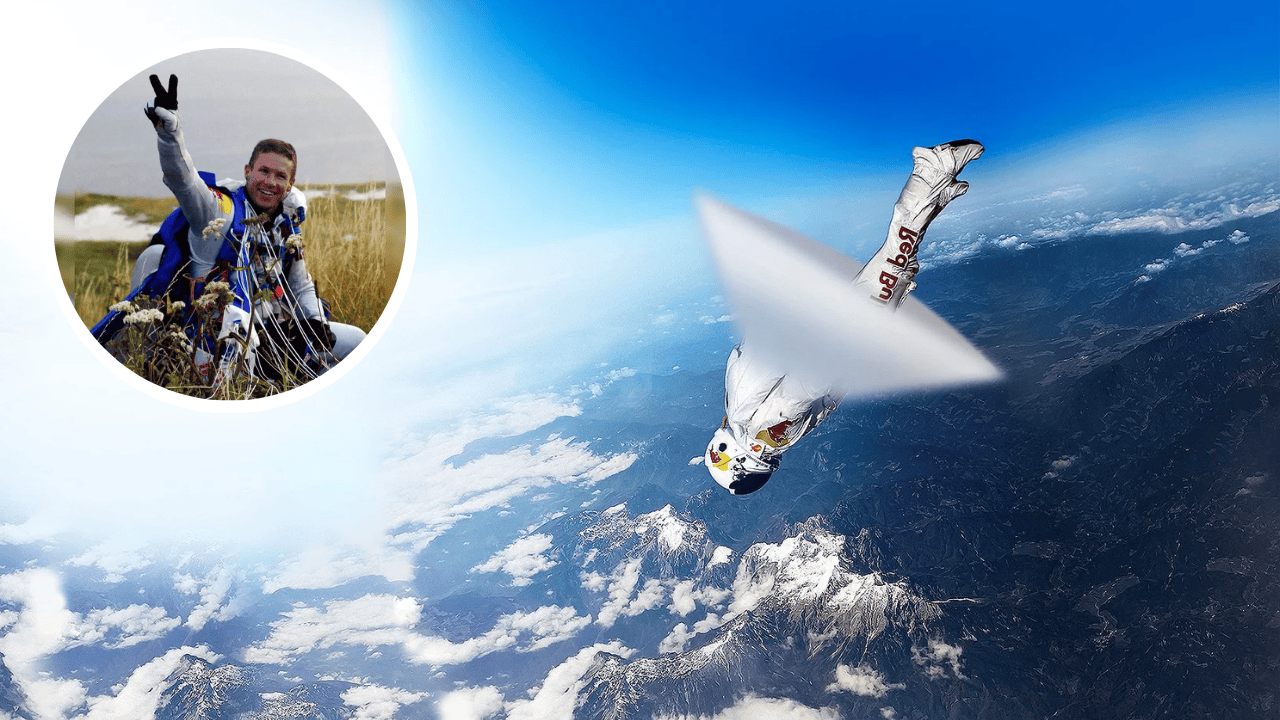
Imagine standing in a tiny capsule floating 24 miles above Earth. The planet below looks like a glowing blue marble. You take one last deep breath, step off the edge, and begin falling faster than sound itself.
That was Felix Baumgartner, an Austrian skydiver who made history on October 14, 2012. His jump wasn’t just a daredevil stunt. It was a carefully planned science mission called Red Bull Stratos, designed to study how the human body reacts at extreme altitudes.
Millions watched the livestream in awe as Felix began his descent from the edge of space. What he accomplished that day would change the limits of what humans believed was possible.
Fast Facts
- Project: Red Bull Stratos high-altitude freefall mission over New Mexico on October 14, 2012.
- Altitude: 128,100 feet (39 km) jump point with a helium balloon and pressurized capsule.
- Top Speed: 833.9 mph (about Mach 1.25) in freefall, the first human to break the sound barrier without a jet.
- Impact: Data advanced high-altitude safety and ejection research for aerospace and spaceflight.
- Audience: 8+ million watched the livestream on YouTube, a record at the time.
Sources: Red Bull Stratos, Smithsonian National Air and Space Museum, YouTube Official Blog.
The Jump That Shocked the World
Baumgartner rode a massive helium balloon to the stratosphere, climbing to 128,100 feet (39 kilometers) above New Mexico. From that height, the sky fades to black, and the Earth curves beneath your feet.
When he opened the capsule door, he could see the edge of space. Millions watched the livestream, hearts pounding as he stepped off and began his fall.
In just seconds, he accelerated to 833.9 miles per hour (Mach 1.25). That means he broke the sound barrier using nothing but his body and gravity.
He became the first human to do so without a jet or spacecraft.
Fact: Over 8 million people watched his jump live on YouTube, making it the most-watched livestream at that time.
A Fight Against Physics
The jump wasn’t smooth. Just seconds after falling, Felix started spinning uncontrollably. The thin air at that altitude gave him little control. His body twisted at nearly 60 revolutions per minute—fast enough to knock him unconscious.
He managed to steady himself after 50 seconds of chaos. Then he spread his arms, controlled his speed, and continued his descent safely until his parachute opened.
Later, Felix said in an interview,
“Sometimes you have to go really high up to understand how small you really are.”
That quote captured what millions felt watching him fall—fear, awe, and wonder all at once.
The Science Behind the Stunt
The mission wasn’t only about breaking records. It was a test for future space safety. Engineers wanted to learn how a person might survive if forced to eject from a spacecraft at extreme altitudes.
Baumgartner wore a pressurized space suit with layers of protection against freezing temperatures and lack of oxygen. His capsule carried over 30 onboard sensors and 15 cameras to record every moment.
Experts compared the data to earlier jumps done by NASA pilot Joe Kittinger in 1960, who served as Felix’s mentor.
Expert Insight:
“This mission pushed the boundaries of aerospace engineering and human physiology in ways NASA can apply to future exploration,” said Dr. Jonathan Clark, former NASA flight surgeon and medical director for the Stratos project.
How the Internet Made It Legendary
Once Felix landed safely, the world exploded with reactions. Clips of his freefall flooded Reddit, Twitter, and YouTube. Some users called him a “real-life superhero.” Others debated whether he was brave or crazy.
The footage became one of the most replayed science videos of the decade. Even today, short edits of his descent still trend on TikTok and YouTube every year around the jump’s anniversary.
What Happened After the Jump
After the mission, Felix Baumgartner didn’t retire quietly. He became a professional helicopter pilot and joined The Flying Bulls, an aerobatic aviation team. His Red Bull capsule and pressure suit are now displayed at the Smithsonian National Air and Space Museum, honoring one of humanity’s boldest moments.
In interviews, he often says the jump changed how he sees life. From space, he saw no borders—just one planet.
A Tragic Farewell
In 2025, the world lost Felix Baumgartner in a paragliding accident in Italy. News of his death shocked fans across the globe. The man who once leapt from space and defied death met his end doing what he loved most — flying close to the Earth he once saw from the edge of space.
Tributes poured in from fellow aviators, engineers, and fans. Many called him “the man who touched the sky — twice.”
Though his life ended too soon, his leap continues to inspire. Scientists still use the data he helped collect, and dreamers still look up, wondering what other boundaries can be broken.
Why This Moment Still Inspires Us
Felix’s jump reminds us that courage and science aren’t opposites—they fuel each other. He faced death to expand what humans know about the upper atmosphere and our own limits.
It wasn’t a superhero movie. It was a real man, using physics, engineering, and courage to test what’s possible.
If curiosity is what makes someone a “geek,” then Felix Baumgartner is the ultimate geek hero—the man who turned a scientific experiment into a global symbol of human potential.
Key Takeaway
Felix didn’t just fall from space. He showed the world that science, courage, and imagination can make the impossible real.
Sometimes, the biggest leaps forward begin with a single step—off the edge