Felix Baumgartner Fell Faster Than Sound From the Stratosphere
Felix Baumgartner’s 2012 Red Bull Stratos jump made him the first person to exceed the speed of sound in free fall without a vehicle.

On 14 October 2012, Felix Baumgartner stepped from a capsule nearly 39 kilometres above New Mexico. During the fall, the Austrian skydiver accelerated beyond the speed of sound without an aircraft around him.
The jump watched around the world
The Red Bull Stratos balloon carried Baumgartner to an exit altitude of 38,969.4 metres. He reached 1,357.6 kilometres per hour—Mach 1.25—and free-fell for more than four minutes before opening his parachute.
38,969 m
Exit altitude
1,357.6 km/h
Maximum speed
Mach 1.25
Peak speed relative to sound
4m 19s
Free-fall time
Source: FAI and Red Bull Stratos
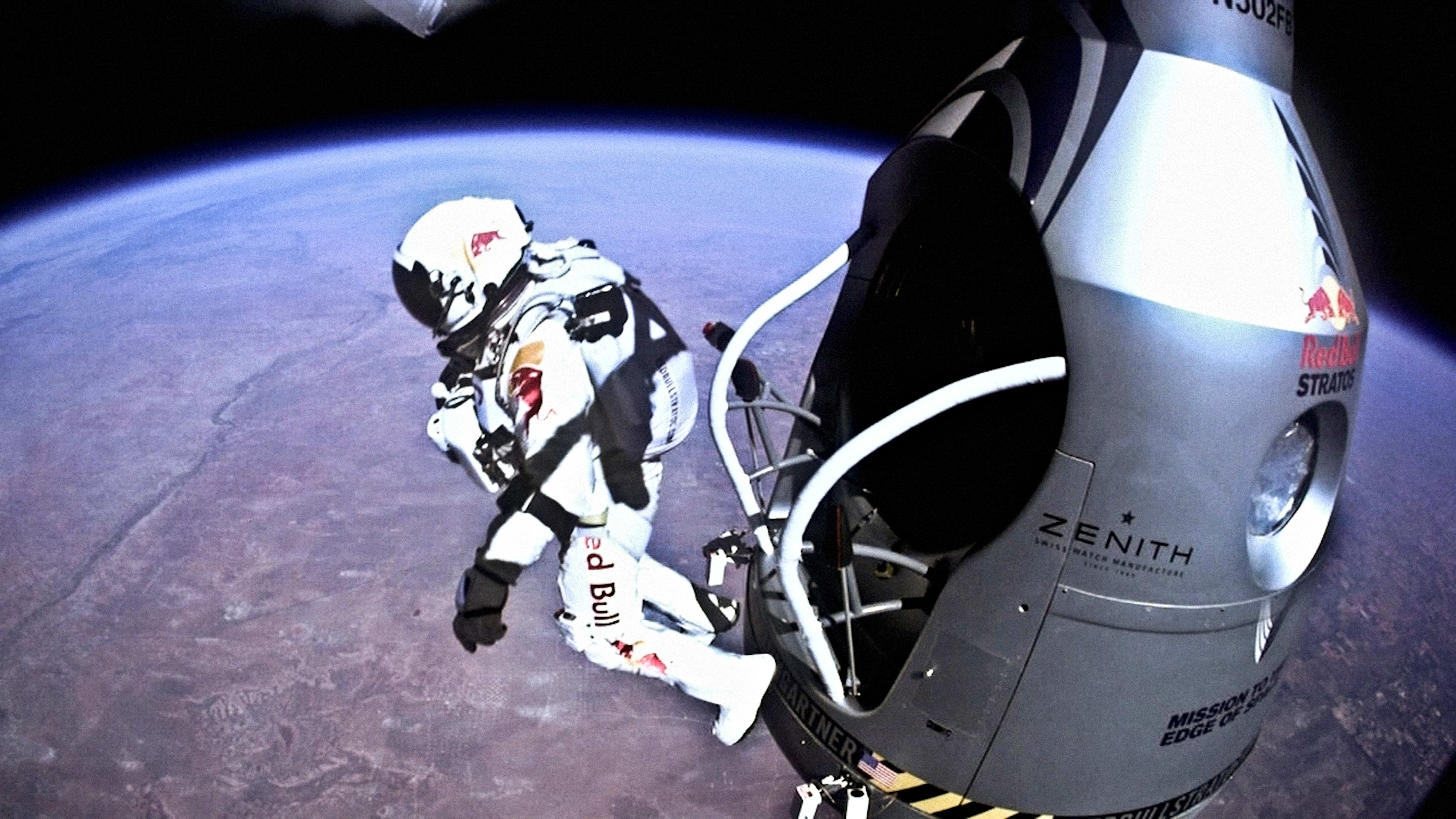
The famous step depended on years of pressure-suit, capsule and emergency-system engineering.
The engineering behind the fall
At stratospheric altitude, low pressure can make body fluids boil without protection. Baumgartner wore a pressurised suit and used a capsule providing life support, communications and a stable platform.
A dangerous flat spin was another concern. During the descent he began rotating, then recovered control before the spin became catastrophic. Training taught him to recognise body position despite limited visual references.
Standing on Kittinger’s shoulders
Joseph Kittinger, whose 1960 jump had defined high-altitude free fall for half a century, served as capsule communicator and adviser. The project joined a pioneer’s experience with modern materials, telemetry and simulation.
Alan Eustace later surpassed Baumgartner’s exit-altitude record in 2014, but Baumgartner’s sound-barrier breakthrough remained a landmark in public aerospace experimentation.
The geek lesson
The leap looked solitary, yet it was a systems achievement. Physiology, meteorology, suit design, balloon control and human decision-making all had to succeed together. Baumgartner’s boundary pushing worked because spectacle rested on engineering discipline.
The weekly question
From obsession to clarity — one original question every week.
We answer one noisy topic at a time, in full. No daily roundup, no thread bait — just the question, the principles, and the system.