
Every entrepreneur knows the infrastructure problem. You have a business idea, a product, a service — and then reality sets in. You need space. You need storage. You need somewhere to work, build, stage, or sell. And the traditional options — commercial leases, warehouse rentals, construction — carry costs and commitments that a bootstrapped founder or early-stage business simply cannot absorb.
A growing number of entrepreneurs are solving this problem with shipping containers. What was once purely a logistics tool — a steel box for moving goods across oceans — has become a surprisingly versatile piece of startup infrastructure. From pop-up retail concepts and mobile food businesses to on-site storage for product-based companies and modular office builds, containers are showing up at the ground floor of a wide range of entrepreneurial ventures. And the economics make sense in ways that traditional alternatives do not.
The Infrastructure Problem for Early-Stage Businesses
Commercial real estate is one of the most significant cost burdens for early-stage businesses, and one of the least flexible. A standard commercial lease typically requires a multi-year commitment, a personal guarantee, and upfront costs that include first and last month’s rent plus a security deposit. For a founder still validating their business model, signing a three-year lease on a retail space or warehouse is not just expensive — it is a bet on a future that has not yet been proven.
Self-storage offers flexibility but limited scale and poor suitability for operational use. You cannot run a business out of a self-storage unit. You cannot receive deliveries there in any practical way, customize the space, or use it as a customer-facing environment. It solves the storage problem but not the operational infrastructure problem.
Shipping containers occupy a different position entirely. They can be purchased outright, placed on owned or leased land without a long-term building commitment, customized for specific uses, and relocated or resold when the business outgrows them or pivots. They provide a physical infrastructure option that matches the flexibility requirements of an early-stage business in a way that conventional facilities rarely do.
How Entrepreneurs Are Actually Using Containers
Pop-Up Retail and Food Concepts
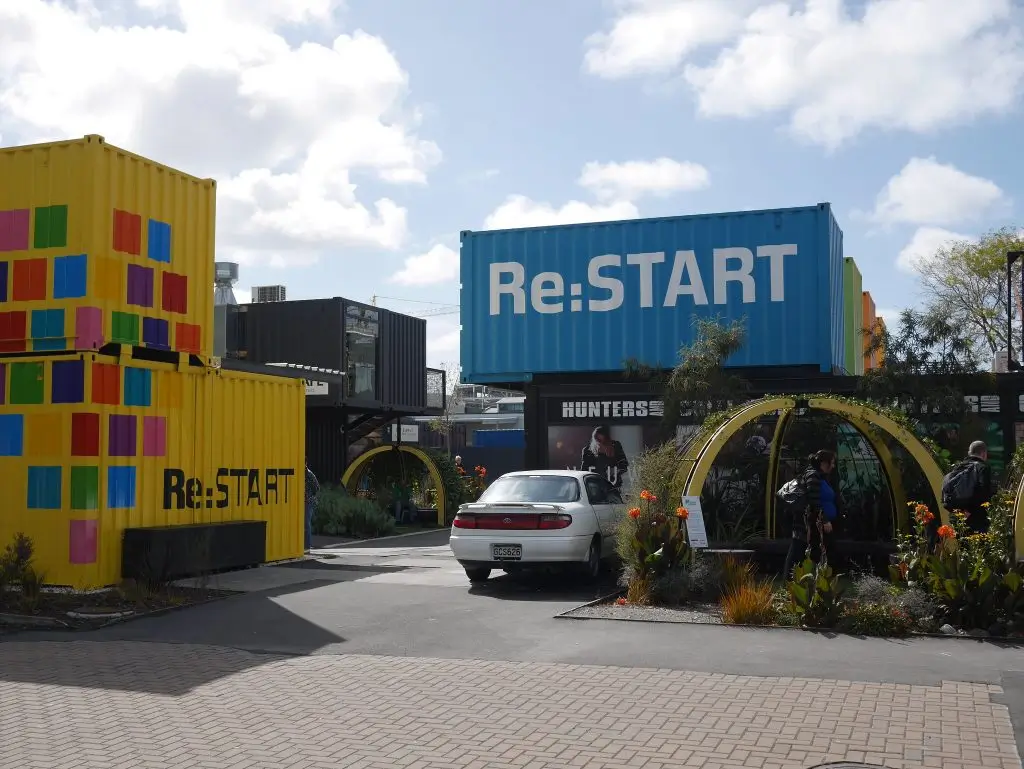
The container pop-up has become a recognized format in retail and food and beverage entrepreneurship. A single container converted into a retail storefront or food service unit can be placed on a leased parking lot, a festival site, or a vacant urban lot — markets where a permanent build would be impossible or prohibitively expensive. The container provides a weatherproof, secure, brandable shell that can be outfitted with display fixtures, service equipment, and point-of-sale systems at a cost that makes a retail experiment financially viable.
For food entrepreneurs specifically, a converted container offers a path to a commercial kitchen or service window without the lease and build-out cost of a conventional restaurant space. Container-based coffee shops, juice bars, food stalls, and specialty retail concepts have launched in cities across the US, often using the format deliberately as a statement of brand identity as much as a cost management tool.
Product Storage and Fulfillment Staging
For product-based businesses — e-commerce sellers, wholesalers, importers, subscription box companies — inventory storage is a recurring operational challenge that grows in proportion to success. Renting warehouse space on short notice is expensive and often requires minimum terms. A purchased container on the business’s own property or a rented yard provides secure, weatherproof inventory storage that scales with the business rather than requiring a lease renegotiation every time storage needs change.
A 40-foot high cube container offers approximately 2,700 cubic feet of interior space — enough for a significant inventory position for most early to mid-stage product businesses. The high cube variant adds an extra foot of interior height compared to a standard container, which matters when stacking shelving or storing taller items. For businesses with diverse SKUs or large per-unit dimensions, the additional cubic footage justifies the modest premium over a standard unit.
Mobile Offices and Job Site Infrastructure
Service businesses and contractors working across multiple locations have found containers useful as portable office infrastructure. A container fitted with insulation, electrical connections, lighting, and basic office furniture provides a functional workspace at a job site, event venue, or temporary location without requiring a permanent building. The unit can be locked and secured when not in use and transported to the next location when the project moves.
For growing service businesses that want to establish a professional operational presence in a new market before committing to a permanent office lease, a container office can serve as a bridge — credible enough to support client relationships, affordable enough to justify before the revenue base is established.
Workshop and Production Space
Makers, craftspeople, small manufacturers, and creative businesses have used containers as workshops and production spaces. The steel shell is naturally robust against the physical demands of workshop use — tools, equipment, materials, and the general wear of production activity. With ventilation and electrical supply, a container workshop can support metalworking, woodworking, electronics assembly, textile production, and a wide range of other craft and manufacturing activities at a fraction of the cost of equivalent commercial industrial space.
The Financial Case for Entrepreneurs
The economics of container ownership are particularly favorable for entrepreneurs because the purchase price represents a one-time capital outlay rather than an ongoing commitment. A used container in good condition can be acquired for $2,500 to $5,000 depending on size and specification. Compare that to the first-year cost of a commercial storage lease or retail space rental in most US markets, and the container purchase often pays back within twelve to eighteen months on operational cost savings alone.
The asset also retains resale value. When a business outgrows a container or no longer needs it, the unit can be sold — typically recovering $1,500 to $3,500 of the original purchase price depending on condition and market. The effective cost of ownership over a two to three year period is often lower than the deposit on a comparable commercial lease.
For businesses that need more capacity over time, containers are modular by design. Adding a second unit to an existing installation doubles usable space without requiring a new facility search, lease negotiation, or construction timeline. The business grows into its infrastructure incrementally, which is exactly the capital efficiency profile that bootstrapped founders and early-stage investors prefer.
Why Texas Entrepreneurs Are Leading the Trend
Texas has emerged as one of the most active markets for entrepreneurial container use in the United States. The combination of strong business formation rates, relatively permissive zoning in many municipalities, affordable land compared to coastal markets, and a culture that favors practical, results-oriented business decisions has created fertile conditions for container-based ventures.
Dallas in particular has seen significant activity across the container retail, storage, and office categories. The city’s rapid commercial and residential growth has created demand for flexible, quickly deployed business infrastructure that traditional commercial real estate cannot supply fast enough. Entrepreneurs who need to establish operational presence quickly find that a container solution can be in place within days of ordering, compared to the months that a conventional build-out requires.
For a Dallas-based entrepreneur needing significant storage or operational space, a used 40ft high cube shipping container in Dallas provides roughly 2,700 cubic feet of secure, weatherproof space that can be delivered directly to the business location and ready for use immediately — without a lease, a long-term commitment, or a construction timeline.
The same pattern is visible in Houston, Austin, and San Antonio, where entrepreneurial activity is high and the practical advantages of container infrastructure resonate with founders who have limited capital and unlimited operational demands.
What to Know Before You Buy
For entrepreneurs considering a container for the first time, a few practical points are worth understanding before placing an order.
New vs. used is the first decision. New containers — one-trip units that have made a single ocean crossing — offer a clean interior and consistent condition, which matters for customer-facing applications or food storage. Used containers cost less and are entirely adequate for storage, workshop, or office use where interior aesthetics are not the primary concern. A cargo-worthy rated used unit will be structurally sound and weathertight.
Size selection follows application. The 20-foot standard unit is the most versatile and the easiest to place and transport. The 40-foot unit doubles capacity and is better suited to businesses with significant inventory or workshop needs. The high cube variant adds interior height, which matters for shelving, equipment clearance, or any application where vertical space is useful.
Delivery logistics are simpler than most first-time buyers expect. Containers are delivered by flatbed truck and placed using a tilt-bed or crane mechanism. The delivery truck needs clear access to the placement location — typically a straight run of 80 to 100 feet. Most commercial and industrial properties accommodate this without difficulty. The supplier handles transport; the buyer just needs a level surface and adequate access.
The container economy has created a genuinely useful tool for entrepreneurs willing to think creatively about infrastructure. The steel box that crossed the ocean is no longer just a logistics asset — it is a building block for businesses that need to move fast, spend smart, and build something real before the runway runs out.