
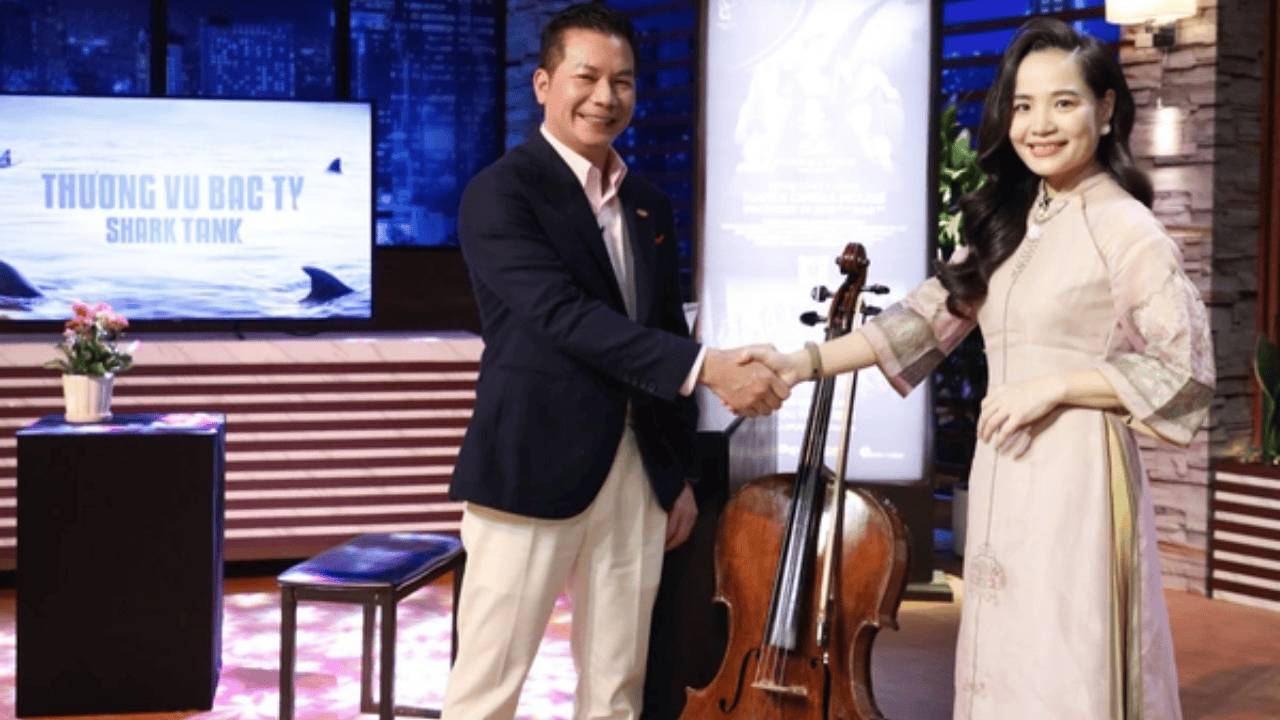
In Vietnam’s Shark Tank Season 4, few moments captured the audience’s attention like the appearance of Dr. Đinh Hoài Xuân, a classically trained cellist with a dream bigger than business itself. Her project, Cello Fundamento, aimed to bring classical music, particularly cello-centered performances, to the Vietnamese public in a modern and emotionally engaging way.
It wasn’t a tech startup or a consumer brand. It was art, redefined as enterprise. And yet, when her deal with the Sharks fell apart, it became the beginning of one of Vietnam’s most inspiring cultural revivals.
The Deal That Sank Before It Began
When Dr. Xuân entered the Shark Tank Vietnam stage, she didn’t just perform. She delivered a statement. She requested 2 billion VND (about $85,000) to fund her next two international symphony concerts, Cello Fundamento 6 (CF6), in exchange for 40% of the profits.
At first, the panel was impressed by her conviction. She spoke about how music could act as a bridge between nations and how her concerts could elevate Vietnam’s cultural reputation worldwide. But Shark Phạm Thanh Hưng offered a deal that changed everything. He would invest the same amount, but he wanted 70% of the profits and full repayment of the initial capital.
This meant the so-called “investment” was more of a loan, not a partnership. The business risk still sat entirely on Xuân’s shoulders.
In an interview after the show, she admitted,
“If I accepted, the financial burden could have crushed the project. It wasn’t sustainable for a mission like ours.”
Although she initially agreed on television for symbolic reasons, the deal eventually collapsed off-screen. Instead of investment, the project transitioned into a sponsorship arrangement. Corporations such as Cen Land and Centours Travel stepped in to support upcoming concerts without demanding equity or repayment.
The televised failure became the spark for a deeper realization that Cello Fundamento was never meant to chase profit. It was meant to chase purpose.
How a Dream Was Born
Before Shark Tank, few in Vietnam imagined a solo cello concert could fill the Hanoi Opera House. But Dr. Đinh Hoài Xuân did.
After completing her PhD in Cello Performance in Romania, she returned to Vietnam in 2016 with a bold idea to make cello performances accessible to everyone, from students to senior citizens. She named her vision “Cello Fundamento”, which in Latin means “the foundation of the cello.”
The project’s early concerts, CF1 to CF5, were not profitable. Ticket prices had to stay affordable to attract the local public, but the cost of international musicians, venue rental, and logistics often exceeded revenue. Xuân personally covered many of these losses through her teaching and performing income.
Yet, she kept going. She once told Nhân Dân newspaper, “Even if I must carry the cello and the cause on my back alone, I will keep doing it until Vietnamese people love the cello like they love the piano or the guitar.”
Her vision wasn’t just to perform. It was to rebuild classical culture in a country where popular music dominates airwaves.
Slowly, her passion began drawing attention from embassies, cultural institutions, and sponsors who shared her dream.
The Turning Point: From Business Pitch to Cultural Mission
After the Shark Tank episode aired, Xuân made one of the most defining moves of her career. In 2023, she officially registered the Cello Fundamento Social Enterprise Company Limited.
This legal transformation marked a clear shift from profit-driven to mission-driven operations. Unlike traditional businesses, social enterprises in Vietnam are required by law to reinvest a major portion of their profits into their social or cultural goals.
In this new model, Cello Fundamento’s goal is to use art as a force for education and cultural exchange. The company expanded its scope to include art training, international event organization, tourism services, and artistic product trade.
This structure gave it flexibility. It could now accept grants, host workshops, or partner with NGOs, something it couldn’t do easily as a private business.
For Xuân, it meant that Cello Fundamento could now survive even without commercial investors. The focus shifted from scaling profits to scaling influence.
A New Model Built on Sponsorship and Diplomacy
To sustain her vision, Dr. Xuân leaned into a model many Western orchestras use, a mix of sponsorship, cultural diplomacy, and ticket revenue. Instead of depending on investment returns, Cello Fundamento began to operate as a cultural bridge between Vietnam and other nations. Each edition became tied to an international milestone.
In 2022, CF6, the same concert she pitched on Shark Tank, was held thanks to sponsorships from Cen Land and Centours Travel. Despite no investor funding, the event sold out and earned positive reviews from both the press and music critics.
In 2023, CF7 took things further. The concert celebrated 50 years of Vietnam–France diplomatic relations, supported by the French and Romanian Embassies. According to VOV3 Radio, “Cello Fundamento has evolved into a platform for cultural diplomacy, not just performance.”
And now, as of 2025, CF8 is in progress, dedicated to the 75th anniversary of Vietnam–Romania relations. Sponsored by PV GAS and endorsed by the Vietnam Ministry of Culture, it will unite international musicians from Europe and Asia in a celebration of art and friendship.
Through these collaborations, Cello Fundamento turned from a music project into Vietnam’s most recognized classical diplomacy platform.
From the Stage to the World
Each concert now goes beyond the stage. It’s part of a long-term cultural message that Vietnam belongs in the global symphony of art.
In CF7, the audience at the Hanoi Opera House witnessed an extraordinary performance featuring the French Enescu Project String Octet, where one violinist played a 310-year-old Stradivarius violin valued at over $20 million. The performance became a national headline, symbolizing how global art could echo through Vietnamese halls.
The event drew thousands of live viewers and hundreds of thousands of online engagements. This attention proved that classical music could still capture hearts in the age of TikTok.
For many Vietnamese youth attending their first symphony, it was a new experience that connected tradition and modernity through emotion.
The Real Economics of Art
While prestige and diplomacy have grown, financial sustainability remains a challenge.
Most of Cello Fundamento’s income still comes from sponsorships and cultural grants, not from stable, recurring revenue like endowments or streaming rights. This creates a dependency on a small group of sponsors. In finance, this is called “Sponsorship Concentration Risk.”
If a main sponsor decides not to renew, operations could struggle. But the team is aware of this. They are now exploring new revenue streams such as music education programs, digital concert licensing, and international tours.
Arts consultant Nguyen Hoang Anh from ToQuoc.vn explained, “The beauty of Cello Fundamento’s model is that it values legacy over profit. But to ensure survival, they must diversify. That’s how art transforms into a sustainable economy.”
Her comment highlights a deeper truth. Even in the world of art, financial strategy matters as much as talent.
Dr. Đinh Hoài Xuân’s Personal Strength
Behind every cello note, there’s the resilience of a woman who never stopped believing.
Dr. Xuân is not only a musician but also an educator, mentor, and cultural leader. She teaches at Vietnam National Academy of Music and collaborates with international institutions to train young artists.
Her personal net worth is modest and primarily comes from her academic work and performances abroad, not from Cello Fundamento’s profits. As a social enterprise founder, she is legally bound to reinvest earnings into her mission, meaning her success is measured in cultural impact, not cash.
Her dual role as both artist and administrator allows her to balance creativity with leadership. As she told VNExpress, “If you wait for perfect funding, you’ll never begin. Music has always moved forward through courage.”
What Makes Cello Fundamento Different
Cello Fundamento’s model challenges the traditional definition of success. It doesn’t measure growth by revenue but by reach, recognition, and cultural diplomacy.
Each concert not only entertains but also trains local musicians, builds networks between embassies, and strengthens Vietnam’s reputation abroad. For example, during CF7, the organization hosted free masterclasses for over 100 young Vietnamese music students, offering rare opportunities to learn from international cellists.
That educational element sets Cello Fundamento apart. It acts as both a concert series and a school of inspiration, nurturing the next generation of artists.
In doing so, it bridges the gap between art and impact, between a stage performance and a cultural movement.
The Future: CF9 and Beyond
Looking ahead, Cello Fundamento plans to expand its influence both online and internationally.
For CF9 (2026), the organization aims to introduce live streaming and digital ticketing to reach overseas Vietnamese audiences. This move aligns with the global shift toward hybrid concerts, where online participation fuels both visibility and income.
There are also discussions with cultural bodies in Japan and Italy for potential collaborations, which could make Vietnam a recurring stop on global classical music circuits.
By doing this, Cello Fundamento not only preserves Vietnamese cultural identity but exports it to the world stage.
The team also plans to build a scholarship fund for underprivileged music students, using concert proceeds and embassy grants.
In essence, what began as a personal dream is becoming a national cultural institution in motion.
A Lesson in Resilience
Cello Fundamento’s journey shows that rejection can sometimes redirect you toward your real purpose.
What looked like a failed Shark Tank pitch turned out to be the foundation of something far more powerful, a movement that blends art, education, and diplomacy.
“If resilience had a sound, it would be the cello of Đinh Hoài Xuân.”
Her comeback isn’t just about music. It’s about redefining success in a world where art still has to fight for its place.
By turning every setback into a note in her melody of persistence, Dr. Xuân and Cello Fundamento have proven that true value lies not in profit, but in purpose.
TL;DR (Too Long; Didn’t Read)
Cello Fundamento, founded by Vietnamese cellist Dr. Đinh Hoài Xuân, turned a failed Shark Tank Vietnam deal into a thriving social enterprise that blends classical music, education, and cultural diplomacy. Backed by major sponsors and embassies, it has grown into one of Vietnam’s leading cultural movements, proving that passion and purpose can outlast profit.
FAQs
What is Cello Fundamento?
Cello Fundamento is a Vietnamese symphony concert series founded by Dr. Đinh Hoài Xuân in 2016. It combines classical cello performances with modern and cultural elements to make classical music accessible to the public. Today, it operates as a social enterprise focused on music education and international cultural exchange.
Did Cello Fundamento get a deal on Shark Tank Vietnam?
No. Although Dr. Đinh Hoài Xuân received an offer from Shark Phạm Thanh Hưng for 2 billion VND in exchange for 70% of profits, the deal was never finalized. Instead, the project continued through sponsorships from companies such as Cen Land and Centours Travel.
Is Cello Fundamento still active in 2025?
Yes. As of 2025, Cello Fundamento is still active and growing. It has hosted multiple international concerts, including CF7 in 2023 celebrating 50 years of Vietnam–France relations, and is preparing for CF8 in 2025 with support from PV GAS and the Vietnam Ministry of Culture.
Who owns and runs Cello Fundamento now?
Dr. Đinh Hoài Xuân is the founder and sole legal representative of Cello Fundamento Social Enterprise Company Limited. She continues to lead the organization as both an artist and entrepreneur, ensuring its focus remains on cultural diplomacy and music education.
How does Cello Fundamento make money?
Cello Fundamento generates revenue mainly through concert ticket sales, sponsorships, and cultural grants. As a social enterprise, it reinvests all profits into its mission of promoting classical music and training young Vietnamese musicians.
What is Cello Fundamento’s net worth or valuation?
While Cello Fundamento’s exact net worth has not been publicly disclosed, the organization is considered financially stable. It operates through sponsorships and embassy partnerships rather than traditional investment funding, focusing on cultural value over profit.
Why did the Shark Tank Vietnam deal fall through?
The deal fell through because the offer was structured more like a loan than an investment. Dr. Đinh Hoài Xuân would have been required to repay the entire 2 billion VND plus share 70% of profits, which made it financially unsustainable for a cultural project.
What makes Cello Fundamento different from other music organizations?
Cello Fundamento stands out for blending classical music with cultural diplomacy. Each concert aligns with international milestones, such as diplomatic anniversaries, and involves collaborations with embassies and global artists. It also provides free masterclasses to Vietnamese music students, making it both an art platform and educational project.
What are Cello Fundamento’s future plans?
The organization plans to expand internationally with CF9 in 2026 and introduce live-streamed concerts for global audiences. It also aims to launch scholarships for underprivileged music students and continue collaborations with cultural bodies in Japan and Italy.
What is the main mission of Cello Fundamento?
Cello Fundamento’s mission is to promote classical music in Vietnam while fostering global cultural exchange. Its goal is to make the cello a symbol of Vietnamese artistry, bridging tradition and modernity through performance, education, and diplomacy.