
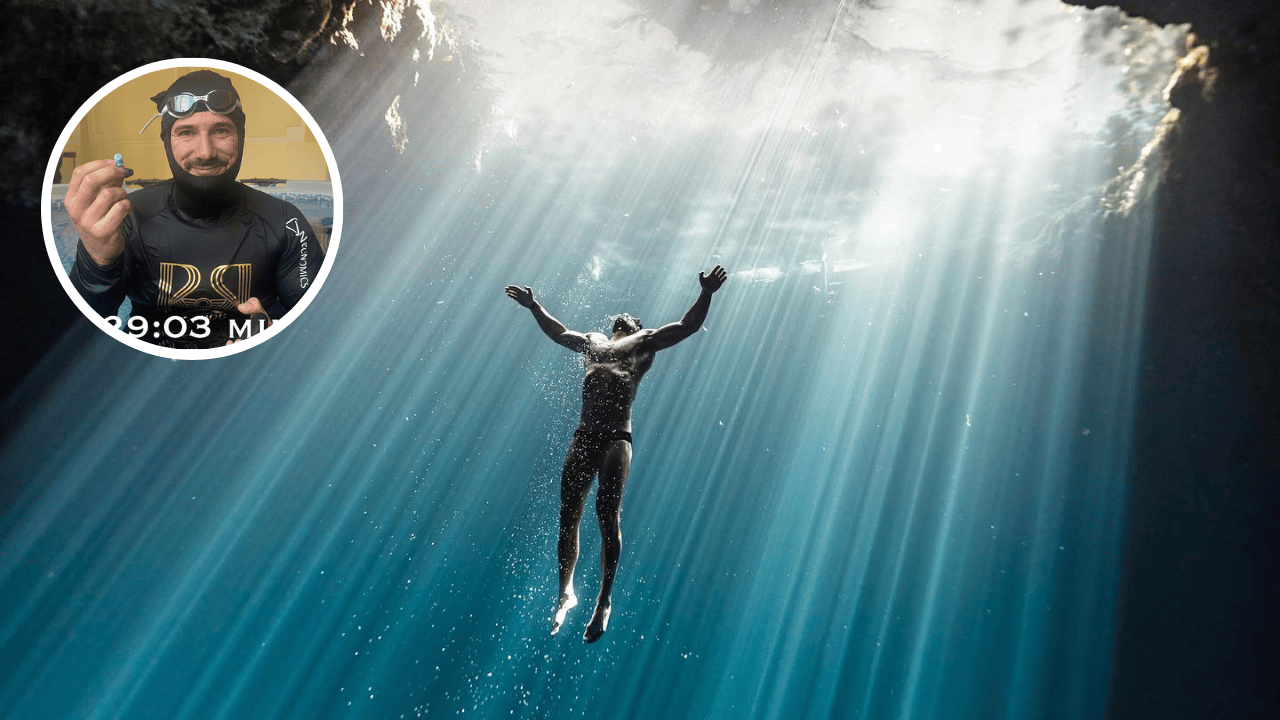
On June 14, 2025, in a quiet hotel lobby in Opatija, Croatia, about a hundred people watched something almost unbelievable. A man lay still in a small pool, face underwater, for what seemed like forever. When he finally came up, 29 minutes later, the crowd erupted.
That man was Vitomir Maričić, a Croatian freediver who broke the Guinness World Record for the longest oxygen-assisted breath hold.
Fast Facts
- Record: Longest oxygen-assisted breath hold underwater, 29 minutes and 3 seconds
- Who: Vitomir Maričić, Croatian freediver and ocean conservation advocate
- Where: Bristol Hotel, Opatija, Croatia — June 14, 2025
- Purpose: To raise awareness for ocean conservation through human endurance
- Recognition: Officially verified by Guinness World Records
Who Is Vitomir Maričić?
Vitomir isn’t a superhero. He’s a man who turned science and discipline into a form of art. Born and raised near the Adriatic Sea, he has spent years exploring how far the human body can go underwater.
He is the President of AIDA Croatia, a certified freediving instructor, and the founder of Adriatic Freediving. His life revolves around water, teaching others how to dive safely and respect the ocean.
In an interview with DeeperBlue, Vitomir explained that his main goal was not fame or records but to raise awareness for ocean conservation.
“After 20 minutes, it actually became easier, at least mentally,” Vitomir said.
The Science Behind the Record
This record wasn’t just about willpower. It was about preparation, control, and deep knowledge of human biology. Before he went underwater, Vitomir breathed pure oxygen for about 10 minutes. This filled his blood with oxygen and lowered the amount of carbon dioxide that causes the urge to breathe.
Then, he slipped into the pool and stayed almost completely still. His heartbeat slowed, his muscles relaxed, and every second stretched into eternity.
According to ScienceAlert, this technique, known as oxygen-assisted static apnea, allows trained divers to safely extend their breath-hold times by reducing oxygen use. It is a separate category recognized by Guinness from unassisted records.
What Happens to the Body After 20 Minutes?
Most of us start to panic after holding our breath for 30 seconds. Freedivers like Vitomir train their bodies to stay calm as carbon dioxide builds up. After about 20 minutes, his body entered what he described as a “mental calm.”
Dr. James Nestor, author of Breath: The New Science of a Lost Art, explains that the human body is capable of incredible adaptations.
“Our lungs can train to hold more air, our spleen releases oxygen-rich blood, and our mind can override panic,”
Source: Interview with James Nestor, 2023
This shows that breath-holding is not about strength but about mastery of calmness, a lesson that goes beyond diving.
Can You Train to Do This Too?
Not to this extreme, but yes, anyone can start improving their breathing safely.
Freedivers begin with breathing exercises, stretching, and relaxation training. Simple practices like slow breathing, mindfulness, and yoga can already improve lung function and calmness.
Vitomir teaches these skills in his workshops, helping people reconnect with their bodies and the ocean.
If you want to try it, start with box breathing: inhale for 4 seconds, hold for 4, exhale for 4, hold again for 4. It’s safe and proven to lower stress.
Why the Internet Fell in Love With This Moment
When Guinness World Records posted the video of Vitomir’s feat, it spread across Instagram, Reddit, and TikTok within hours. Comments flooded in, calling him a “real-life Aquaman.”
Science fans debated how the body could last that long without air. Others were inspired to learn about breathwork and ocean protection.
The timing was perfect. In an era when most viral stories come from technology or celebrity drama, this one reminded people of something raw and human, our connection to nature and our untapped potential.
The Debate: Is It “Cheating”?
Some commenters online argued that using pure oxygen makes the feat less impressive. However, Guinness World Records separates oxygen-assisted and unassisted categories to keep things fair.
Even with oxygen support, no one had reached 29 minutes before. The record is both scientifically valid and physically extraordinary.
To put that into perspective, a bottlenose dolphin can hold its breath for about 10 minutes. Only deep-diving whales can stay submerged longer than Vitomir did.
The Message Behind the Record
Beyond breaking limits, Vitomir had a purpose: to make people care about the ocean. Through his project “Fit for the Ocean,” he links physical fitness with ocean health, showing that strength and respect for nature go hand in hand.
He believes that if more people understand their own breathing, they will better understand the planet’s need for balance.
What’s Next for Vitomir Maričić?
Since setting the record, Vitomir continues to train divers and promote sustainable practices through his courses. He’s using his fame to spread awareness about marine conservation and the beauty of the underwater world.
He says his next challenge isn’t just about numbers. It’s about getting more people to experience calmness and connection through freediving.
Final Thought
Vitomir Maričić’s story isn’t just about breaking a record. It’s about breaking the limits of what we think humans can do. In a noisy world, he found silence. In that silence, he reminded us to breathe, to pause, and to care for the world that gives us air in the first place.