

Astronomers have made a surprising discovery just 22 light-years from Earth. Using NASA’s Transiting Exoplanet Survey Satellite (TESS), they found two Earth-sized planets orbiting a pair of tiny stars locked in a close dance. The system, called TOI-2267, is made up of two cool red dwarfs that circle each other only eight times farther apart than Earth is from the Sun.
This discovery stands out because scientists did not expect to find planets in such a compact binary system. The gravitational pull between two close stars often disrupts the material that forms planets. Yet, here are two confirmed Earth-sized worlds and one more possible planet orbiting them. It’s a small cosmic neighborhood that is rewriting what we know about planet formation.
“Our analysis shows a unique planetary arrangement: two planets are transiting one star, and the third is transiting its companion star,” said lead author Sebastián Zúñiga-Fernández, who led the study published in Astronomy & Astrophysics.
“This makes TOI-2267 the first binary system known to host transiting planets around both of its stars.”
Fast Facts
- Discovery: Two confirmed Earth-sized planets and one possible candidate orbiting the twin-star system TOI-2267.
- Distance: Located just 22 light-years from Earth in the constellation Camelopardalis.
- Stars: A pair of cool red dwarfs (M5V and M6V types) orbiting each other about 8 AU apart.
- Orbits: Planets complete their revolutions in 2–3.5 days, forming one of the most compact binary systems known.
- Significance: First known binary system with Earth-sized planets orbiting both stars, challenging previous models of planet formation.
What Exactly Did Astronomers Find in the TOI-2267 System?
The TOI-2267 system sits in the constellation of Camelopardalis, a northern sky region known for faint red stars. The two host stars are called TOI-2267A and TOI-2267B. Both are dim and cool compared to our Sun. The larger one is classified as an M5V-type red dwarf, and the smaller is an M6V-type.
Two confirmed planets orbit one of these stars. The first, TOI-2267 b, completes its orbit every 2.28 days. The second, TOI-2267 c, circles in 3.49 days. Both are roughly the same size as Earth, with diameters close to one Earth radius. A third signal, known as TOI-2267.02, repeats every 2.03 days and might also be a planet, but scientists need more data to confirm it.
Even though the planets are close to their stars, their orbits appear stable. The two main planets move in what astronomers call a 3:2 resonance, meaning that for every three orbits of the inner planet, the outer one completes two. This pattern often helps planets stay in balance instead of crashing into each other.
Why This Discovery Matters for Astronomy and Planet Science
The discovery of Earth-sized planets in such a tight binary system challenges many long-held ideas about how planets form. For decades, scientists believed that strong gravitational forces between two nearby stars would destroy the gas and dust disks where planets grow.
The TOI-2267 system shows that small, rocky planets can still form and survive even when two stars are closely bound. If the third planet candidate is confirmed, it would mean each of the two stars has at least one planet. That would make TOI-2267 the most compact known binary system with planets orbiting both components.
“This discovery breaks several records, as it is the most compact and coldest pair of stars with planets known,” explained Francisco J. Pozuelos, co-author of the study.
“It is also the first in which planets have been recorded transiting around both components.”
This finding gives researchers a new way to test planet formation theories. It could help explain how stable orbits emerge in chaotic multi-star environments. The system also provides insight into how common Earth-sized planets might be, even around faint and cool stars.
How Scientists Discovered These Hidden Worlds
The journey to uncover TOI-2267’s planets began with NASA’s TESS mission. TESS looks for tiny dips in a star’s brightness that happen when a planet passes in front of it. These events are called transits. Each dip tells scientists that something small and round is blocking part of the starlight.
After TESS spotted the signals, astronomers used powerful ground telescopes to confirm them. Observatories like SAINT-EX in Mexico, TRAPPIST-North in Morocco, and the Gran Telescopio Canarias in Spain took part in the follow-up study. By comparing light curves from multiple telescopes, researchers confirmed that the dips were caused by planets and not by background stars or other objects.
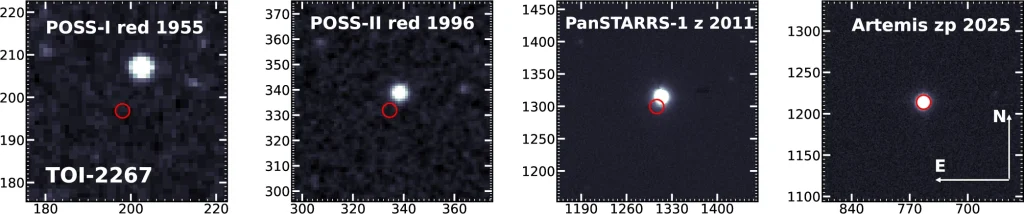
High-resolution imaging also revealed that TOI-2267 is a pair of red dwarfs, not a single star. That made the analysis more complicated. Scientists had to determine which star the planets orbit. Current evidence suggests that the two confirmed planets likely orbit the larger star, TOI-2267A, while the possible third planet orbits the smaller one.
Related Reading
NASA’s James Webb Telescope made history by capturing real weather patterns on a planet 400 light years away, revealing heat flow, storms, and winds in stunning detail.
Read the Full StoryCould Any of These Planets Support Life?
The planets of TOI-2267 are close to their stars, completing orbits in just a few days. That makes them “warm” Earth-sized planets, not habitable ones. Their short orbits mean they receive far more radiation than Earth does from the Sun. Any atmosphere they might have would face strong stellar winds and high temperatures.
Still, their discovery is important for the search for life. Studying how these planets formed and how their atmospheres behave can help scientists understand what makes a planet habitable. The stars are red dwarfs, which are smaller and cooler than the Sun. These stars are common across the galaxy, so learning about their planets can show us where else life might be possible.
Future missions like the James Webb Space Telescope (JWST) may target TOI-2267 to study the planets’ atmospheres. Webb can analyze the starlight that passes through a planet’s atmosphere during a transit. That data can reveal what gases are present, such as carbon dioxide or water vapor, giving clues about the planet’s chemistry and history.

Who This Discovery Affects and What’s Next
This discovery has several ripple effects across the world of science and education.
For astronomers, TOI-2267 offers a rare example of how small planets form in difficult environments. It helps refine models of planet evolution in multi-star systems.
For astrobiologists, the system provides a way to study how radiation and gravitational forces shape a planet’s surface and potential for life.
For students and the general public, it’s a reminder that space is full of surprises. Even a simple pair of faint red stars can host worlds similar in size to our own. And at only 22 light-years away, these planets are practically next door in cosmic terms.
“This system is a true natural laboratory for understanding how rocky planets can emerge and survive under extreme dynamical conditions, where we previously thought their stability would be compromised,” said Pozuelos.
Researchers will continue observing the system with larger telescopes. If they confirm the third planet, TOI-2267 will become the first known binary system where both stars have transiting planets. That would make it an essential target for long-term study and one of the best opportunities to understand how planets evolve under the influence of two suns.
A Small Step Toward Understanding the Universe Next Door
Discoveries like this bring humanity closer to understanding our place in the galaxy. The TOI-2267 system shows that planets can form in almost any kind of environment, even between two stars locked in a close orbit. It expands the range of places where scientists might one day search for habitable worlds.
For now, these new Earth-sized planets remind us how small our solar system is compared to the vast number of systems around us. Each discovery adds another piece to the puzzle of how the universe builds planets, stars, and possibly even life itself.
The next time you look at the night sky, remember that just a few light-years away, two small suns shine on their own set of Earth-sized worlds. The universe, it seems, still has plenty of surprises waiting to be found.
FAQs
Astronomers used NASA’s Transiting Exoplanet Survey Satellite (TESS) to detect small dips in starlight caused by planets passing in front of their stars. They then confirmed these findings with powerful ground-based telescopes like SAINT-EX, TRAPPIST-North, and the Gran Telescopio Canarias. This combination of space and ground data allowed scientists to verify that the signals came from real planets, not background stars or data noise.
The TOI-2267 system challenges old ideas about planet formation in binary star systems. It shows that Earth-sized planets can exist even where strong gravitational forces make formation unlikely. This discovery helps scientists refine models of how planets form and points to new targets for the James Webb Space Telescope to study atmospheres and potential habitability.
Not yet. The planets orbit very close to their stars and are much warmer than Earth, making them unsuitable for life as we know it. However, studying these planets helps scientists understand how atmospheres behave under extreme conditions. These insights are key to identifying which nearby exoplanets could host life in the future.