Andrew Wiles Worked in Secret for Seven Years to Prove Fermat's Last Theorem
Andrew Wiles spent seven secret years proving Fermat's Last Theorem, then overcame a devastating gap to complete the historic proof.

When Andrew Wiles was ten years old, he found a book in a Cambridge library that described Fermat's Last Theorem.
The problem looked simple enough for a child to understand and had resisted proof for more than three centuries.
Decades later, Wiles returned to it in secret.
For roughly seven years, he worked alone in his attic, telling almost no one what he was trying to prove. In 1993, he announced a solution—then discovered a serious gap.
The final repair took another year and produced one of the most celebrated proofs in modern mathematics.
The Problem Fermat Left in a Margin
Pierre de Fermat wrote his famous claim around 1637.
The equation is:
xⁿ + yⁿ = zⁿ
For n = 2, whole-number solutions exist. The familiar example is 3² + 4² = 5².
Fermat claimed that no positive whole-number solutions exist when n is greater than 2.
He added that he had a “marvelous proof,” but the margin was too small to contain it.
No proof was found among his papers.
Why the Theorem Survived for Centuries
The statement uses elementary notation, but proving it requires control over infinitely many possible exponents and numbers.
Mathematicians solved special cases one by one. Their efforts created new techniques in algebra and number theory, yet the general theorem remained open.
The problem became famous because the entrance was simple and the interior was deep.
1637
Approximate year Fermat wrote the claim
350+ years
Time the general proof remained open
7 years
Wiles's period of secret work
1994
Year the corrected proof was completed
Source: Oxford, Princeton and historical accounts
Seven Years of Work in Secret
Wiles had already become a leading number theorist when a major development made Fermat's theorem approachable through a different route.
The Taniyama–Shimura conjecture connected elliptic curves with modular forms. Mathematicians realized that proving enough of this connection would imply Fermat's Last Theorem.
Wiles decided to attempt it.
He withdrew from most conferences and reduced the number of new projects that might expose his direction. Only his wife knew the full goal.
Secrecy protected him from distraction and allowed him to develop ideas before public scrutiny.
The Announcement in Cambridge
In June 1993, Wiles delivered three lectures at the Isaac Newton Institute in Cambridge.
He did not reveal the destination at the beginning. The final lecture ended with the statement that Fermat's Last Theorem followed from his work.
The room erupted.
A childhood obsession had apparently become a proof.
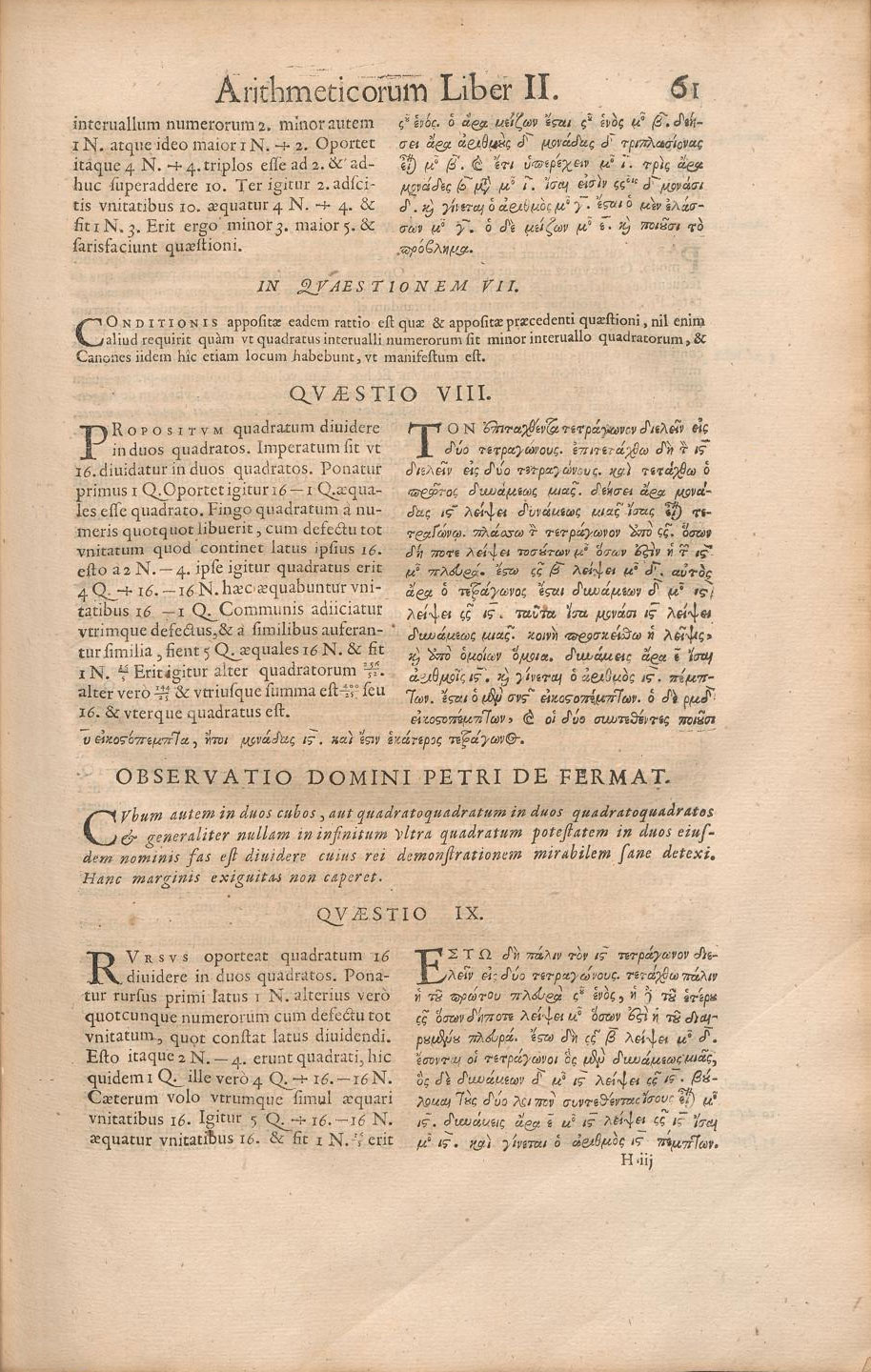
Fermat's claim became famous through a note written beside a problem in Diophantus's Arithmetica. Source: Wikimedia Commons.
The Gap That Threatened the Proof
Peer review found a problem in a crucial part of the argument.
The gap was not a small typographical mistake. A method needed to justify one stage of the proof did not work as claimed.
Wiles returned to isolation.
For months, he and Richard Taylor tried to repair the argument. The pressure was intense because the proof had already become international news.
In September 1994, Wiles recognized that an earlier approach he had abandoned could be combined with the newer framework.
The repair worked.
Why the Proof Was Bigger Than Fermat's Equation
Wiles did not prove the theorem by manipulating Fermat's equation directly.
He established a major case of the modularity conjecture for semistable elliptic curves. Earlier work had shown that this result would force Fermat's Last Theorem to be true.
The route connected areas that once seemed separate:
- whole-number equations,
- elliptic curves,
- modular forms,
- and representations in number theory.
That bridge became more important than the original puzzle alone.
Recognition After the Proof
Wiles received many of mathematics' highest honors.
He was knighted in 2000 and received the Abel Prize in 2016.
The University of Oxford and the Royal Society identify him as one of the central figures in modern number theory.
Around age 10
Discovers the theorem in a library book
1986
Begins a secret effort after a breakthrough links the problem to elliptic curves
June 1993
Announces a proof in Cambridge
1993–1994
Works to repair a serious gap
1994
Completes the corrected proof
What Andrew Wiles's Story Teaches About Obsession
Wiles spent years working privately on a problem that had defeated generations.
The public triumph lasted a moment. The real story includes the isolation, the gap, and the willingness to return to a proof after the celebration had already begun.
His achievement shows that persistence in mathematics is not simply refusing to stop.
It is the ability to abandon a method, preserve what remains useful, and recognize when two incomplete ideas can repair one another.
Fermat's margin created the legend.
Wiles's patience created the proof.
Featured image: Sir Andrew Wiles, via the Royal Society.
The weekly question
From obsession to clarity — one original question every week.
We answer one noisy topic at a time, in full. No daily roundup, no thread bait — just the question, the principles, and the system.