Alexis Lemaire Found the 13th Root of a 200-Digit Number in 70 Seconds
French computer scientist Alexis Lemaire mentally extracted the 13th root of a 200-digit number in just 70.2 seconds.
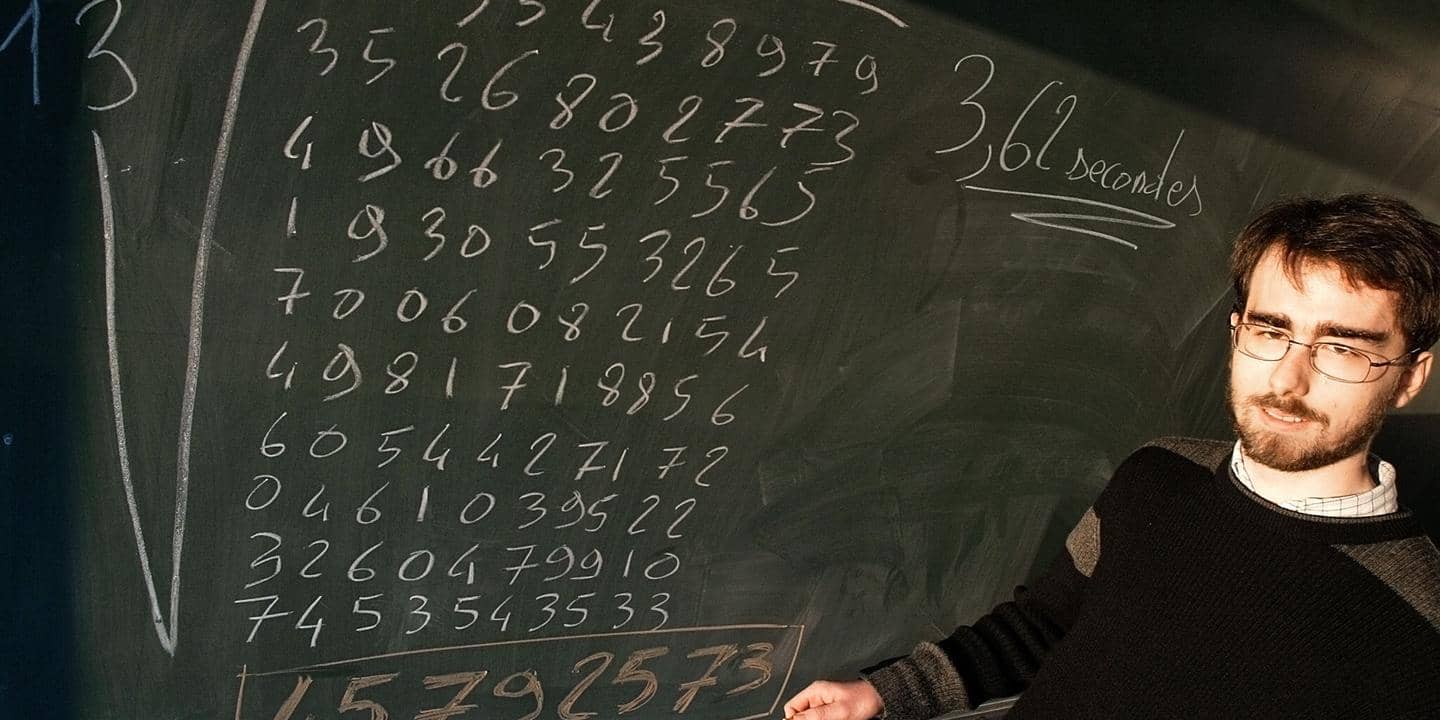
In December 2007, French computer scientist Alexis Lemaire was given a randomly generated 200-digit number.
Without using a calculator, he identified its 13th root in 70.2 seconds.
The answer was a 16-digit number. Multiplied by itself 13 times, it produced the enormous number he had been shown.
Lemaire's performance turned an obscure mathematical challenge into a dramatic demonstration of what trained mental calculation can do.
What Does a 13th Root of a 200-Digit Number Mean?
A 13th root reverses repeated multiplication.
If a number is multiplied by itself 13 times, the result is its 13th power. The challenge is to start with that enormous result and work backward to the original number.
For a 200-digit perfect 13th power, the hidden root is typically a 16-digit number.
The size of the input makes the feat look impossible. But the challenge is not the same as searching every possible 16-digit number one at a time.
An elite calculator uses mathematical properties, modular patterns, estimation, and a highly practiced internal method to narrow the possibilities.
200
Digits in the given number
13th
Root calculated mentally
70.2 sec
Record time in 2007
Source: Science Museum reporting, Le Monde and MathWorld
The 70.2-Second Calculation in London
Lemaire completed the 70.2-second performance at London's Science Museum.
A computer generated a 200-digit number that was known to be a perfect 13th power. Lemaire studied the number, calculated mentally, and announced the correct 16-digit root.
Contemporary reporting emphasized the scale of the search space. The correct answer sat among hundreds of trillions of possible 16-digit values.
The achievement was not a lucky guess. Lemaire had spent years building and refining a specialized calculation system.
How His Record Developed Over Time
Lemaire did not begin with a 200-digit number in 70 seconds.
In May 2002, he calculated the 13th root of a 100-digit number in 13.55 seconds.
He later moved to the harder 200-digit category. In April 2005, a witnessed attempt in Paris took about 4 minutes and 28 seconds.
Lemaire's 2005 performance was reported by Le Monde, which described him as a computer science student at the University of Reims.
By 2007, he had reduced the time dramatically.
May 2002
Calculates a 100-digit 13th root in 13.55 seconds
April 2005
Solves a 200-digit challenge in about 4 minutes 28 seconds
July 2007
Reduces the 200-digit time to under 78 seconds
December 2007
Reaches 70.2 seconds in London
The timeline shows deliberate specialization. Each attempt was a test of the same narrow skill, refined through repetition.
Why the Challenge Is Hard to Standardize
Mental-calculation records depend on exact rules.
The input must be randomly generated. It must be a perfect 13th power. The calculator needs a fair way to view the number, and the time must include clearly defined stages.
Wolfram MathWorld notes that Guinness stopped maintaining a 13th-root category because of difficulties standardizing the task.
That does not erase Lemaire's performances. It means record claims should identify the rules, witnesses, and context rather than relying only on a headline.
The best-documented accounts describe staged public attempts with mathematical observers and generated inputs.
The Computer Scientist Behind the Mental Calculator
Lemaire studied computer science and later completed doctoral work related to artificial intelligence.
That background makes his obsession especially interesting.
Computers can solve the same numerical problem almost instantly. Lemaire was not trying to prove that the unaided brain was a more efficient general-purpose machine.
He was exploring how far a human could optimize one demanding cognitive process.
His work sat between mathematics, memory, pattern recognition, and algorithmic thinking.

Mental calculation competitions test speed, accuracy, and the ability to perform under pressure. Source: Wikimedia Commons.
A practiced mental calculator does not approach every number from scratch. Training builds internal shortcuts and retrieval structures, much as software uses optimized procedures.
Was It Memory or Mathematics?
The answer is both.
Lemaire needed mathematical insight to reduce the problem. He also needed memory to retain intermediate results, recognize numerical patterns, and execute his method without losing track.
Working memory is especially important because each partial result must remain available while the next operation is performed.
Long-term practice also converts slow steps into familiar routines.
That is why mental calculation is not simply “being good at arithmetic.” At the highest level, it becomes a performance skill built from strategy, recall, attention, and speed.
What Alexis Lemaire's Story Teaches About Expertise
Alexis Lemaire became famous for answering one extremely specific question:
What 16-digit number, multiplied by itself 13 times, produced the 200-digit number in front of him?
He trained until he could answer in just over a minute.
The achievement illustrates how expertise grows. A difficult task is analyzed. Useful patterns are isolated. A repeatable method is built. Practice removes hesitation.
Most people will never mentally extract a 13th root from a 200-digit number.
But the broader lesson applies far beyond arithmetic: remarkable speed often comes from years spent making the hidden structure of a problem familiar.
Featured image: Alexis Lemaire presenting a mental-calculation result, via Le Monde.
The weekly question
From obsession to clarity — one original question every week.
We answer one noisy topic at a time, in full. No daily roundup, no thread bait — just the question, the principles, and the system.