
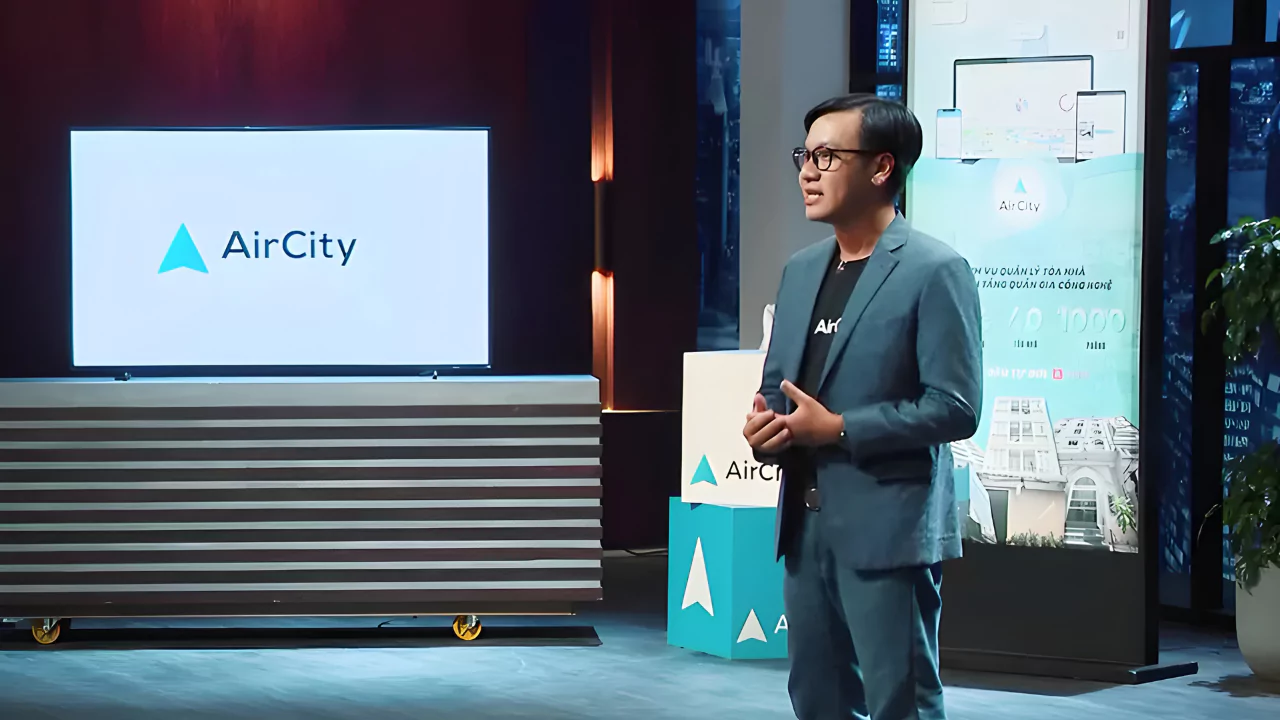
In 2021, two young entrepreneurs from Vietnam, Lê Hoàng Nhật and Lê Xuân Vũ, entered the Shark Tank Vietnam stage with a futuristic idea. Their startup, AirCity, aimed to automate the entire rental management process using artificial intelligence and IoT technology. From facial recognition access to automated invoicing, the founders pitched a full-stack platform that promised to reduce property management costs by up to 50%.
At the time, they managed around 500 apartments across 40 buildings. They asked for $100,000 in exchange for 2% equity, which placed their startup valuation at a bold $5 million. The sharks were skeptical. In the end, they closed a deal with Shark Phạm Thanh Hưng for $100,000, but gave up 10% equity. This marked an 80% drop in their proposed valuation.
Today, AirCity has scaled to over 2,000 units across five major Vietnamese cities and has set its sights on an even bigger goal: managing 100,000 properties across Southeast Asia by 2026. But can they actually do it? Let’s explore AirCity’s journey, the technology powering it, its financial reality, and whether this Vietnamese startup can become a smart city powerhouse.
What Is AirCity?
AirCity is a Vietnam-based proptech startup designed to fully automate the management of rental properties. Unlike traditional real estate software that assists landlords with listings and basic communication, AirCity goes several steps further by integrating artificial intelligence, machine learning, and connected devices to take over day-to-day operations.
The system handles tenant check-ins and check-outs, contract signing, rent collection through VietQR, and even property access using facial recognition technology. In many properties, tenants can enter their apartments without ever speaking to a manager. Security systems are automated through license-plate recognition and AI-powered surveillance. Maintenance requests are submitted and tracked through an app, reducing delays and communication gaps. The result is a seamless experience for both landlords and tenants, requiring little to no human intervention in most operations.
What Happened on Shark Tank Vietnam?
AirCity’s appearance on Shark Tank Vietnam Season 5 was a turning point. Their ask was bold: $100,000 for just 2% equity, implying a $5 million valuation. Shark Phạm Thanh Hưng saw potential but wasn’t convinced of the valuation. He made a counteroffer of $100,000 for 10%, and the founders accepted. While the valuation drop may have appeared damaging, the exposure and strategic partnership were worth far more.
The national broadcast allowed AirCity to showcase its product to a broad audience, including property owners, developers, and potential partners. The deal with Hưng brought not just funding but also real estate expertise, connections, and credibility. These were exactly what a tech startup in this industry needed.
Growth Since Shark Tank: From 500 to 2,000+ Units
At the time of their pitch, AirCity managed 500 serviced apartments. By mid-2025, they are managing more than 2,000 apartments across 60 properties. They now operate in five Vietnamese cities: Hanoi, Ho Chi Minh City, Da Nang, Can Tho, and Hai Phong.
The growth wasn’t just in unit numbers. Their tenant base has also expanded to more than 3,000 active residents. Despite the scale, their employee count remains lean at just 34 people. This is due to the company’s emphasis on automation. In 2024, they introduced AirCity Insights, a dashboard that provides real-time data for landlords. It covers occupancy rates, rent collections, service response times, and more. This helped attract larger developers who wanted deeper analytics and decision-making tools.
Their expansion has been driven by strategic integration of new features, continuous improvements in user experience, and clear communication with both landlords and tenants.
What Is AirCity’s Net Worth and Valuation Today?
AirCity’s early funding came from Antler Singapore, which provided $85,000 for 12% equity. This placed their valuation just below $700,000 at the pre-seed stage. The Shark Tank deal raised that to $1 million post-money. In 2023, they secured follow-on investments led by Sopoong Ventures, a Korean climate-tech fund, along with VSV Capital and several angel investors.
Although the exact funding amounts were not made public, reports and investor profiles have estimated AirCity’s valuation to be between $3 million and $5 million as of 2025. This is based on their growing footprint, tech partnerships, and increasing monthly recurring revenue from SaaS subscriptions and service fees.
Revenue estimates have not been officially confirmed, but with over 2,000 units and tiered software plans, AirCity is likely generating a steady income stream through monthly service fees, hardware sales, and data analytics solutions. Their selection for the Vietnam Smart City Award 2023 also boosted their standing and visibility.
Key Partnerships and Ecosystem Support
One of AirCity’s biggest strengths is its ecosystem. In its early days, Antler Singapore provided startup mentorship and connections to global tech communities. Later, Sopoong Ventures aligned with AirCity’s mission of sustainability and smart urban living.
The company also partnered with HANET, a leading Vietnamese AI camera company, to provide facial recognition access systems. These are integrated into buildings and replace traditional keys or passcodes. Another key partner is WingArc1st, a Japanese data visualization company whose business intelligence tools now power the AirCity Insights dashboard.
AirCity was also selected for Google for Startups’ Southeast Asia program, receiving mentorship and platform support to scale their cloud infrastructure and user base. These alliances have given AirCity a level of technological robustness and industry recognition that few early-stage startups achieve.
How Does AirCity Make Money?
AirCity runs a hybrid SaaS and services model. They charge landlords a monthly subscription fee per unit, which covers software access, data dashboards, and support. For example, a property with 100 units pays a recurring monthly fee for access to the system. There are also additional costs for hardware such as smart locks and surveillance cameras.
They also earn a commission on collected rent payments processed through their system. This performance-based model ensures AirCity’s growth is aligned with the landlord’s success. Additional services like on-demand maintenance, cleaning, or legal contracts add to their revenue streams.
The business model is scalable, predictable, and deeply integrated into property operations, making it difficult to replace once installed.
The Founders Behind the Vision
Lê Hoàng Nhật, the CEO, previously attempted to build a SaaS platform for property owners but failed due to limited user adoption. This experience taught him that landlords don’t just need tools. They need outcomes. His insight was that full automation, rather than manual management with digital help, was the real solution.
Lê Xuân Vũ, the CTO, is an engineer with a background in embedded systems and hardware-software integration. He built the core IoT architecture that powers AirCity’s physical automation layer. Together, they bring a strong balance of business strategy and technical capability.
Their vision goes beyond solving today’s rental management problems. They aim to reimagine what residential life looks like in future smart cities.
What Makes AirCity Different?
AirCity’s competitors typically offer property listing platforms or CRM-style landlord software. AirCity stands out because it removes the need for traditional property managers entirely. Its AI handles check-ins, access control, maintenance, and rent collection without requiring staff on-site.
In many properties under their management, tenants never interact with a human manager. Contracts are digital, rent is paid by scanning a QR code, and access is granted via face recognition. Problems like leaks or power outages are logged through an app and routed to service providers automatically. Landlords are notified through dashboards and can monitor building performance remotely.
This hands-free model, combined with AirCity’s real-time analytics tools, creates a powerful offering that is especially attractive in a fast-growing, tech-forward market like Vietnam.
Can They Really Reach 100,000 Homes by 2026?
Scaling from 2,000 to 100,000 units in just two years is incredibly ambitious. It would require a compound monthly growth rate of nearly 20% and expansion beyond Vietnam. However, AirCity believes this goal is achievable with the right funding and partnerships.
Several factors are working in their favor. Vietnam is actively promoting smart city initiatives. Urbanization is accelerating, and landlords are increasingly looking for solutions that reduce overhead and improve tenant experiences. With backing from tech investors and strategic hardware partnerships, AirCity is in a strong position to scale rapidly. This is especially true if it partners with large developers or government projects in the region.
That said, they face challenges as well. Scaling hardware installations across borders is complex. Competition from global proptech companies entering Southeast Asia could pressure margins. The company will also need to prove it can remain profitable while scaling.
Still, if AirCity maintains its current pace and continues innovating, 100,000 units might not be a fantasy. It could be the beginning of a regional transformation.
Final Thoughts: A True Smart City Contender?
AirCity started with a bold idea and a tough Shark Tank deal. But instead of giving up, the founders used that moment to fuel their growth. They scaled efficiently, proved their model, and built a smart rental ecosystem that aligns with the future of urban living.
Today, they are no longer a scrappy startup fighting for attention. They are a rising force in Vietnam’s smart city movement. Whether or not they hit the 100,000-unit mark, AirCity is already redefining what it means to manage properties in a digital world, and that is a win worth celebrating.
TL;DR (Too Long; Didn’t Read)
Vietnamese proptech startup AirCity is on a mission to automate 100,000 rental units by 2026 using AI and IoT. After a Shark Tank deal in 2021, it has scaled to over 2,000 smart apartments and is now a serious contender in Southeast Asia’s smart city race.
FAQs
Is AirCity still active in 2025?
Yes, AirCity is active and growing in 2025, managing over 2,000 apartments across five major cities in Vietnam.
Did AirCity get a deal on Shark Tank Vietnam?
Yes, AirCity secured a deal with Shark Phạm Thanh Hưng for $100,000 in exchange for 10% equity during Season 5 of Shark Tank Vietnam.
What is AirCity’s estimated net worth in 2025?
As of 2025, AirCity’s estimated valuation ranges between $3 million and $5 million based on growth, partnerships, and investment rounds.
What does AirCity do?
AirCity is a Vietnamese proptech startup that automates property management using AI and IoT. It handles tasks like tenant check-ins, security, invoicing, and maintenance.
Can AirCity really manage 100,000 homes by 2026?
AirCity has set a goal to manage 100,000 homes across Southeast Asia by 2026. While ambitious, this target depends on continued growth, partnerships, and funding.
Where does AirCity operate?
AirCity currently operates in five cities in Vietnam: Hanoi, Ho Chi Minh City, Da Nang, Can Tho, and Hai Phong.
How does AirCity make money?
AirCity earns revenue through monthly SaaS subscription fees, hardware installation services, and performance-based commissions on rent collections.
Who are AirCity’s investors?
AirCity has received investment from Antler Singapore, Sopoong Ventures, VSV Capital, and multiple angel investors.