15-Year-Old Girl Builds Flashlight That Works Without Batteries
How Ann Makosinski Lit Up the World with Her Body-Heat-Powered Invention
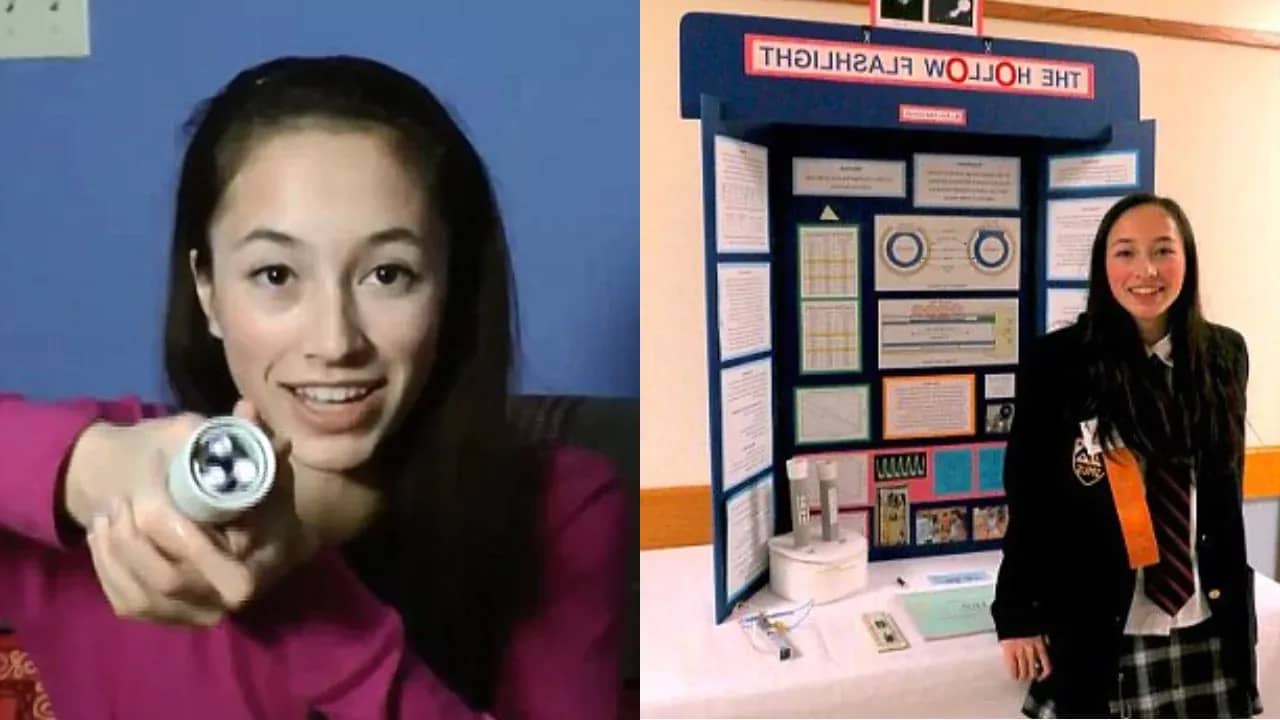
Imagine picking up a flashlight and watching it turn on, not because you flipped a switch or charged it overnight, but because your hand is warm. It sounds like something from a sci-fi movie, but it’s a real invention created by a high school student. No batteries, no cords, no solar power, just body heat.
This groundbreaking flashlight was built by Ann Makosinski, a 15-year-old student from Victoria, British Columbia, Canada. Her creation, called the Hollow Flashlight, stunned judges at the 2013 Google Science Fair and later amazed millions around the world. What started as a simple science fair project turned into a viral success story and a real solution for people who live without steady access to electricity.
Fast Facts
- Project: Hollow Flashlight powered by body heat
- Inventor: Ann Makosinski, 15-year-old Canadian student
- Goal: Create a flashlight that works without batteries or external power
- Viral Moment: Finalist at the 2013 Google Science Fair
- Platform Buzz: Featured on YouTube, CBC, and TEDx Talks
The Invention That Went Viral
Ann didn’t set out to go viral. She was simply trying to solve a problem she deeply cared about. One of her close friends in the Philippines often struggled to study at night because her family couldn’t afford electricity. This inspired Ann to ask herself: What if light could come from something we always have: our own bodies?
She entered her flashlight into the Google Science Fair, an international competition that invites students from around the world to showcase creative science projects. Out of thousands of entries, Ann stood out and became the only finalist from Canada that year. Her project was posted in a YouTube video through the official Google Science Fair channel in April 2013.
Things really took off when the media noticed her invention. On June 27, 2013, Google announced her as a finalist, and the next day, CBC News ran a story titled “Body-heat powered flashlight takes teen to Google Science Fair.” Shortly after, Daily Mail, Mashable, and other media outlets across the globe picked up the story. Even years later, social media accounts like @UberFacts and @WomenWhoCode continued sharing her flashlight, proving how much her idea stuck with people over time.
People couldn’t believe a flashlight could work just from your hand. But it did, and it worked for over 20 minutes.
How Does the Flashlight Actually Work?
Ann’s flashlight works by using something called thermoelectric energy. More specifically, it uses Peltier tiles, which are thin, flat components that produce electricity when one side is heated and the other is kept cool.. This energy is small, but it’s enough to power an LED light.
Here’s how she put it all together. Ann used a metal aluminum tube as the center of her flashlight. This material conducts heat well, but it also allows air to flow inside, keeping the inner part cool. She then placed Peltier tiles on the outside of the tube, where your hand would grip the flashlight. As your warm hand heats up one side and cool air passes through the hollow inside, the temperature difference creates a flow of electricity.
However, there was a challenge. The voltage from the Peltier tiles wasn’t strong enough to power an LED by itself. So Ann designed and built a custom transformer and circuit that could boost the voltage. She learned how to do this by reading energy harvesting articles online and experimenting with her own designs. To finish the build, she added PVC casing and foam insulation to improve the flashlight’s grip and keep the temperature difference stable.
The final result was a flashlight that could run for over 20 minutes using nothing but the heat from a person’s hand. And the best part? It only cost around $26 to build.
Who Is Ann Makosinski?
Ann Makosinski wasn’t your average high schooler. From an early age, she had a strong interest in science, building, and problem-solving. Born in 1997 to a Filipino mother and Polish father, she grew up in Saanich, a district on Vancouver Island in British Columbia, Canada. Her curiosity started young. When she was just a child, she played with her father’s box of old transistors. By the time she was 9, she had already learned to solder circuits.
Before inventing the Hollow Flashlight, Ann had already built a candle-powered radio for a 7th-grade science fair and later created a piezoelectric flashlight in 9th grade. These early projects show just how dedicated she was to exploring new ways to create energy.
Today, Ann is much more than a student inventor. Now in her late 20s, she is a public speaker, entrepreneur, and media host. She founded Makotronics Enterprises, a company dedicated to sustainable innovation. She is also writing a book titled The Inventing Mindset, which is set to be released in Spring 2025 by Knopf Canada.
You can learn more about her through her personal website, or follow her on Instagram and LinkedIn. Her story continues to inspire young creators around the world.
Why People Loved Her Invention
The Hollow Flashlight wasn’t just smart; it was meaningful. One reason it captured the world’s attention is because it tackled a real, global problem. Many people in developing countries don’t have access to consistent electricity. For students in those areas, something as simple as a flashlight can mean the difference between doing homework or falling behind in school. Ann’s invention offered a clean, affordable, and battery-free way to light the dark.
Her flashlight also stood out for its simplicity. Anyone could understand the concept: warm your hand, light turns on. And yet, it required deep thinking and precise engineering to make it work. People were amazed that someone so young could build such a powerful and practical tool.
Online reactions were full of admiration. On websites like New Atlas and social media platforms like X (formerly Twitter), users praised her intelligence, creativity, and environmental awareness. One comment read, “A very simple but original thought on your part for a device that will likely be commonplace in a decade.” Another said, “She’s smarter than most engineers I know.”
Her story wasn’t just about science. It was about hope, compassion, and curiosity.
Ann’s Journey: From School Project to Global Stage
Ann’s journey is like something from a movie. She started as a regular student, curious about energy and technology. She had no team, no lab, and no big budget. All she had was a question, a goal, and the will to learn.
She began building the flashlight on her own, experimenting in her home using materials she found online and in her father’s workshop. After submitting her project to the Google Science Fair, her life changed overnight. From that point on, her work spread across the internet and news media. She won the 15–16 age category at the fair and gained international recognition.
Since then, Ann has delivered five TEDx Talks, spoken at global events like the G7 and Y20 Summits, and was featured in Forbes’ 30 Under 30 and Time’s top young inventors list. Her story proves that you don’t need to wait until you’re older or have a degree to create something meaningful.
View this post on Instagram
What’s She Doing Now?
Ann didn’t stop with the Hollow Flashlight. In 2018, she invented the eDrink mug, a cup that uses the heat from your hot drink to charge small devices like smartphones. This invention was so impressive it earned her a spot on The Tonight Show with Jimmy Fallon, where she demonstrated how it worked in front of a national audience.
She also received a $50,000 clean-energy grant to continue her work on sustainable devices. Later, she became a brand ambassador for Maybelline’s Green Edition makeup line, helping connect science with creativity.
Today, Ann continues to inspire and educate. She is currently writing The Inventing Mindset, a book that will share her creative process and encourage others to invent boldly. She is also working on new projects, including green-energy toys for kids and even a headlamp powered by body heat, much like her flashlight.
Can You Build a Flashlight Like This?
The Hollow Flashlight is not something you can build overnight, but with some effort and the right tools, it’s definitely possible for students and hobbyists to create something similar.
Ann’s design involved real electrical work, such as soldering circuits and building voltage transformers, so beginners may need to study a bit first. However, there are lots of websites with tutorials to help you learn. Sites like SparkFun, Adafruit, and Instructables offer step-by-step guides on working with Peltier tiles, LEDs, and thermoelectric energy.
Ann herself learned by reading online articles and testing things out at home. Her message is clear: you don’t need fancy tools or lots of money to invent something. What you need is a good idea and the courage to try.
What One Idea Can Do
Ann Makosinski’s flashlight did more than just light up a room. It lit up possibilities. It showed what one person, one young student, can do with curiosity and a little determination.
Her invention gave people hope for a greener, brighter future. It encouraged kids to look at the world around them and ask, “What if I built something better?” And it reminded adults that smart solutions don’t always come from big labs. They can come from someone holding a soldering iron in their bedroom.
So if you’re ever holding a flashlight, imagine one that glows just from your touch. Then ask yourself: What could I build that the world needs next?
If Ann’s story inspired you, don’t keep it to yourself. Share it with a teacher, a friend, or someone who loves science and innovation. You never know. Your share might spark the next big idea.
Let’s light up the world, one hand-held invention at a time.
The weekly question
From obsession to clarity — one original question every week.
We answer one noisy topic at a time, in full. No daily roundup, no thread bait — just the question, the principles, and the system.