
Wurkin Stiffs After Shark Tank: The Deal That Never Closed
Jonathan Boos accepted a $100,000 offer, but it never closed. Here is what happened to Wurkin Stiffs and what its current product range shows.

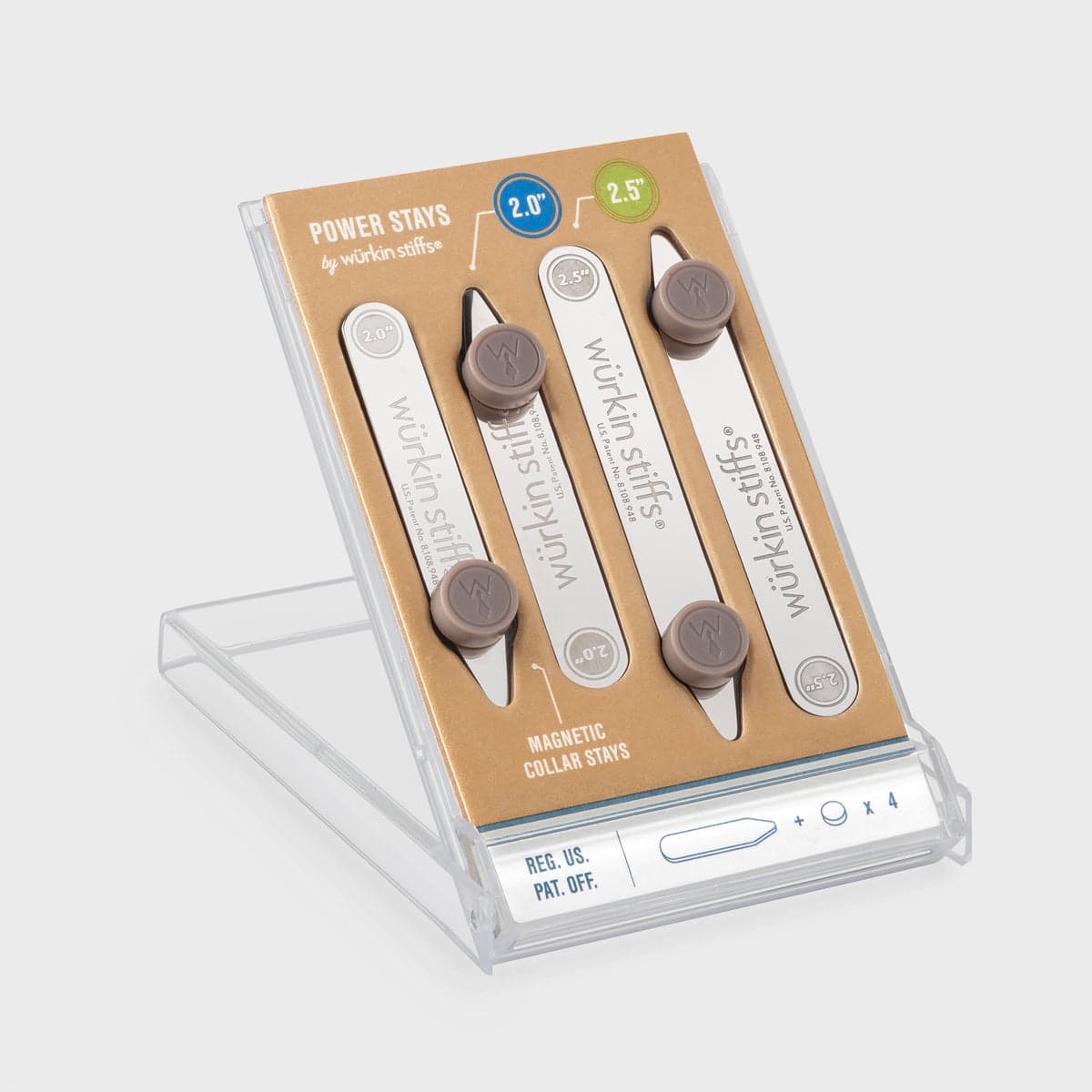
A shirt can fit well and still look untidy when its collar curls away from the neck. Jonathan Boos built Wurkin Stiffs around that small frustration. His magnetic collar stays aimed to hold the collar where the wearer wanted it, without adding a visible button.
The idea was simple enough to demonstrate in seconds. Building a business around it required a different set of decisions: which stores to approach, how many versions to make, and whether a larger partner should license the product. Those questions became central after Boos appeared on Shark Tank.
Viewers saw Barbara Corcoran and Daymond John agree to invest. Years later, Boos explained that the agreement never closed. Wurkin Stiffs nevertheless continued selling accessories, making its story more interesting than the familiar claim that a Shark investment created a valuable company.
Here is what the evidence establishes about the product, the televised offer, the business afterward and the current buying options. It also explains why a pitch valuation should not become a present-day net-worth estimate.
Wurkin Stiffs after Shark Tank: Quick Answer
If you are short on time, Wurkin Stiffs accepted a Shark Tank offer but did not receive that investment. Jonathan Boos asked for $85,000 for 10% and accepted $100,000 for 40% from Barbara Corcoran and Daymond John.
Boos later said a disagreement over licensing prevented the deal from closing. He continued building the company outside that agreement. The distinction matters: an accepted television offer is evidence of a negotiation, while a completed investment requires separate confirmation.
Current status: Wurkin Stiffs maintains an official online shop with metal and plastic magnetic collar stays, polo options, replacement magnets and accessories. Product listings are visible, but current revenue, profit and company value have not been independently established.
Product snapshot
| Detail | Verified background |
|---|---|
| Company | Wurkin Stiffs |
| Founder | Jonathan Boos |
| Product | Magnetic collar stays and clothing accessories |
| Category | Apparel accessories |
| Appearance | Season 2, Episode 1; March 20, 2011 |
| Current evidence | Official shop and product listings remain available |
What are Wurkin Stiffs, and who created them?
Wurkin Stiffs sells accessories designed to control the shape and position of a shirt collar. Ordinary collar stays stiffen the fabric. A magnetic stay also works with a small magnet to help hold that fabric in position.
The intended customer is someone who wants a neat collar without changing the shirt itself. Compatibility matters. Shirts with collar-stay pockets take a different approach from polos and other collars without those pockets.
The company’s history says Jonathan and his wife Amie began selling to men’s specialty shops in 2006. Their early work involved introducing a small, unfamiliar accessory to shop owners who could demonstrate it to customers.
That origin helps explain the business’s emphasis on retail. A shopper may understand the collar problem immediately after seeing the product used, even if they would never have searched for a magnetic solution.
The same history dates a Nordstrom relationship to 2009 and describes later plastic and polo variations. These are company-reported milestones. They establish the brand’s account of its development, rather than an independently audited measure of its size.
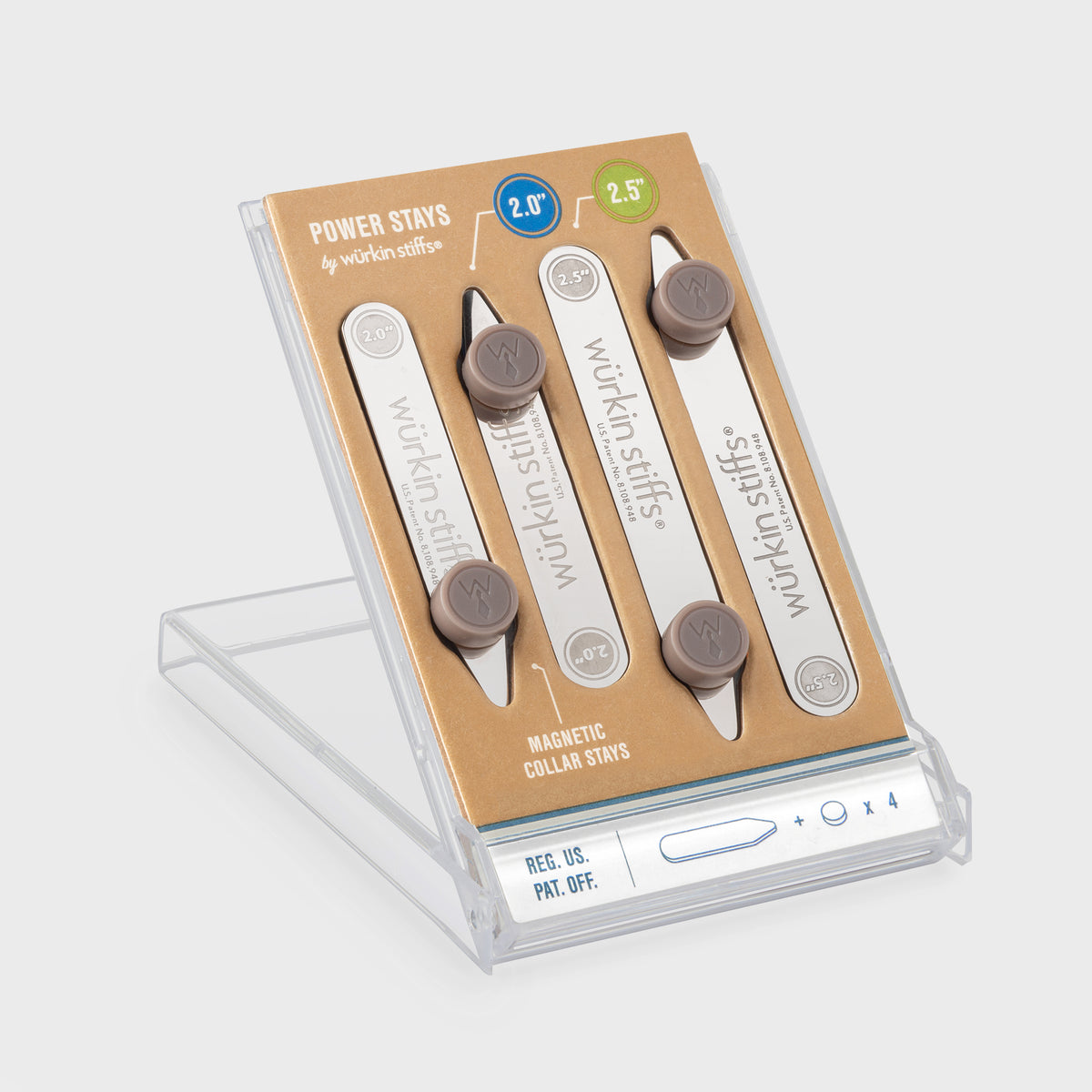
The two-pair Power Stays product. Photo: Wurkin Stiffs.
Why different collar types matter
A single accessory design does not necessarily suit every shirt. The company’s range separates metal stays, plastic stays and options for collars without conventional pockets. The useful buying question is therefore which version fits the garment.
For the business, that creates opportunities to offer different formats and bundles. It also creates a need for clear product instructions. More choice only helps when customers can identify what they need.
What happened to Wurkin Stiffs on Shark Tank?
Boos appeared in the opening broadcast episode of Shark Tank USA Season 2. He sought $85,000 for 10% and accepted a larger amount of cash in exchange for a much larger ownership stake.
The televised negotiation
| Deal detail | On-air terms |
|---|---|
| Original ask | $85,000 for 10% |
| Accepted offer | $100,000 for 40% |
| Sharks | Barbara Corcoran and Daymond John |
| Implied value at the ask | $850,000 |
| Implied value at the accepted offer | $250,000 |
| Post-show funding | The accepted deal did not close |
The two implied values come from dividing the proposed investment by the proposed ownership percentage. They describe the negotiation at that moment. Neither establishes what the company is worth today.
The offer also shows why an investment cannot be judged only by its cash amount. Boos would have received $15,000 more than he requested while giving up substantially more ownership. Whether that trade was worthwhile depended on the help the partners could provide and the strategy they could agree on.
In a later founder interview, Boos explained that he wanted operational support. He said John favored licensing, while he was not ready to take that route.
A similar distinction appears in Tippi Toes’ Season 2 story: a televised agreement did not become the final business arrangement.
How does Wurkin Stiffs make money?
Wurkin Stiffs sells physical accessories, individually and in sets. Its website also provides wholesale and corporate-gift channels. Those routes reach different buyers: an individual replacing collar stays, a shop stocking accessories, or a business ordering gifts.
Business model and practical constraints
| Element | How it applies |
|---|---|
| Customer need | Keep a collar in the desired position |
| Main offer | Magnetic stays and related clothing accessories |
| Sales channels | Direct website, wholesale enquiries and corporate gifts |
| Expansion opportunity | Different collar formats, sets and replacement components |
| Operating challenge | Explain compatibility and hold useful stock across variations |
| Financial limitation | Public evidence does not establish margins or current profit |
The small size of the product can make it suitable for an accessory purchase or a gift. That is a business-model observation, not proof of low shipping costs or high margins. Packaging, customer acquisition, returns and retailer terms still affect the economics.
Direct selling and wholesale also involve different responsibilities. The brand can explain its range in detail on its own website. A retail partner may introduce it to customers who have never heard of it, but the seller must make the demonstration and packaging work in that setting.
Licensing would represent another arrangement again. Instead of simply selling more units through the same channels, the owner would grant another party agreed rights to use the product or brand. Boos’s account suggests that the disagreement concerned the business’s direction, not whether collar problems existed.
The broader point resembles the history of Fridge Fronts, whose successor business continued despite its own uncompleted Shark agreement. A company can retain customers and a useful product after a financing discussion ends.
What happened after Shark Tank?
Latest update — November 18, 2026: The official website lists Power Stays, plastic Stiff-N-Stays, polo options and replacement magnets. Two-pair metal sets were listed at $30 and a three-pair metal set at $45 during the review. These are retail listings; this review did not place an order or independently verify annual sales.
The clearest post-show evidence comes from Boos’s own retrospective. He confirmed that the investment did not close, but described a continuing business relationship with John. That distinction should survive any later retelling: occasional collaboration is not proof that the original equity deal was completed.
The brand also developed more than one solution to the original collar problem. Its current shop offers several formats instead of relying on a single original product. That supports a claim of continued product activity, without supporting speculative estimates of company wealth.
Evidence behind the current update
| Question | Evidence checked | What it establishes |
|---|---|---|
| Does the brand have a sales channel? | Official online shop | Product pages and purchase controls remain available |
| Did the Shark deal close? | Direct founder interview | Boos said it did not |
| Has the range changed? | Brand history and current catalogue | Multiple collar-stay formats are documented |
| Are current annual sales known? | No verified financial statement found | A revenue figure should not be presented as established |
| Is the original offer a current valuation? | Historical negotiation only | No |
There are limits to each source. A founder interview is useful for what the founder says happened, but it is not an audited financial statement. A company website is useful for current products, but its testimonials and marketing claims are not independent customer research.
This is also why an old retailer list needs care. A store relationship reported years ago does not confirm that every branch carries the product today. Buyers should check current stock rather than rely on a historical distribution claim.
Where can you buy Wurkin Stiffs?
The official Wurkin Stiffs shop is the clearest starting point for comparing the current range. Check the collar type, stay length, package contents and delivery terms before ordering.
A metal set for a dress shirt and a version intended for a collar without pockets solve related but different fitting problems. Replacement magnets are another category, so a cheaper listing may not contain a complete set.
Prices observed in this review included $30 for two pairs of metal Power Stays and $45 for a three-pair set. These figures may change. Use the seller’s checkout for the final cost, including shipping and any tax.
The shop displays customer reviews, but those are hosted by the company. They can help identify questions to investigate; they do not replace an independent assessment of durability or fit.
What can founders learn from Wurkin Stiffs?
Agree on the growth strategy before treating an offer as a solution
A founder seeking help with operations may want something different from an investor interested in licensing. Both approaches can be reasonable, yet the partnership still needs a shared plan.
Wurkin Stiffs makes that issue concrete. The investment did not close, while the company continued developing and selling products. The result should not be simplified into either a failed business or a completed Shark success story.
Make the buying decision easier as the range grows
More versions create more opportunities to serve customers, but they also create more questions. Which shirt does this fit? Is the magnet included? Is the listed price for one pair or several?
Clear comparisons can reduce that confusion. This lesson applies to other apparel accessories, including One Sole’s interchangeable footwear, where compatibility is part of the product’s value.
Keep the evidence proportional to the claim
An active catalogue supports saying a product is being offered. A dated founder interview supports a historical account. Neither automatically supports a current revenue number or a founder’s personal net worth.
Wurkin Stiffs has a substantial story without those estimates. It began with a visible clothing problem, reached the Tank, declined to complete a proposed arrangement and retained a product range beyond the show. That is enough to examine the decisions that mattered.
Wurkin Stiffs FAQs
Is Wurkin Stiffs still in business?
Its official website continues to offer products and purchase controls. That supports an active sales-channel description, while order fulfillment and current financial performance were not independently tested.
Did Barbara Corcoran and Daymond John invest?
They made an accepted on-air offer. Boos later confirmed that the agreement did not close after filming.
Who founded Wurkin Stiffs?
Jonathan Boos founded the brand. The company’s history also describes his wife Amie’s role in its early selling efforts.
What is Wurkin Stiffs worth today?
A reliable current company valuation has not been established. The $250,000 implied value of the accepted television offer is historical negotiation arithmetic.
Do the stays fit every shirt?
The company offers different versions for different collar constructions. Check the garment and product specifications rather than assume one set fits every shirt.
What season featured Wurkin Stiffs?
It appeared in Season 2, Episode 1, broadcast on March 20, 2011.
The weekly question
From obsession to clarity — one original question every week.
We answer one noisy topic at a time, in full. No daily roundup, no thread bait — just the question, the principles, and the system.


