
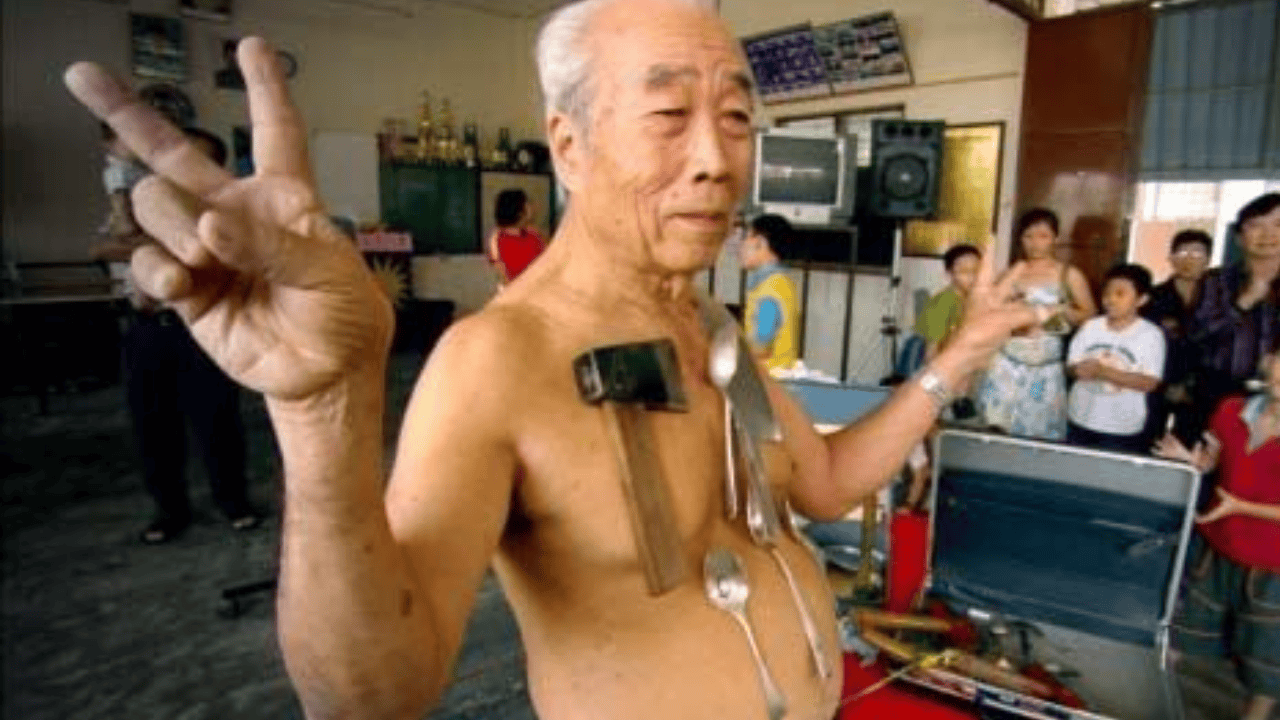
Imagine standing shirtless in front of a crowd. You place spoons, hammers, and even a flat iron on your chest and they stick. No tape. No glue. No tricks.
That is exactly what happened when a Malaysian man named Liew Thow Lin went viral for doing what looked like a real-life superpower. He became known as the Human Magnet, and his videos continue to amaze people around the world.
But here is the twist. What looked like magnetism was something else entirely. And the truth is even more surprising than the myth.
Fast Facts
- Name: Liew Thow Lin, also known as the “Human Magnet”
- Claim to Fame: Could stick up to 36 kg of metal objects to his skin
- Scientific Explanation: High skin friction, not actual magnetism
- Legacy: Performed at charity events and became a viral science icon
- Time Period: Rose to fame in early 2000s; passed away in 2013
Who Was the Human Magnet?
Liew Thow Lin was a retired building contractor from Ipoh, Malaysia. He was not a scientist or magician. He was a humble man who discovered, by accident, that metal objects stuck to his skin. Spoons, tools, and even car parts would cling to him. He once carried up to 36 kilograms of metal on his body without anything falling.
He used this strange skill to perform in charity events and shows. He never tried to sell a product or build a business from it. He just wanted to entertain and raise money for good causes.
“I myself am surprised by my extraordinary ability.”
FlatRock.org coverage of Liew’s 2008 charity event
Liew passed away in 2013, but his videos keep resurfacing. People still wonder: how did he do it?
The Viral Moment That Sparked Global Curiosity
Liew first gained wide attention in the early 2000s after appearing on the Discovery Channel and in national Malaysian news. Clips of him walking around with irons stuck to his chest shocked viewers.
Later, his footage was shared on YouTube, Facebook, and even Reddit. One Reddit post during the 2021 “magnetic vaccine” rumor wave linked back to his video as a way to explain the science of “magnetic” people.
These repeat appearances kept his name in the public eye. Every few years, someone stumbles upon the Human Magnet again, triggering a new wave of shares, laughs, and disbelief.
So Was It Magnetism?
No. And this is where science gives us a surprising answer.
Liew was tested by scientists at Universiti Teknologi Malaysia (UTM). They found no magnetic field coming from his body. So what made the objects stick?
The answer is something called friction.
Liew had skin with unusually high friction and surface tension. This helped smooth, flat objects cling to his skin, especially when the surface was a bit moist. It worked much like how a suction cup grips a wall. Not because of glue, but because the contact between two flat surfaces can create real sticking power.
Some people tested this by using talcum powder on their skin. Once the powder removed moisture and reduced friction, the spoons would fall off.
Even more proof? Liew could stick plastic plates and glass to his body. Those are not magnetic.
Why It Keeps Going Viral
The internet loves things that feel like magic but turn out to be science.
Every time a strange rumor goes viral, like people claiming magnets stick to their arms after vaccines, someone brings up the Human Magnet to set the record straight. Science YouTubers, Reddit users, and educators often repost Liew’s story to explain real physics.
Because he was filmed years ago, his clips have a nostalgic feel. Add to that the awe of watching a man hold up dozens of spoons with no straps or glue, and it becomes the perfect mix of weird and wonderful.
The Man Behind the Myth
Liew never chased fame. He performed only to raise money for charity and help local causes in Malaysia. Despite his international fame, he kept a simple life as a retired builder.
His story reminds us that you don’t have to be rich or famous to do something amazing. Sometimes, your body holds surprises you didn’t even know were possible.
Lessons From the Human Magnet
Liew’s ability is rare, but it does teach us something bigger. Sometimes the wildest things have simple explanations. What looks like magic might just be science you didn’t know yet.
If you ever see something strange online, like a person sticking forks to their forehead, pause and ask, could friction explain this?
Even more, Liew’s story shows how viral fame can start with a small local show and end up educating people all over the world.
Final Thoughts
Liew Thow Lin’s story is not just about spoons and science. It’s about curiosity, kindness, and the mysteries of the human body.
When people saw him hold up metal like a superhero, they asked the wrong question: Is this magic? The better question is: What amazing things might we discover next—once we stop to look closer?