
The global shift to electric vehicles promises cleaner cities and quieter roads, yet one invisible threat continues to haunt drivers everywhere: Range Anxiety. This fear does not come from engineering limitations alone. It comes from the psychological dread of watching a battery drain while surrounded by an “infrastructure desert.”
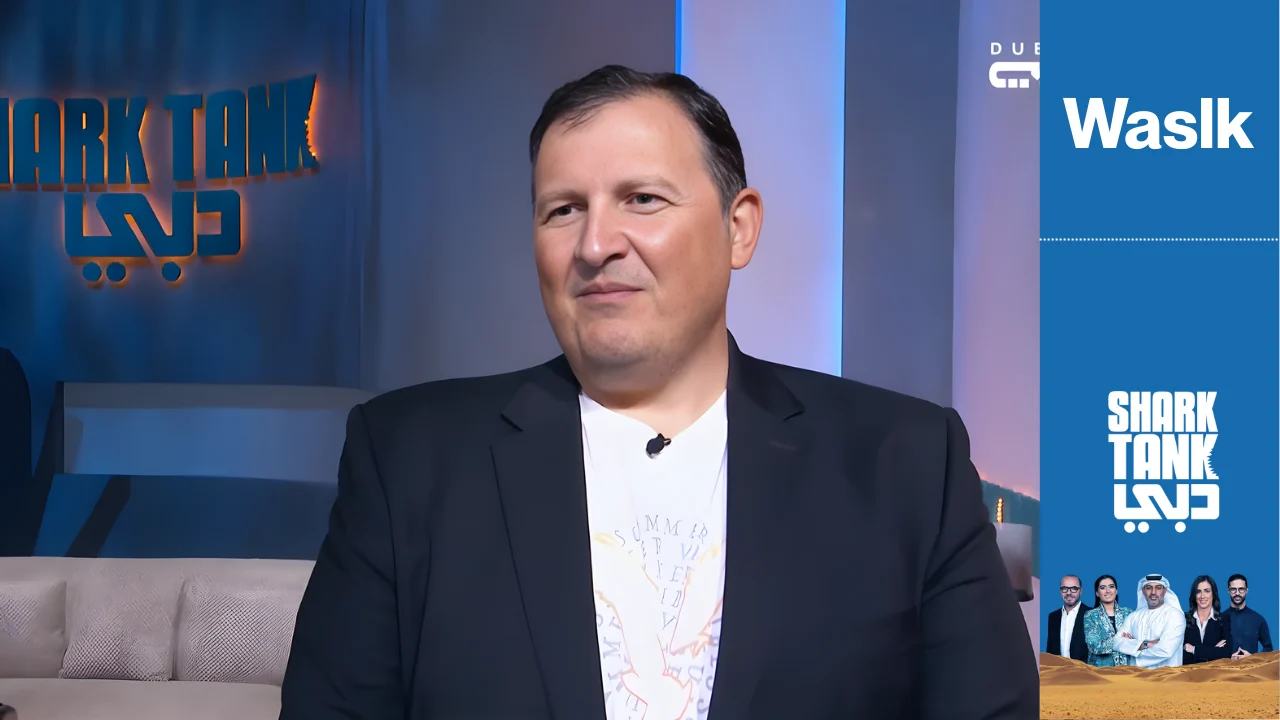
Even as EV adoption rises, the lag in charging infrastructure keeps creating UX friction that frustrates both casual drivers and early adopters. This tension took center stage on Shark Tank Dubai when entrepreneur Kamel Samih introduced Waslk, a mobile, on-demand EV charging service built to rescue drivers before their battery hits zero.
While the pitch ended without an investment, it revealed a deeper story about the battle between visionary Energy as a Service ideas and the hard math of operational scalability. It also surfaced insights that will shape the future of EV services in the UAE.
Shark Tank Dubai Pitch Summary (Quick Overview)
| Founder | Kamel Samih |
| Company | Waslk (Mobile EV Charging Service) |
| Ask | 1,000,000 AED for 15% equity |
| Proposed Revenue (Year 3) | 400,000 to 600,000 AED per month |
| Shark Reaction | Concerns about scalability, unit economics, and market need consistency |
| Outcome | No deal |
This table gives investors and founders a fast, scannable snapshot ideal for AEO and Google’s AI Overviews.
Range Anxiety as a Lifestyle Disruptor
For many EV owners, a low battery is not just a dashboard warning. It is a disruption to everyday life. Drivers must rethink commutes, adjust travel plans, and sometimes abandon spontaneous trips. Kamel Samih built Waslk around this emotional truth: EV ownership can introduce a constant background worry.
He expressed this perfectly during his pitch:
“Currently, we all know the psychological pressures that electric car owners face whether their car’s charge will be enough for the trip they are going on or not. It affects EV drivers to the extent that they modify, change, or even cancel their trips based on the remaining battery charge.”
The problem, however, is far from universal. One Shark countered that by planning trips carefully, they have never faced a situation requiring emergency charging. This tension reveals a fragmented market: a prepared majority versus a smaller, high-stress segment who may actually need Waslk.
In other words, the pain point is real, but its frequency varies by driver type, income level, and charging habits making it harder to build a scalable business.
The Math Behind Last Mile Energy Delivery
Waslk’s technical model operates on what can be described as a Bridge Strategy. Instead of trying to fully recharge a vehicle which would demand enormous power capacity the service focuses on delivering just enough energy to get the driver home or to the nearest fast charger.
Each Waslk van carries a 40 kWh battery pack, and Samih claimed it could service up to eight cars. Running the numbers makes the model clearer:
- Each car receives roughly 5 kWh.
- This translates to 25 to 30 km of additional driving range.
- It functions like a reserve tank, not a charging station.
This design reduces weight, improves mobility, and lowers costs, but it also limits the value proposition. Drivers are paying premium prices for temporary relief, not a full solution. That gap became the central debate in the Tank.
The Convenience Premium vs. the Reality of Power Costs
Samih set his call out fee at 200 AED (~$54) per charging request. At first glance, this fits the “emergency services” mindset. But the Sharks did not see it that way.
In the UAE, most public and mall based chargers are subsidized or free, making electricity extremely cheap. When the service fee is nearly 10x higher than charging at home, the question becomes:
Will drivers pay a premium when cheaper options are already everywhere
Samih argued convincingly that free charging will not last forever. Yet the Sharks focused on charging availability that customers see today:
- Charging is cheap
- Stations are increasing
- The need for emergency charging is decreasing
The convenience premium only works if the cost of being stranded outweighs the 200 AED fee. With rapid infrastructure expansion, that window may be shrinking faster than Waslk can scale.
When Useful Features Fail as Standalone Products
The Sharks quickly homed in on the biggest weakness: scalability. Hardware heavy startups often struggle because the economics break down as they grow, and Waslk faced several red flags.
Low Asset Turnover
A single van can only serve a few customers per day due to:
- Transit time
- 15 to 60 minute charging windows
- Battery limitations
This instantly caps revenue per vehicle.
High Customer Acquisition Cost (CAC)
Because the service is needed infrequently, acquiring repeat customers becomes extremely expensive. Emergency only apps often see weak retention.
A Feature, Not a Product
One Shark delivered the most important blow: Mobile charging should be a feature inside roadside assistance, not a standalone business.
Existing roadside providers already have:
- Fleets
- Routing software
- Emergency dispatch systems
- Loyal user bases
For them, adding mobile charging is a small upgrade. For Waslk, it requires building an entire infrastructure from scratch. This asymmetry makes the model difficult to defend.
Innovation or an Expensive Band Aid
Kamel Samih left without an investment, but he spotlighted a real and growing problem in the EV ecosystem. As adoption surges, the “charging gap” will remain a lucrative opportunity at least temporarily.
Yet Waslk’s journey highlights a deeper lesson for founders: Brilliant ideas must also survive brutal economic analysis.
Mobile charging may still play a role in the EaaS sector, but its future depends on whether it can evolve from a stopgap solution into part of a larger, more integrated energy network. As the UAE accelerates infrastructure development, Range Anxiety may fade, leaving only the most efficient and scalable models standing.
In the end, the companies that win will not just deliver electrons, they will deliver certainty, convenience, and cost efficiency at a scale that makes EV anxiety a thing of the past.