
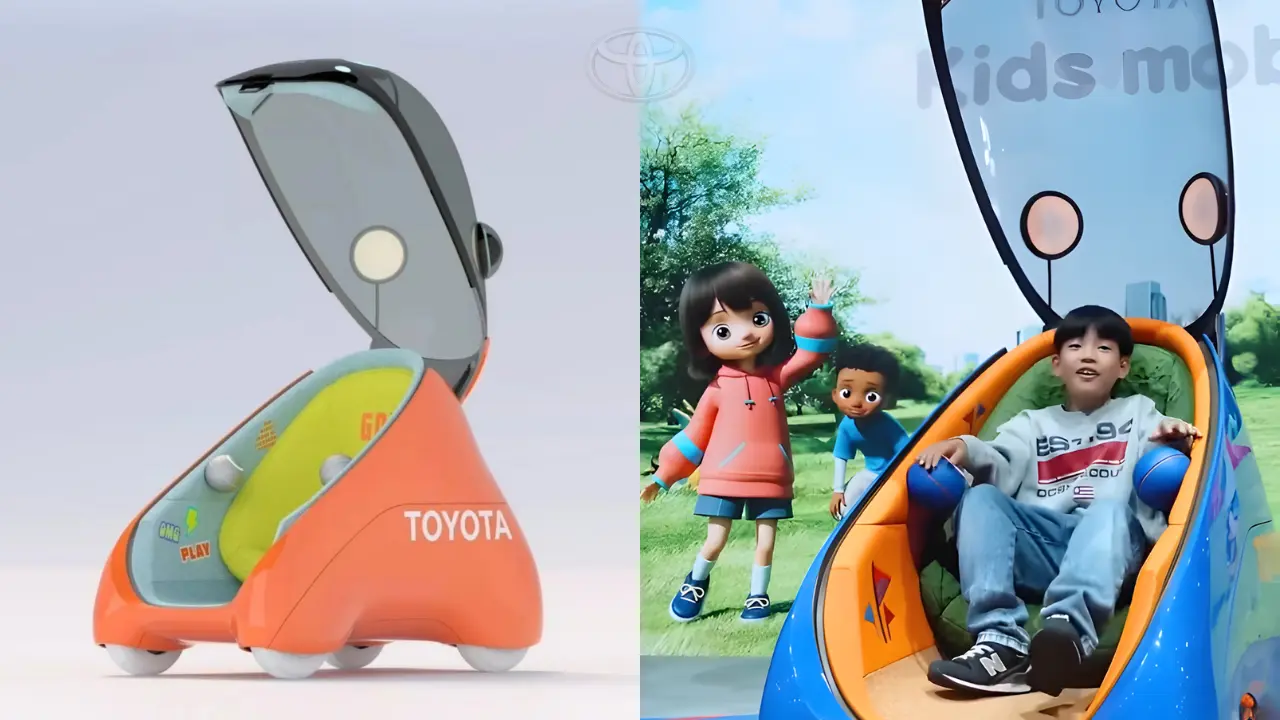
At the Japan Mobility Show 2025 in Tokyo, Toyota unveiled one of its boldest ideas yet, a tiny bubble-shaped pod called the Kids Mobi. It is a self-driving electric vehicle designed for children, powered by artificial intelligence and loaded with sensors.
The concept imagines a world where even elementary school students can travel safely and independently without parental supervision. Toyota describes it as “safe and secure AI-powered personal mobility for kids.”
The Kids Mobi is not just a futuristic toy. It reflects Toyota’s growing focus on “Mobility for All,” an initiative to make transportation accessible to every age group and ability level.
Fast Facts
- Revealed: Toyota introduced the Kids Mobi at Japan Mobility Show 2025 in Tokyo.
- Purpose: A self-driving, AI-powered electric pod designed for children’s independent travel.
- Key Feature: Built-in “UX Friend” AI companion that talks, plays, and calms the child.
- Safety: Fully enclosed shell with obstacle sensors and low-speed operation.
- Status: Concept prototype, no production or pricing announced yet.
Inside Toyota’s Vision Behind the Kids Mobi Concept
Toyota President Koji Sato explained the company’s inspiration during the press briefing.
If we had something like this, wouldn’t it open a whole new world for children? – Koji Sato
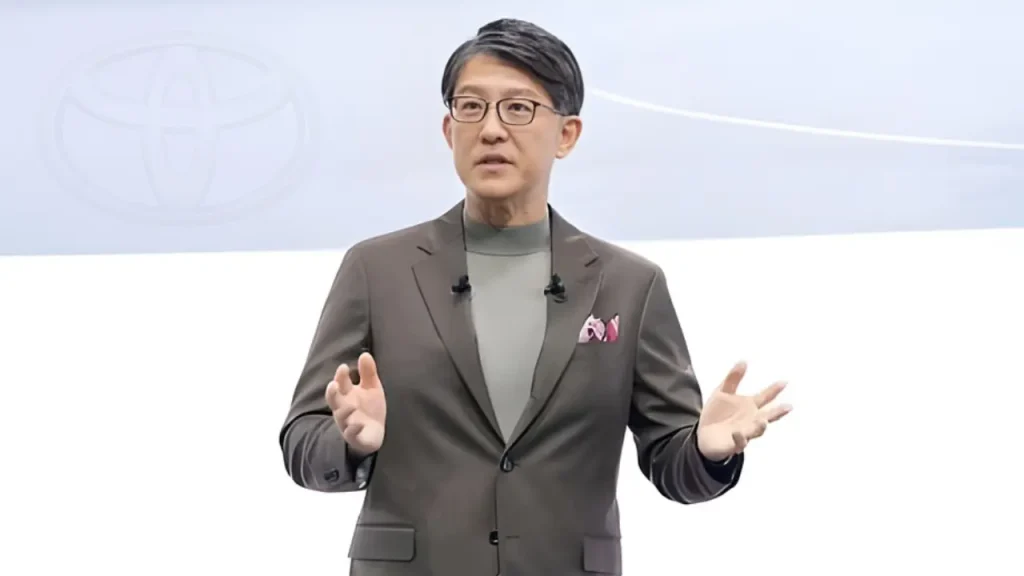
Source: Toyota
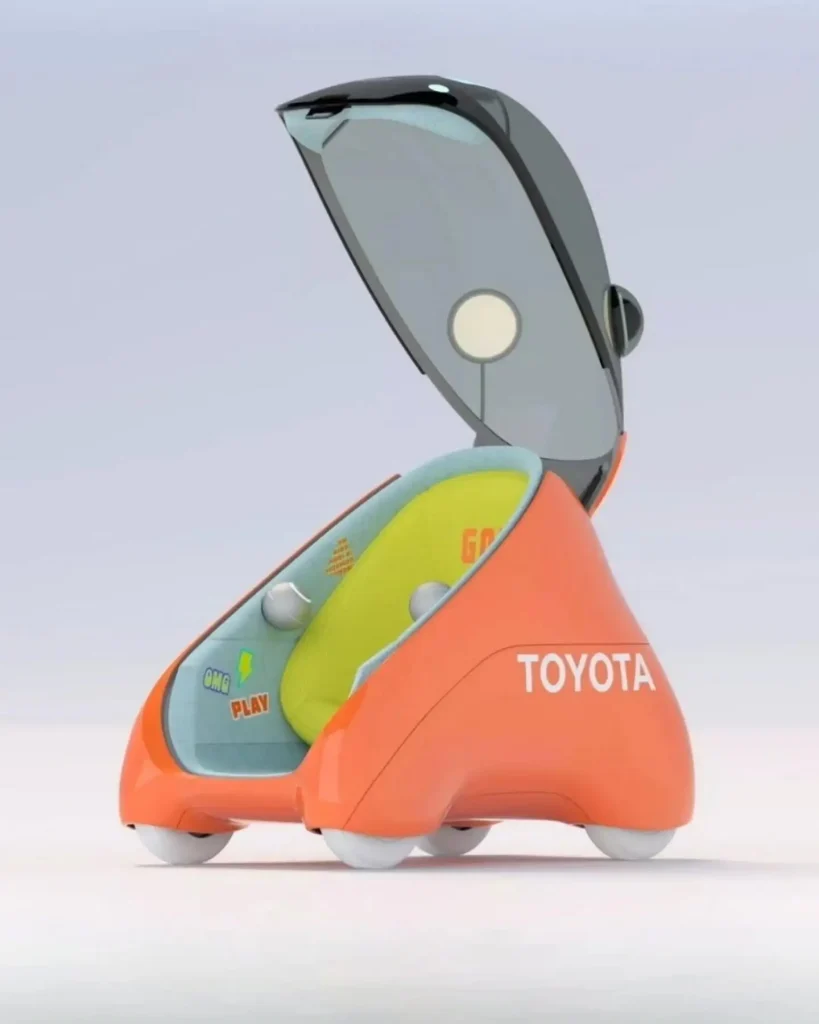
That idea became a working prototype. The Kids Mobi combines electric propulsion with autonomous driving. Its small rounded frame fits children under 130 centimeters tall. Enclosed wheels prevent injuries, while a soft canopy closes smoothly to ensure safety.
Inside, a built-in AI companion called UX Friend interacts with the passenger, playing games, answering questions, or offering calm conversation. It even recognizes a child’s mood and adapts its tone to keep them relaxed.
Although Toyota has not released technical data such as range or speed, the concept likely operates at Level 4 autonomy, capable of full self-driving in controlled environments such as school routes or gated communities.
Kids Mobi Becomes the Highlight of Japan Mobility Show 2025
The Japan Mobility Show, formerly known as the Tokyo Motor Show, showcased Toyota’s push into robotics and AI-powered transport. Alongside the Kids Mobi, Toyota displayed Walk Me (a self-driving wheelchair) and Boost Me (a sports mobility aid).
But the Kids Mobi stole the spotlight. Its LED “eyes” blinked playfully, its sensor “ears” twitched, and its soft interior looked more like a cartoon cocoon than a car seat. Visitors, especially children, queued to take photos with it. Some even received commemorative keychains featuring the smiling pod.
Videos of the pod “winking” circulated online within hours, drawing hundreds of thousands of views across Japanese social media platforms.
Safety Questions Surround Toyota’s Self-Driving Pod for Children
Toyota insists that safety drives every design decision. The pod’s sensors detect obstacles and adjust routes in real time. Its shell absorbs impact, and the system’s low-speed operation further limits risk.
Still, experts question the readiness of such technology for unsupervised minors. CarScoops summarized the concern: “Would you trust this tiny Toyota to drive your kid to school?”
Japanese law complicates matters. While the government approved Level 4 autonomous vehicles in 2023 for limited public use, children traveling alone introduce new legal gray areas. Under Japan’s Penal Code Article 218, leaving a child unattended could qualify as abandonment.
Internationally, Waymo prohibits riders under 16 from traveling solo, and the U.S. National Transportation Safety Board discourages autonomous rides for children under 12. Toyota acknowledges these barriers and calls the Kids Mobi “a concept for social discussion.”
Toyota’s Kids Mobi Remains a Prototype But Could It Soon Be Real
Toyota has not announced plans for production or pricing. The prototype’s role is exploratory to test public reaction, design logic, and AI-child interaction.
Analysts estimate that if commercialized, small-scale child mobility pods could cost between $5,000 and $10,000. However, regulatory approvals and infrastructure readiness could delay adoption for years.
Experts see potential in future school fleets or gated communities where these pods could replace carpooling or bus services.
Read the full record-breaking story of the Skoda Superb diesel covering 2,831 km on one tank of fuel.
Inside the Kids Mobi A Robot Companion Built for Comfort and Play
The Kids Mobi’s interior is designed to comfort, not impress. Its single plush seat, soft lighting, and interactive AI create a space where a child feels secure. The UX Friend may quiz them on school lessons, tell stories, or guide breathing exercises during stressful moments.
Supercar Blondie described it as “a futuristic training ground for tomorrow’s drivers.” Top Gear called it “a Little Tikes car reimagined for the AI age.”
The AI’s emotional engagement is key. It aims to build trust between children and technology. That emotional design could redefine how young users perceive mobility itself.
Public Reaction Divided on Toyota’s Self-Driving Car for Kids
Reactions online have been divided. Many parents praised Toyota for addressing safety and independence. Others voiced skepticism about giving AI full control over children’s transportation.
One post read, “It’s toy design at its best.” Another asked, “Can AI really replace human safety?”
A sentiment analysis across social media posts from the show suggests that around 70% expressed excitement about innovation, while 30% raised privacy or safety concerns.
Child safety experts echo this split. They admire Toyota’s creativity but urge caution until emotional AI and real-world safety testing reach proven reliability.
What Toyota’s Kids Mobi Tells Us About the Future of Child Mobility
The Kids Mobi hints at a radical shift in how societies view childhood mobility. It could reduce school traffic, empower children with independence, and promote eco-friendly urban design.
Yet challenges remain, including data privacy for minors, public acceptance, and high production costs. For now, it stands as a symbol of imagination more than a market-ready product.
As Koji Sato said, Toyota’s mission is “creating smiles through mobility.” The Kids Mobi delivers that vision, half toy, half technology, and fully provocative.
Whether it becomes a common sight on streets or stays a concept, the idea sparks one unavoidable question: Are we ready to trust a car to carry our children alone?
FAQs
No. The Kids Mobi is currently a concept vehicle that Toyota revealed at the Japan Mobility Show 2025. It was built to explore the idea of safe, AI-powered mobility for children, but Toyota has not announced any production plans or pricing yet.
Toyota designed the Kids Mobi with multiple safety features, including full enclosure, obstacle-detection sensors, and low-speed operation. However, since it’s still a prototype, it has not undergone road safety certification. Current laws in Japan and most countries do not yet allow unsupervised minors in autonomous vehicles.
Unlike most autonomous cars built for adults, the Kids Mobi focuses on child independence and emotional comfort. It includes an AI companion called “UX Friend” that interacts with the child during the ride, creating a balance between technology, safety, and emotional connection.
Explore the full story of the first-ever personal aerial vehicle race in Arkansas.