
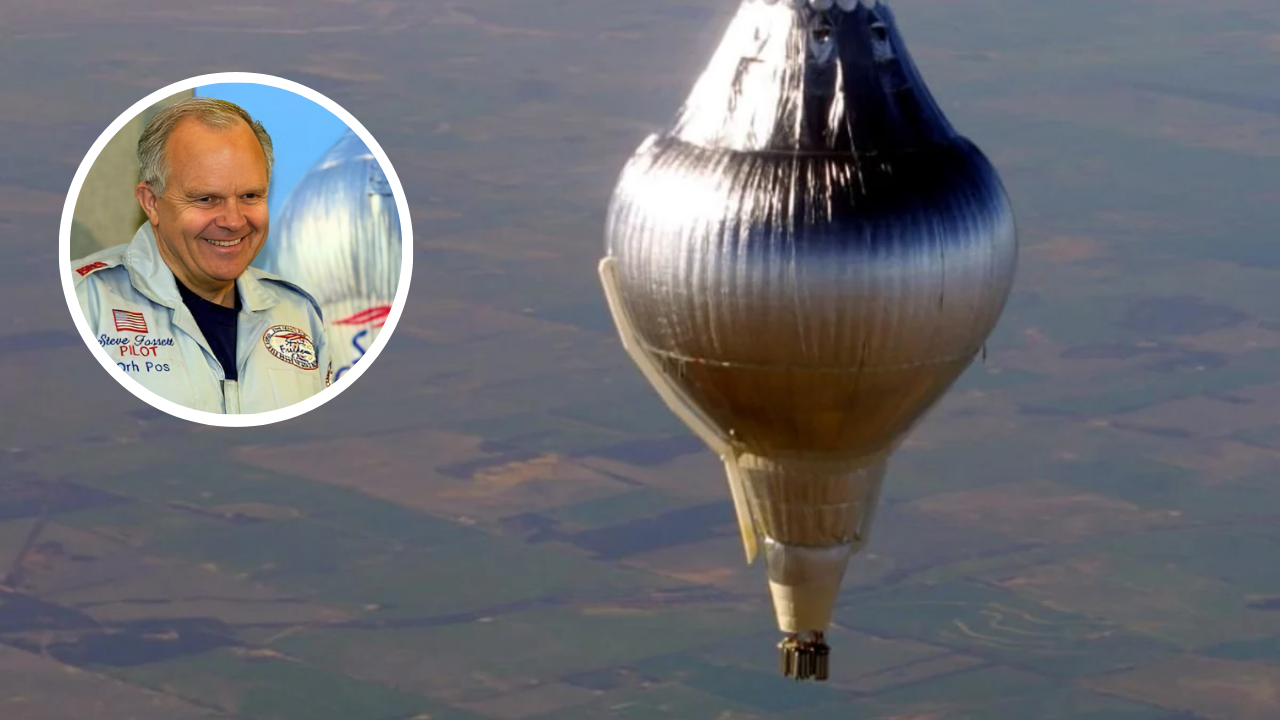
On June 19, 2002, a giant silver balloon lifted off from Northam, Australia. Inside the small capsule sat Steve Fossett, a former Chicago businessman with a mind for numbers and a heart for adventure. His goal was simple to describe but nearly impossible to achieve: fly alone around the entire planet without stopping or refueling.
For the next 13 days, Fossett rode powerful jet stream winds across the Southern Hemisphere. He slept in short bursts, often just minutes at a time, while his 10-story Roziere balloon called Spirit of Freedom drifted at speeds close to 200 miles per hour. By July 3, he had covered more than 20,600 miles and landed safely in Queensland, Australia, becoming the first person in history to complete a solo nonstop balloon flight around the world.
Fast Facts
- Achievement: First solo nonstop balloon flight around the world in July 2002.
- Distance & Duration: Over 20,600 miles in 13 days and 8 hours.
- Balloon: 10-story Roziere design named Spirit of Freedom.
- Legacy: Over 100 world records in aviation, sailing, and gliding.
- Mystery: Disappeared during a 2007 plane flight; wreckage found a year later.
The Mind Behind the Mission
Fossett was not a thrill seeker without a plan. Before this flight he had already set more than 100 world records in sailing, gliding, and aviation. According to aviation historian Tom Crouch of the Smithsonian National Air and Space Museum,
“Fossett treated every expedition like a research project, testing each variable until nothing was left to chance.”
He relied on a global team of meteorologists and engineers who tracked jet streams and fine-tuned his route. The balloon itself combined helium for lift and hot air for control, an advanced design known as a Roziere. This allowed Fossett to conserve fuel and adjust altitude with precision.
A Geek’s Triumph
Think of the flight as a giant chess game with the planet. Fossett used real-time weather models and satellite communications to chase the best winds. He packed enough propane to heat the air for nearly two weeks and carried custom navigation software built for long-range ballooning. His success showed how careful planning and science can turn a daring idea into reality.
The Mystery That Followed
Five years after the record flight, Fossett took off in a single-engine Super Decathlon airplane from a private Nevada ranch on September 3, 2007. He planned a short sightseeing trip and told no one his exact route. When he failed to return, a massive search began, involving the Civil Air Patrol, satellites, and thousands of volunteers.
For over a year nothing was found. Then in late 2008 a hiker discovered Fossett’s identification cards in the Sierra Nevada Mountains. Investigators later located the wreckage of his plane. The National Transportation Safety Board concluded that powerful downdrafts likely forced the aircraft into terrain at high altitude.
Why His Story Still Spreads Online
Each year in June and July, social media users share videos and articles about his flight. Reddit history threads and Facebook “On This Day” posts continue to bring new readers to the tale. The mix of awe and mystery—one man circling Earth alone and later disappearing—keeps the story alive.
Legacy and Inspiration
Fossett’s capsule from Spirit of Freedom now rests in the Smithsonian. Balloonists and engineers still study his methods when planning long-distance flights. For anyone drawn to exploration, his life proves that disciplined curiosity can push human limits.
If you want a taste of high-altitude adventure, local ballooning clubs and weather-balloon projects offer safe entry points. While a global flight remains out of reach for most people, Fossett’s careful preparation offers lessons in planning and perseverance.
Disclosure: We may earn a commission when you make a purchase through the ads.