
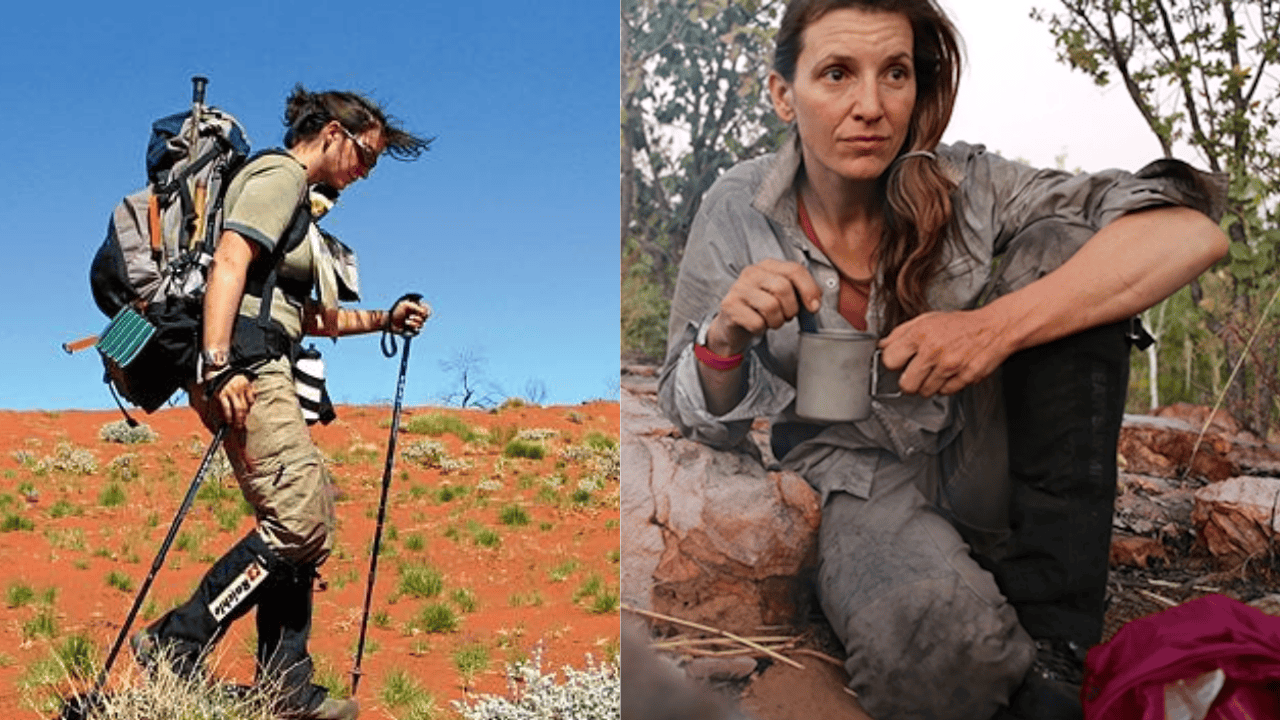
In a world where every step is tracked by technology, one woman decided to turn it all off. Sarah Marquis, a Swiss explorer, walked more than 10,000 miles across six countries with no GPS, no team, and no safety net. Her only tools were a paper map, her instincts, and unshakable courage.
Fast Facts
- Explorer: Sarah Marquis, Swiss solo adventurer recognized by National Geographic.
- Journey: Walked 10,000 miles through six countries from Siberia to Australia (2010–2013).
- Method: No GPS or backup, guided only by paper maps, instincts, and endurance.
- Recognition: Named National Geographic Adventurer of the Year in 2014.
- Legacy: Author of Wild by Nature and global advocate for human resilience and minimalism.
The Start of an Unbelievable Journey
Between 2010 and 2013, Sarah traveled on foot from the cold forests of Siberia through Mongolia, the Gobi Desert, China, Laos, and Thailand. From there, she sailed on a cargo boat to Australia, where she crossed the empty and dangerous Nullarbor Plain.
She faced blistering heat, hunger, and exhaustion almost every day. To survive, Sarah learned to forage for food, collect rainwater, and even disguise herself in remote villages to avoid unwanted attention. Every decision she made came down to one question: Can I trust my senses?
How She Survived Without GPS
While most explorers use satellite systems and rescue beacons, Sarah chose to travel without them. She navigated using topographic paper maps, the sun, and landmarks. She carried her supplies in a small hand cart and carefully rationed her food.
In her book Wild by Nature, she wrote,
“I always carry good topographic maps on paper. Do not trust electronics in the remote wild.”
This mindset transformed her journey from a physical challenge into a mental one. It became an experiment in pure human endurance.
Facing the Impossible
Sarah endured near-freezing nights in Siberia and scorching days in the Gobi Desert. She once walked through three days of sandstorms with little water. At another point, she suffered a severe tooth infection that forced her to pause for medical help. When she recovered, she returned to the exact spot where she had stopped and continued.
According to National Geographic, she averaged about 23 miles a day, covering more ground than some endurance athletes complete in a week.
Her resilience earned her the title of National Geographic Adventurer of the Year and inspired thousands of people worldwide.
Why Her Story Went Viral Again
Years after completing her trek, clips from her TED Talks and interviews resurfaced on Instagram, TikTok, and YouTube. People were stunned that she walked across continents without technology or backup. In an era when many cannot go an hour without checking their phones, her journey felt both wild and refreshing.
Her story became a symbol of digital minimalism and the idea that humans can still thrive without constant connection. It tapped into a growing global trend where people seek to disconnect to reconnect.
The Geeky Side of Her Adventure
Sarah’s feat might look simple, but it required incredible technical planning. She logged weather patterns, tracked terrain changes, and calculated food-to-distance ratios before starting each leg of her trip. In a way, she was performing a real-life algorithm of survival.
Adventure psychologist Dr. Eric Brymer explains, “Extreme adventurers like Sarah engage with risk not to escape life, but to experience it more fully.”
This insight helps explain why her journey fascinates so many. It was not just about survival but about testing what the human mind can endure when stripped of comfort.
What We Can Learn from Her
Sarah’s story reminds us that solitude is not weakness. In fact, it can sharpen awareness and build inner strength. Her three-year journey teaches that modern humans can still survive — and even thrive — without being constantly guided by technology.
She now gives talks worldwide, encouraging people to reconnect with nature and trust themselves again. Her message is simple: You do not need a signal to find your direction.
The Legacy of Sarah Marquis
Since completing her walk, Sarah has written several books, appeared in documentaries, and continues to explore remote regions. Her mindset has influenced survivalists, tech minimalists, and even software engineers who study human focus and endurance.
She is still a living example of what happens when courage meets precision. Every step she took left a footprint, not just on the earth but in the hearts of people searching for meaning in an overconnected world.
Final Thought
Sarah Marquis proved that sometimes the greatest discoveries happen when we let go of control. She walked through silence, danger, and isolation, not to prove she was fearless — but to remind us that human grit is the most powerful navigation system of all.