
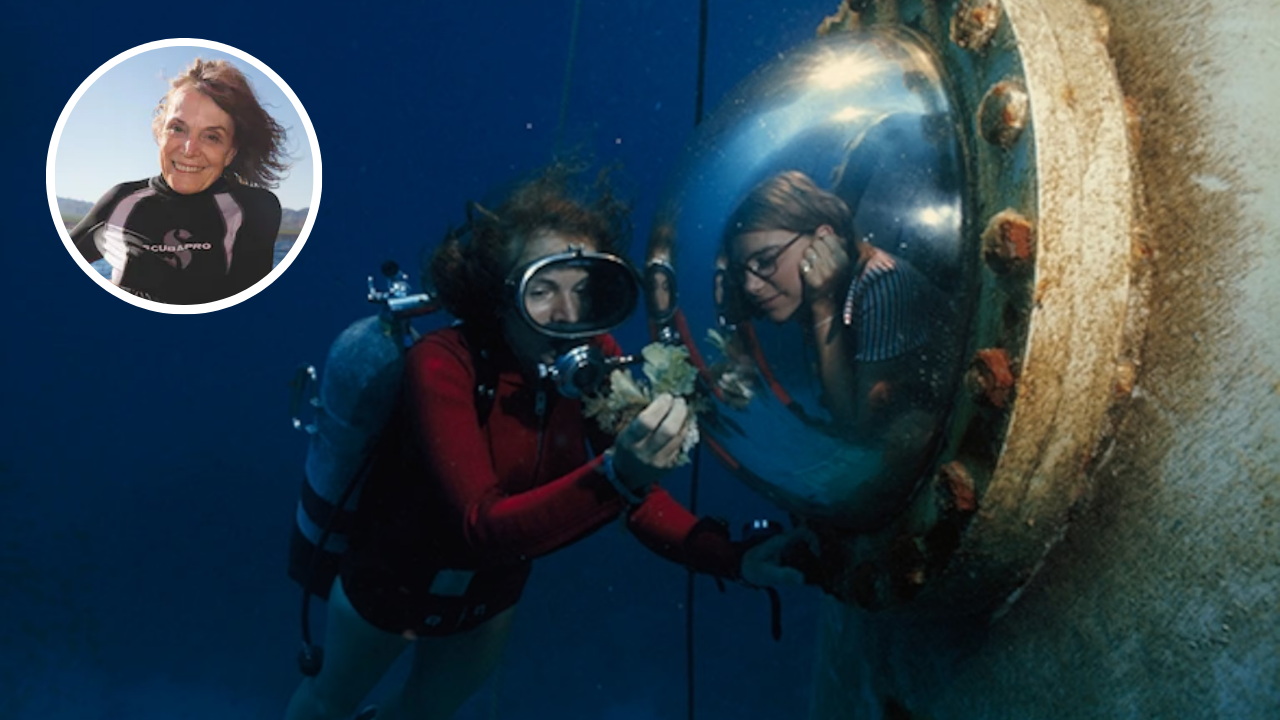
Imagine spending nearly a full year of your life underwater. Sylvia Earle, an oceanographer known as “Her Deepness,” has done exactly that. She has logged more than 7,000 hours beneath the waves and recently, her story resurfaced online. A post highlighting her record-breaking dives and fearless ocean walks started circulating on Facebook and TikTok, sparking curiosity among millions who had never heard her name before.
The internet loves numbers that feel impossible. Seven thousand hours underwater is one of those facts that makes people pause and share. Suddenly, Sylvia Earle was trending again, not for a new mission, but because people rediscovered what she had already revealed years ago: the ocean holds secrets we cannot afford to ignore.
Fast Facts
- Name: Sylvia Earle, also known as “Her Deepness”
- Hours Underwater: Over 7,000 logged in exploration
- Historic Feat: First woman to lead an all-female aquanaut team in 1970
- Record: Walked alone on the ocean floor at 1,250 feet in 1979
- Mission: Founder of Mission Blue, protecting global “Hope Spots”
Who Is Sylvia Earle
Sylvia Earle was born in 1935 in New Jersey. She became fascinated by the sea at a young age and turned that passion into a lifetime career. In 1970, she led the first all-female aquanaut mission called Tektite II, where her team lived underwater for two weeks. In 1979, she set another record by walking solo on the ocean floor at a depth of 1,250 feet while wearing a pressurized JIM suit.
Her list of achievements does not stop there. She served as the first female Chief Scientist at the National Oceanic and Atmospheric Administration (NOAA) and later founded Mission Blue, an organization that works to protect marine “Hope Spots.”
“The goal is to protect biodiversity and use all means at your disposal: films, expeditions, the web, new submarines,” Sylvia Earle said in an interview.
How Did She Do It
Sylvia Earle’s accomplishments may sound like science fiction, but they were made possible by real tools and fearless curiosity.
- Tektite II Habitat: A steel underwater base where her team could live and work beneath the sea.
- JIM Suit: A deep-diving armored suit that protected her from crushing pressure, allowing her to walk untethered at 1,250 feet.
- Deep Rover Submersibles: Small submarines she helped design to make deep-sea exploration more accessible.
Think of her work as the ocean’s version of NASA’s space program. Instead of rockets, she relied on diving suits and submersibles. Her explorations helped prove that the deep ocean could be studied safely, opening doors for future scientists.
Why Is This Viral Now
The internet is driven by moments that feel larger than life. Sylvia’s numbers and records give people a sense of awe. Conservation-focused pages on Facebook and TikTok climate accounts started sharing her stats again, and the posts spread quickly.
Her story also resonates with current trends. As climate change and ocean health dominate global conversations, younger audiences find inspiration in her lifelong fight to protect marine ecosystems. What feels new is not her work itself, but the renewed recognition that we need ocean defenders now more than ever.
Can Others Do This Too
Most people cannot walk the ocean floor at 1,250 feet, but Sylvia’s story shows that geeky passion for exploration is not limited to scientists with advanced equipment. Anyone can:
- Join local dive clubs or citizen science projects.
- Use apps and VR experiences that bring underwater exploration to your screen.
- Support groups like Mission Blue that protect marine habitats.
For those who want to go deeper, studying marine biology, ocean engineering, or even science communication can open doors to careers inspired by her path.
The Impact and Challenges
Unlike many viral figures, Sylvia’s reputation has faced little controversy. The main challenge has been misinformation or simplified retellings of her feats. Some posts exaggerate the number of expeditions she led or blur timelines. However, her credibility is well documented through NOAA, National Geographic, and Mission Blue.
Her message is consistent: we must treat the ocean as our lifeline, not as a dumping ground.
What’s Next for Sylvia Earle
At 89, Sylvia shows no signs of stopping. Through Mission Blue, she continues to fight for marine “Hope Spots” and often partners with younger climate activists. She appears in documentaries, lectures worldwide, and remains a mentor to a new generation of explorers. Her viral moment is more than nostalgia. It is a reminder that protecting the deep blue is protecting ourselves.
Disclosure: We may earn a commission when you make a purchase through the ads.