
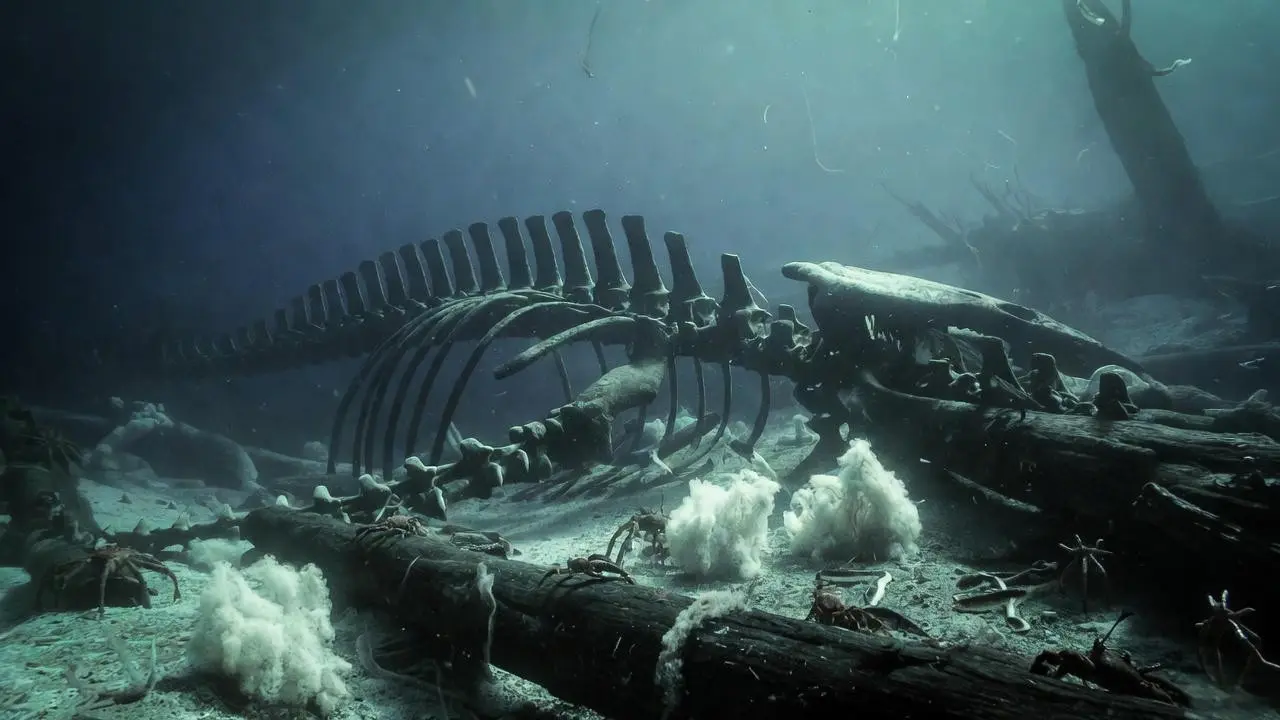
In a first of its kind study, researchers watched deep-sea animals take over whale bones and wood near the seafloor and found oxygen levels strongly shape who survives and thrives.
The team found that large deep-sea animals, called megafauna, behave very differently on whale bones, sunken wood, and rock when oxygen is scarce. This matters because oxygen in the deep ocean is falling as the climate warms and oxygen zones expand.
Study focus: Scientists tracked deep-sea animals living on whale bones, wood, and rock in a low-oxygen ocean canyon. Key finding: Low oxygen sharply reduced animal diversity and blocked species that normally break down bones and wood. Why it matters: As climate change lowers oxygen in deep oceans, these hidden ecosystems may shrink, altering nutrient recycling and deep-sea biodiversity.
Scientists set up whale bones, pieces of Douglas fir wood, and plain rock at about 890 meters deep in Barkley Canyon off Canada. They used underwater cameras that took short videos every few hours for over eight months. This let them watch which animals showed up and how communities changed over time.
On the whale bones, white bacterial mats formed early, and animal numbers and diversity moved up and down in a way different from wood or rock. The bone-eating worms and wood-boring clams that normally reshape these habitats in well-oxygenated waters stayed away. These “ecosystem engineers” normally break down bones and wood and make space for other animals.
Researchers explained the deep-sea world like an underwater neighborhood. When oxygen drops, the usual residents cannot move in, and the community becomes smaller and simpler. Oxygen acts like a life switch that flips parts of the ecosystem on or off.
This work matters because deep ocean oxygen levels are shrinking in many places as Earth’s climate warms. If oxygen goes down, the hidden communities that depend on sunken bones and wood may disappear. That could affect how the ocean recycles nutrients and supports life far beyond these isolated spots.
Lead author Craig R. Smith of the University of Hawaii said the results show how sensitive deep-sea life is to oxygen loss. Coauthor Lisa A. Levin at the Scripps Institution of Oceanography added that knowing how these habitats change helps predict how the ocean’s web of life will shift in a warming world.
The findings also touch on broader issues like carbon cycling and the roles of deep ecosystems in storing or releasing nutrients. Changes in these hidden communities could ripple up to affect fisheries, climate feedbacks, and how we manage ocean health.
Next, the team plans to compare these patterns with other deep canyons around the world and over longer time spans to see if oxygen thresholds hold universally. They also want to learn whether other stressors like temperature change add to oxygen effects.
This study opens a window into the deep ocean’s hidden life and shows that oxygen levels shape the very fabric of deep-sea ecosystems. The changes observed here could help scientists predict how climate change will transform life in the ocean’s darkest reaches.
Story Source:
Materials provided by Frontiers in Marine Science. Content may be edited for style and length.
Journal Reference:
Craig R. Smith, Paulo V. F. Correa, Aharon G. Fleury, Lisa A. Levin, Fabio C. De Leo. High-frequency study of megafaunal communities on whale bone, wood and carbonate in hypoxic Barkley Canyon. Frontiers in Marine Science, 2024. Volume 11. DOI: 10.3389/fmars.2024.1464095