
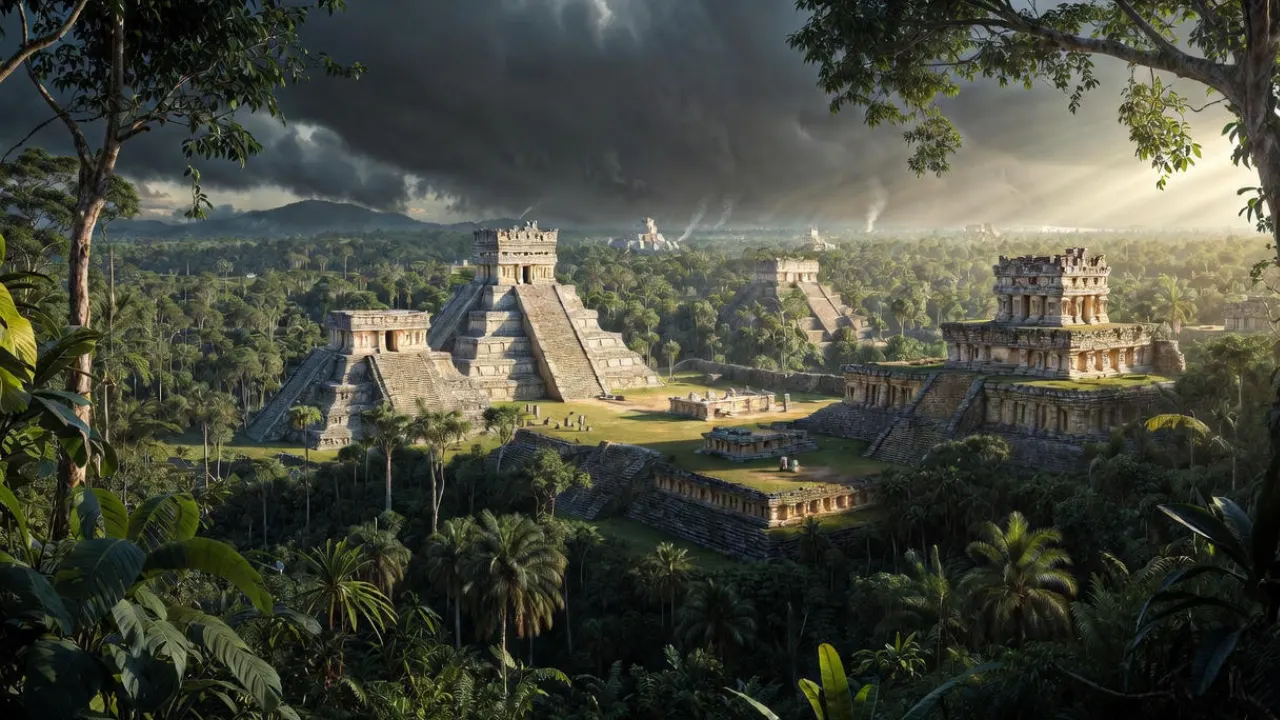
The new research gives a clear picture of how Classic Maya cities grew strong and then unraveled and why that chain of events still matters today. It blends climate records, ancient population patterns, and fresh mathematical modeling to explain the forces that drove one of history’s most studied collapses.
Fast Facts
Discovery: New modeling shows how climate stress, rising conflict, and growing city size together shaped the rise and collapse of Classic Maya cities. Why It Matters: The study explains how environmental shifts and social pressures interact, offering insights for modern cities facing climate and resource challenges.
Scientists built a unified model to show how drought cycles, competition over farmland, and the costs and benefits of big urban centers created long term patterns across the Maya world. This explains why some cities flourished during good rain years and why many began to struggle once climate stress increased. It also connects political conflicts with the pressure that growing populations placed on food systems.
The research team tested their ideas by combining data from ancient inscriptions, settlement surveys, climate archives, and computer simulations. The model used simple steps: track how people move when water or farmland becomes scarce, measure how cities gain power as they grow, and calculate how conflict rises when rivals compete for resources. Even though the system sounds complex, the method works like a map showing how choices build on each other over centuries.
The results matter because they give a clearer idea of how climate stress interacts with political and social systems. When rainfall dropped, farms produced less. When farms produced less, leaders needed more control to manage food and labor. That extra pressure raised conflict, which then made cities more fragile. The study suggests that collapse came not from a single cause but from many forces hitting at the same time.
Experts involved in the study say this work helps solve a long debate about whether drought alone toppled the Classic Maya. The new model shows drought was a major trigger, but it worked through human systems that were already stretched. Some researchers note that the framework matches patterns seen in the written record on monuments shown on page 2, where conflict events increase in the Late Classic period. Others say the results are useful because they match both archaeological evidence and what we know about how large settlements behave under stress.
The discovery also links ancient history to current global challenges. Urban centers today face their own pressure from climate shifts, growing populations, and limited resources. The study shows that when environmental change, political tension, and economic strain stack together, societies can become less stable. This gives modern planners a reminder that cities must adapt early rather than wait for crisis.
The team now plans to test the model with other ancient societies and update it with more detailed climate records. They aim to understand which parts of the system make cities most vulnerable and how early warning signs appear. Open questions include how trade, migration, and leadership structures changed as pressures grew.
This research gives a powerful lesson: civilizations rise when climate, cooperation, and resources align, but they weaken when those forces break apart. By showing how these pieces fit together, the study helps us understand not only the Classic Maya but the long term risks that complex societies face today.
Story Source:
Materials provided by Insert Institution Here. Content may be edited for style and length.
Journal Reference:
Full Author List. Modeling the rise and demise of Classic Maya cities: Climate, conflict, and economies of scale. PNAS, 2025. 122(42). DOI: 10.1073/pnas.2512325122