

Archaeologists working on the island of Sulawesi in Indonesia have made a discovery that changes how we see human history. They found stone tools buried in ancient riverbeds that date back more than 1 million years. These tools are simple flakes of chert, a type of stone, but they were clearly shaped by human hands.
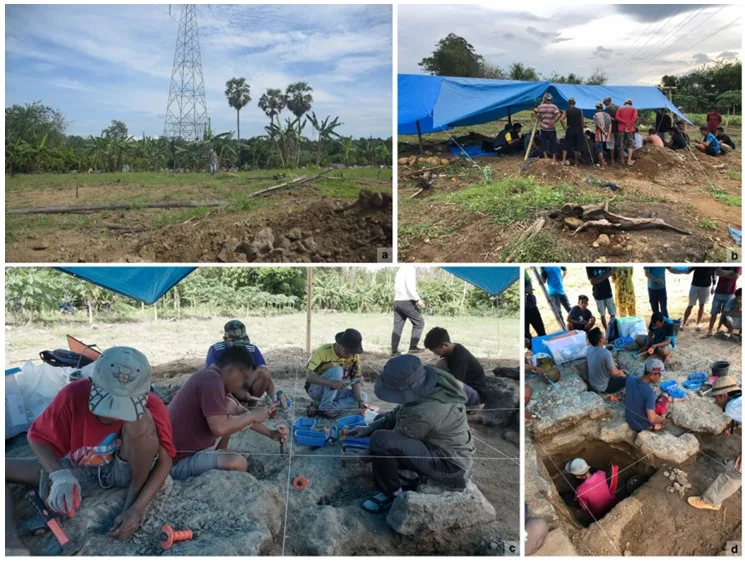
The site, called Calio, sits in the Walanae Depression of South Sulawesi. Today, it is a quiet corn field. But in the Early Pleistocene, it was a river channel where early humans shaped tools and likely hunted animals nearby.
The research was led by Budianto Hakim of Indonesia’s National Research and Innovation Agency (BRIN) and Professor Adam Brumm from Griffith University’s Australian Research Centre for Human Evolution. Their team uncovered seven artefacts from the sandstone layers. These small but sharp flakes were struck from larger pebbles, most likely gathered from nearby riverbeds.

Image credit: Hakim et al., 2025, Nature
Dating the layers where the tools were found was done using two methods: palaeomagnetism, which measures Earth’s ancient magnetic field shifts, and uranium-series electron spin resonance dating, which analyzed a fossil pig tooth found with the artefacts. Both methods confirmed that the tools are at least 1.04 million years old, and possibly as old as 1.48 million years.
This pushes back human presence on Sulawesi by hundreds of thousands of years.
Fast Facts
- Discovery: Stone tools found in Sulawesi, Indonesia
- Age: Dated between 1.04 and 1.48 million years old
- Significance: Proves early humans crossed seas much earlier than thought
- Researchers: Led by BRIN (Indonesia) and Griffith University (Australia)
- Open Question: Identity of the toolmakers remains unknown
Why This Matters
Before this discovery, the oldest evidence of humans in Sulawesi came from another site called Talepu, which dated to around 194,000 years ago. The Calio tools reveal that humans or their relatives lived on the island far earlier.
This matters because Sulawesi was never connected to the Asian mainland. To get there, early humans had to cross deep seas, beyond a boundary known as the Wallace Line. This biogeographic line separates Asian and Australasian ecosystems. Crossing it meant leaving familiar lands and entering an island world full of unique animals.
“This discovery adds to our understanding of the movement of extinct humans across the Wallace Line, a transitional zone beyond which unique and often quite peculiar animal species evolved in isolation.” — Professor Adam Brumm
Until now, experts thought such daring voyages only happened much later in history. The Calio discovery proves that our ancestors were adventurous ocean travelers much earlier than we believed.
It also raises a big question: who made these tools? No fossils have been found at Calio, so the identity of the toolmakers remains a mystery.
“It’s a significant piece of the puzzle, but the Calio site has yet to yield any hominin fossils, so while we now know there were tool-makers on Sulawesi a million years ago, their identity remains a mystery.” — Professor Adam Brumm
They could have been Homo erectus, a species known from nearby Java. Or they might have been an unknown ancestor of the tiny Homo floresiensis, the “Hobbit,” from Flores. Whoever they were, they left behind evidence of skill and survival that still echoes today.
How Scientists Confirmed the Age
Dating ancient artefacts is never simple. The team used a careful mix of techniques.
- Palaeomagnetism: Earth’s magnetic field has flipped many times. By measuring the magnetic direction in rock layers, scientists can pinpoint when they formed. At Calio, the results showed the layers were older than the last major flip 773,000 years ago.
- Uranium-Series and ESR dating: Fossilized teeth from an extinct pig, Celebochoerus, were found with the tools. These fossils contained uranium that decays in a predictable way. By measuring this decay, scientists confirmed the fossils, and the tools, date back at least 1.04 million years.
The study was published in Nature, one of the world’s most respected scientific journals, adding strong credibility to the findings.
Why Indonesia Holds the Keys to Our Past
Indonesia has long been central to the story of human migration. The islands of Wallacea, including Sulawesi, Flores, and Luzon, were never connected to Asia or Australia, even during ice ages. To reach them, humans had to cross the sea.
Earlier discoveries in this region already shocked scientists. On Flores, the site of Wolo Sege revealed stone tools dating to about 1.02 million years ago. Fossils of Homo floresiensis later showed that small-bodied humans lived there much more recently, around 60,000 years ago. In Luzon, in the Philippines, stone tools and butchered animal bones date back to about 700,000 years ago.
Now Sulawesi joins this growing list. The Calio artefacts are among the oldest yet found in Wallacea. Together, these sites show that early humans were capable of extraordinary journeys across seas long before modern humans evolved.
Related Reading
From ancient survival to modern threats, nature continues to test humanity. See how wildfires endanger lives in unexpected ways.
Read MoreWho Is Impacted by This Discovery
This find has broad impacts.
- Archaeologists and scientists now have new evidence that challenges older ideas of how humans spread through Asia.
- Indonesia and its people gain recognition as caretakers of one of the most important chapters in human history. This discovery may boost cultural pride and even tourism in Sulawesi.
- The general public is reminded that curiosity and survival are not new traits. These million-year-old tools prove that human adventure began much earlier than we thought.
The Mystery of Early Sea Crossings
One of the biggest mysteries is how early humans reached Sulawesi. The island has always been separated by deep water. Some scientists believe they drifted on natural rafts of vegetation. Others argue that even early hominins were intelligent enough to build simple rafts on purpose.
“It is more likely that hominins got to Sulawesi by accident, most probably as a result of ‘rafting’ on natural vegetation mats.” — Professor Adam Brumm
Either way, they crossed. That act alone makes them pioneers of the sea. It challenges the old belief that ocean exploration only began with Homo sapiens.
Comparing to Other Discoveries
When viewed together, discoveries across Wallacea form a fascinating timeline.
- Flores: Stone tools at Wolo Sege show humans there at least 1.02 million years ago. Later, Homo floresiensis fossils revealed survival until about 60,000 years ago.
- Luzon: Tools and butchered animal bones date to around 700,000 years ago.
- Sulawesi: Now confirmed to host humans or human relatives over 1 million years ago.
This pattern suggests Southeast Asia was not a forgotten corner but a hub of human migration and evolution. The Wallace Line did not stop early humans. Instead, the islands became stepping stones for exploration.
Related Reading
Just as ancient humans shaped stones for survival, today’s scientists are shaping sunlight into fuel. Learn about the breakthrough turning solar energy into clean, usable power.
Read MoreEvolution in Isolation: The Big What-If
The absence of fossils at Calio leaves big questions open. Could Homo erectus have reached Sulawesi and, like on Flores, evolved into a smaller form over time? Or might the large, ecologically rich island have allowed them to evolve in a completely different way?
“Sulawesi is a wild card, it’s like a mini-continent in itself.” — Professor Adam Brumm
“If hominins were cut off on this huge and ecologically rich island for a million years, would they have undergone the same evolutionary changes as the Flores hobbits? Or would something totally different have happened?” — Professor Adam Brumm
As Professor Brumm explained, Sulawesi is like a “mini-continent.” If humans lived there in isolation for a million years, they may have experienced unique evolutionary changes. The mystery of what they became remains unsolved, but it is one of the most tantalizing questions in human evolution.
The Human Story Behind the Tools
It is easy to see these flakes of stone as lifeless objects. But behind each flake was a hand and a purpose. Picture an ancestor by the river a million years ago, striking pebbles from the stream to create sharp tools. With these, they butchered animals, cut wood, and survived in a challenging land.
These small acts, repeated for generations, allowed them to thrive. Today, they give us a glimpse into the courage and creativity that still define us.
Questions Still Waiting for Answers
Even with this breakthrough, many mysteries remain.
- Which species of human made the tools?
- Did they evolve uniquely on Sulawesi, as they did on Flores?
- Why have we not yet found their fossils?
- What eventually happened to them?
Future excavations may provide answers. For now, the Calio tools are a powerful reminder of how much of our story remains untold.
A Shared Legacy
The discovery of ancient tools in Sulawesi is not only about the past. It is also about us. It shows that exploration and survival are in our DNA. Our ancestors crossed seas, faced the unknown, and adapted to every challenge.
This story belongs to all of humanity. It connects people across nations and cultures, reminding us that we share the same roots and the same restless drive to explore.
Conclusion
The discovery of 1-million-year-old stone tools in Indonesia rewrites human history. It proves that humans or their relatives reached Sulawesi long before anyone thought possible. It also highlights the bravery, skill, and adaptability of our ancestors.
As scientists continue to study the Calio site, one thing is certain. Human history is full of surprises, and Sulawesi has just revealed one of the most extraordinary surprises of all.
FAQs
Archaeologists used two independent dating methods: palaeomagnetism, which measures ancient shifts in Earth’s magnetic field, and uranium-series electron spin resonance dating on a fossil pig tooth found with the tools. Because both methods gave consistent results, scientists are confident the artefacts are at least 1.04 million years old. Multiple lines of evidence make the dating more reliable than relying on a single technique.
Sulawesi sits in Wallacea, a group of islands that were never connected to Asia or Australia. This means early humans had to cross deep seas to reach them. Discoveries here prove that humans or their relatives were capable of ocean crossings far earlier than once thought. These islands also act as natural “labs” for studying evolution in isolation, since species often changed dramatically once cut off from the mainland.
It is possible. Some scientists think Homo erectus reached Sulawesi and could have evolved in unique ways, just as populations on Flores shrank into the small-bodied Homo floresiensis. However, no fossils have been found at Calio yet, so their identity remains a mystery. This uncertainty makes Sulawesi one of the most intriguing places for future archaeological research.
The find shows that early humans were not just land wanderers but capable explorers. They could adapt to new environments, make tools, and possibly even build rafts to cross dangerous seas. In simple terms, curiosity and problem-solving were part of our story long before modern humans appeared. This reshapes how we see our ancestors, not as passive survivors, but as bold adventurers.