
Ride-On Carry-On After Shark Tank: Barbara’s Deal and the SitAlong Story
Follow Ride-On Carry-On’s Barbara Corcoran deal, post-show growth and later SitAlong listings, with clear limits on current product availability.

Getting a young child through an airport can mean managing a stroller, a suitcase and a tired passenger at the same time. Ride-On Carry-On tried to combine two of those jobs.
Darryl and Randy Lenz developed a folding seat that attached to rolling luggage. The parent could pull the suitcase while the child rode in the attached seat, and the seat folded against the bag when it was not needed.
For Darryl, a flight attendant, the problem was familiar. For Shark Tank viewers, the demonstration made the idea easy to understand. Barbara Corcoran offered the investment the couple requested, and later reporting documented a substantial burst of attention after the broadcast.
The buying question is less straightforward today. The historical deal and subsequent sales reports do not establish that the original product is still being manufactured. Later SitAlong listings also need to be considered separately.
Our Shark Tank Season 2 guide includes Ride-On Carry-On among the season’s practical household inventions. This update follows the documented partnership and explains the limits of current availability.
Quick answer: Darryl and Randy Lenz asked for $50,000 for 25% of Ride-On Carry-On in Season 2, Episode 4. Barbara Corcoran offered those terms, and they accepted. Contemporary founder reporting and a later show update support an ongoing post-show relationship.
Later specialist coverage connects the product to the SitAlong Toddler Luggage Seat name and reports that it is no longer available. We could not verify current manufacture or a reliable direct purchase route for new original units. Historical sales figures should not be presented as current revenue.
Current status: The accepted Barbara Corcoran deal is documented; current production and original-product availability are unverified.
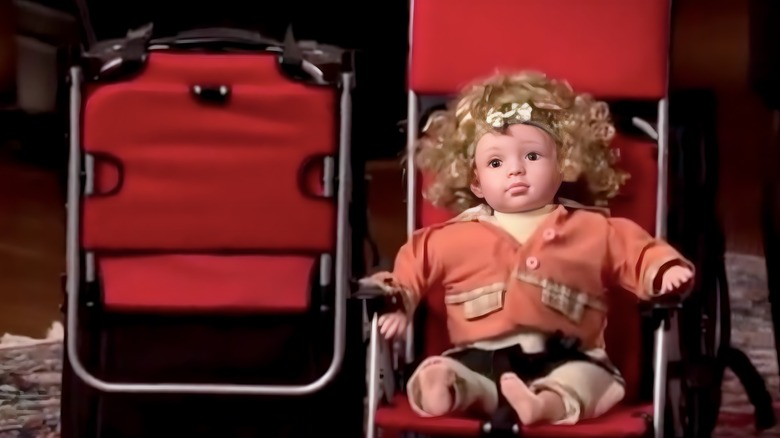
Image: ABC/Shark Tank, via Explore.
Who created Ride-On Carry-On?
Darryl and Randy Lenz developed the product. Darryl’s experience as a flight attendant helped identify the practical problem of moving through an airport with luggage and a small child.
The Citizen’s April 2011 founder reporting describes the couple’s prototypes, subsequent manufacturing and sales before the television appearance. The business therefore existed before the Sharks saw it.
The product was an attachment rather than a new suitcase. That distinction was central to the proposition: the family could use an existing rolling bag instead of purchasing an entirely separate ride-on luggage system.
| Design element | Intended purpose |
|---|---|
| Folding seat | Provided a place for a child during terminal travel |
| Luggage attachment | Combined the seat with a rolling bag |
| Fold-flat arrangement | Reduced bulk when the seat was not in use |
| Travel-focused design | Addressed a specific airport problem |
These are descriptions of the historical concept, not a current compatibility guarantee. Anyone assessing an old unit needs the instructions for that model and the appropriate luggage and user limits.
The invention’s appeal was its recognizable use case. Parents did not need a complicated explanation of the problem before seeing why the couple had tried to solve it.
What happened on Shark Tank?
The couple requested $50,000 for 25% and accepted Barbara Corcoran’s offer on those terms.
| Pitch detail | Outcome |
|---|---|
| Entrepreneurs | Darryl and Randy Lenz |
| Appearance | Season 2, Episode 4 |
| Product | Folding child seat attached to rolling luggage |
| Request | $50,000 for 25% |
| Accepted offer | $50,000 for 25% |
| Shark | Barbara Corcoran |
The request implied a $200,000 valuation at the proposed terms. That is a historical deal figure, not a current net-worth estimate.
The record also extends beyond the handshake. Contemporary reporting describes Corcoran’s contact with the founders after the segment aired. Later coverage describes a Season 3 follow-up about the business.
That provides more support for an ongoing relationship than a pitch recap alone, although private closing documents were not reviewed for this article.
This differs from Mod Mom Furniture’s deal history, where the founder later explicitly said the accepted investment did not close. Each agreement needs its own follow-up evidence.
What changed after the broadcast?
The first documented change was attention. The Citizen reported that the couple shipped 500 units in the four days after their episode aired.
That is a dated account of the immediate response, not an annual sales rate. Multiplying a brief television-driven surge across an entire year would produce an unsupported revenue claim.
Explore’s later account describes a March 2012 Season 3 update in which reported sales had reached $500,000, compared with $40,000 before the show. Those figures belong to the historical update.
| Evidence | What it tells readers |
|---|---|
| April 2011 local reporting | The broadcast produced an immediate order response |
| Post-show founder contact | Corcoran remained in touch after airing |
| Reported Season 3 update | The business had a later televised follow-up |
| Historical sales figures | A snapshot of that period, not present revenue |
For a demonstrable travel accessory, television could show the problem, the product and its use in a short sequence. That is our analysis of why the format suited the invention; it is not a measured attribution of every subsequent order.
The practical challenge after exposure is fulfilling demand and keeping customers informed. Attention alone does not answer how long production will continue or what the business will look like years later.
What happened to the SitAlong name?
All Shark Tank Products reports that Ride-On Carry-On later became known as the SitAlong Toddler Luggage Seat and states that it is no longer available.
Later retail listings use the Think King SitAlong name. The reviewed material does not establish a complete primary-source chronology of licensing, ownership or manufacturing arrangements, so this article does not invent one.
A later product name can reflect a changed commercial arrangement, but the name alone cannot tell us which company manufactured a particular unit or what support is available now.
| Name or listing | How to interpret it |
|---|---|
| Ride-On Carry-On | The product name associated with the Shark Tank pitch |
| SitAlong Toddler Luggage Seat | Later name reported in specialist coverage |
| Think King retail listing | Evidence that a listing existed, not proof of current production |
| Used or old-stock offer | Availability of that item, not necessarily an active manufacturer |
This distinction is particularly useful when researching products from early seasons. Retail pages often remain searchable after availability changes.
Flipoutz’s acquisition history offers a related lesson: later branding and transactions should be described only as far as the documentation supports.
Can you buy Ride-On Carry-On today?
Latest update — November 18, 2026: We could not verify current production of the original Ride-On Carry-On or a dependable direct buying route for a newly manufactured unit.
A Walmart Canada SitAlong listing remains a historical retail reference, but its availability could not be freshly verified during this update. It should not be treated as a confirmed recommendation to buy.
A marketplace may also show a used seat or old inventory. Before relying on such an offer, establish what is actually being sold and who can answer questions about it.
Useful checks include:
- The exact brand and model.
- Whether the seller has the item in stock.
- Whether it is new old stock or used.
- Whether the original instructions and attachment components are included.
- The relevant compatibility and user limits.
- The seller’s return and support arrangements.
This update does not certify an old unit’s condition or treat it as a substitute for an approved in-flight child restraint. The historical pitch concerned a luggage-attached travel seat, and the correct instructions for any specific item remain essential.
What is Ride-On Carry-On worth now?
A reliable current business valuation is not available in the reviewed sources.
The $200,000 figure implied by the pitch terms is sometimes carried forward as though it were an enduring net worth. It is not. A historical investment proposal cannot establish the present value of a business with an uncertain current operating status.
| Figure or claim | Correct context |
|---|---|
| $50,000 | Accepted investment amount on the show |
| 25% | Equity associated with the offer |
| $200,000 | Valuation implied by those terms |
| Post-show sales reports | Historical snapshots |
| Current annual revenue | Not independently verified |
| Current company valuation | Not independently verified |
Nor does unclear availability establish a precise shutdown date. We have not verified a founder announcement or corporate record that supplies one.
This is the same evidence distinction used in Fitness Stride’s update: a reported or observed availability problem should not become an invented financial history.
Ride-On Carry-On’s strongest documented story remains a practical travel invention, an accepted Corcoran offer and a measurable early response to the show.
Frequently asked questions
Who invented Ride-On Carry-On?
Darryl and Randy Lenz. Darryl’s flight-attendant background informed the travel problem the product addressed.
Which Shark made the deal?
Barbara Corcoran offered $50,000 for 25%, matching the couple’s request.
Is there evidence beyond the handshake?
Yes. Contemporary founder reporting and a later reported show update support a continuing post-show relationship. Private closing documents were not reviewed.
Was it renamed SitAlong?
Specialist product coverage reports that later name. A complete primary-source ownership and licensing chronology was not verified.
Is Ride-On Carry-On still manufactured?
Current production has not been verified.
Can old sales numbers be used as current revenue?
No. The post-show reports describe their own historical periods.
What is the business worth today?
A reliable current valuation is not established by the available evidence.
The weekly question
From obsession to clarity — one original question every week.
We answer one noisy topic at a time, in full. No daily roundup, no thread bait — just the question, the principles, and the system.


