
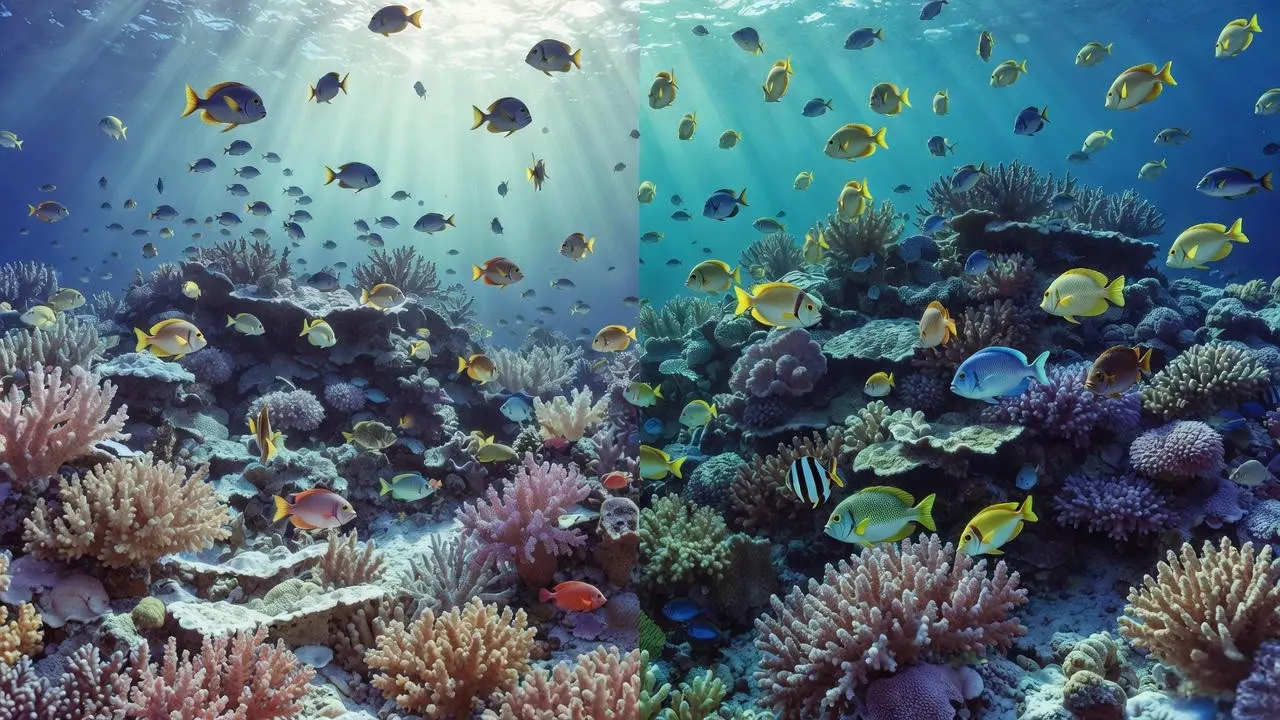
Researchers say many coral reefs are producing far less food than they could, and new evidence reveals how much humanity is losing by letting fish stocks decline. The study shows that rebuilding these damaged reef systems could create millions of new fish servings each year at a moment when food insecurity is rising across the tropics.
Fast Facts: A new global study shows most coral reefs are producing far less food than they could. Rebuilding fish populations to healthy levels could boost sustainable yields by nearly fifty percent and provide millions of extra fish servings each year, especially in nations facing hunger. Researchers analyzed over a thousand reef sites, modeled recovery timelines, and found that well-managed reefs can support stronger food security even as oceans warm.
The team behind the study found that most of the world’s coral reef fisheries are operating far below their sustainable potential. Many reefs hold less than half the fish biomass needed to produce maximum sustainable harvests. This gap means communities are losing both food and income, and these losses are far larger than previously measured.
The new research analyzed 1,211 reef sites across 23 tropical jurisdictions. It reveals reefs could increase sustainable fish yields by nearly fifty percent if fish populations were allowed to recover. The scientists used decades of fish survey data and a model that estimates how fast fish communities grow when not overharvested. Though the modeling is complex, the idea is simple: healthy reefs can produce far more food than the degraded ones most people rely on today.
The researchers created clear recovery targets by estimating how much fish biomass each reef needs to rebuild. Many sites would need to double their fish populations, which they say is possible but requires strong fishing limits. The team also estimated how long recovery would take. Full rebuilding could take as few as six years under strict protections or up to five decades under lighter management.
The study suggests recovering coral reef fish populations could greatly strengthen food security, especially in countries with high rates of hunger. Jurisdictions like Kenya, Mauritius, and Oman could increase their sustainable catch by more than three hundred percent per square kilometer. Malaysia, Tanzania, and the Maldives could also see large gains. When converted into real-world meals, these increases translate into tens of thousands to millions of additional yearly fish servings. That means more families could meet recommended seafood intake levels linked to heart health.
Experts involved in the study noted that nations suffering the highest hunger and micronutrient deficiencies are also those with the greatest potential gains. In places like Madagascar, Mozambique, Tanzania, Kenya, Indonesia, and the Philippines, rebuilding reef fisheries could help over one million more people meet annual seafood intake recommendations. This creates both urgency and hope: the places that need more nutritious food most stand to benefit the most from rebuilding fish stocks.
The findings link reef recovery to global issues far beyond the ocean. Climate models show future warming and heatwaves will strain reefs, making recovery more difficult. Yet the study argues that even under climate stress, well-managed fisheries can improve long-term food access. This connects marine conservation to public health, agriculture, economics, and climate adaptation. Rebuilding reefs is not just an environmental task but a nutrition and development strategy.
Next, the scientists want to understand how recovery timelines change under different climate futures and social conditions. They also hope to evaluate how alternative income sources, such as aquaculture or tourism, can support communities during early recovery periods when fishing pressure must be reduced. The study points out that practical recovery will require planning, funding, fair access to food, and local involvement.
The overall takeaway is clear. Rebuilding coral reef fish populations could dramatically increase the global supply of nutritious seafood. The people who benefit most would be those in regions facing hunger and micronutrient deficiencies. The study suggests the world could unlock a major food source by restoring one of the planet’s most threatened ecosystems.
Story Source:
Materials provided by King Abdullah University of Science and Technology, Harvard T.H. Chan School of Public Health, Lancaster University, James Cook University, University of Sydney, Dalhousie University, University of Leeds, University of Queensland, University of Technology Sydney, Leibniz Centre for Tropical Marine Research, IPB University, University of Montpellier, Ifremer, and Smithsonian Tropical Research Institute. Content may be edited for style and length.
Journal Reference:
Jessica Zamborain-Mason, Joshua E. Cinner, M. Aaron MacNeil, Maria Beger, David Booth, Sebastian C. A. Ferse, Christopher D. Golden, Nicholas A. J. Graham, Andrew S. Hoey, David Mouillot, Sean R. Connolly. Potential yield and food provisioning gains from rebuilding the world’s coral reef fish stocks. PNAS, 2025. 122(51). DOI: 10.1073/pnas.2508805122