
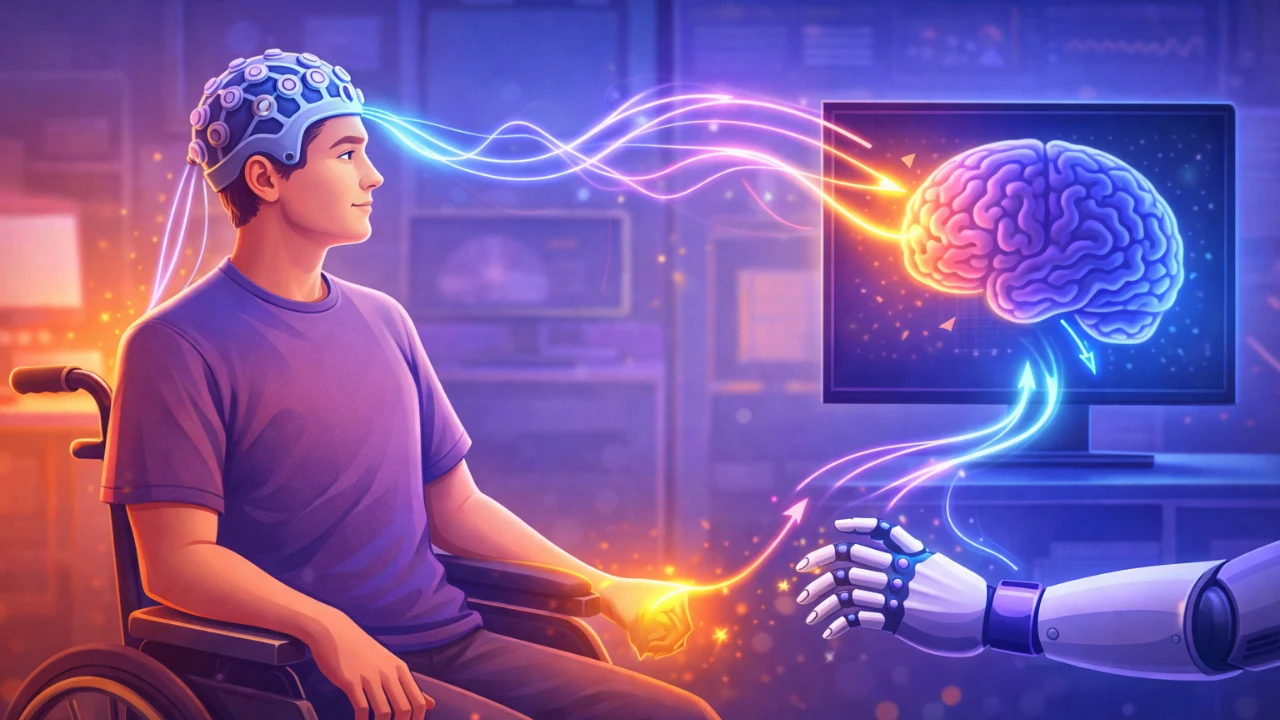
The Jan. 24, 2026 ScienceDaily report centers on a study in APL Bioengineering where EEG-based decoding linked to a spinal cord stimulator translated intention into action for a paralyzed limb without invasive hardware.
Conducted by researchers in Italy and Switzerland, the work demonstrates that real-time decoding of movement intention via a non-invasive brain-computer interface can trigger movement in a affected limb through external stimulators, offering a safer alternative to implanted electrodes. Nature Communications reported on related advances in non-invasive BCIs that pair EEG with robotic control, underscoring a growing trend toward safety and accessibility.
Nevertheless, the study remains in an early stage with a small cohort, and questions about long-term durability and real-world scalability persist. NIH overview notes that translating signals from scalp recordings to actionable movement is challenging but feasible with iterative refinement.
At the heart of the work is a machine-learning pipeline that interprets EEG patterns associated with attempted movement. The system reliably distinguished moments of intent from rest, but it struggled to differentiate distinct actions like standing versus walking—a reminder that movement specificity remains a hurdle in non-invasive decoding.
Lead author Laura Toni and colleagues emphasize that the method could mature to recognize actions such as standing, walking, or climbing, and could eventually be paired with implanted stimulators if needed in future trials. ScienceDaily has the full narrative of the trial and its implications for rehab.
As public interest in neurotech/BCI grows, this study provides a concrete demonstration that brain signals can translate into real movement without surgery, fueling both clinical and consumer conversations.
What this could mean for rehab and patients
If replicated at scale, non-invasive BCIs could shorten rehabilitation timelines, reduce surgical risk, and enable home-based therapy that complements traditional rehab in clinics. In the near term, researchers envision EEG caps guiding assistive devices in real-world settings, potentially widening access to movement restoration for more people.
Researchers caution that more trials are needed to assess durability, consistency across patients, and integration with everyday devices. The path to widespread adoption will depend on larger cohorts, standardized protocols, and clear safety benchmarks. For patients and families, the message is one of cautious optimism: the technology is moving from the lab toward safer, scalable rehab options.
Ultimately, the era of the implant may be ending; a future built around safe, scalable non-invasive BCIs could bring real movement restoration from clinic to living room.
- Non-invasive BCIs can decode movement intention in real time and translate it into action without implants.
- Early-stage results come from small patient groups and require larger trials to confirm durability and real-world use.
- Potential to shorten rehab timelines and widen access by moving therapy outside hospital settings.
- The next frontier involves refining movement specificity and exploring home-based, EEG-guided rehabilitation tools.
New research reveals how a hidden immune signaling chain links chronic gut inflammation to the earliest stages of colon cancer.
Read the Full Story