Why Off-The-Shelf Cancer Cell Therapies Are Finally Real: The Notch Timing Twist
In a sunlit bench at the University of British Columbia, Dr. Ross D. Jones steadies a pipette as a glowing Notch timing diagram ticks toward the exact window that decides whether stem cells become helper T cells.

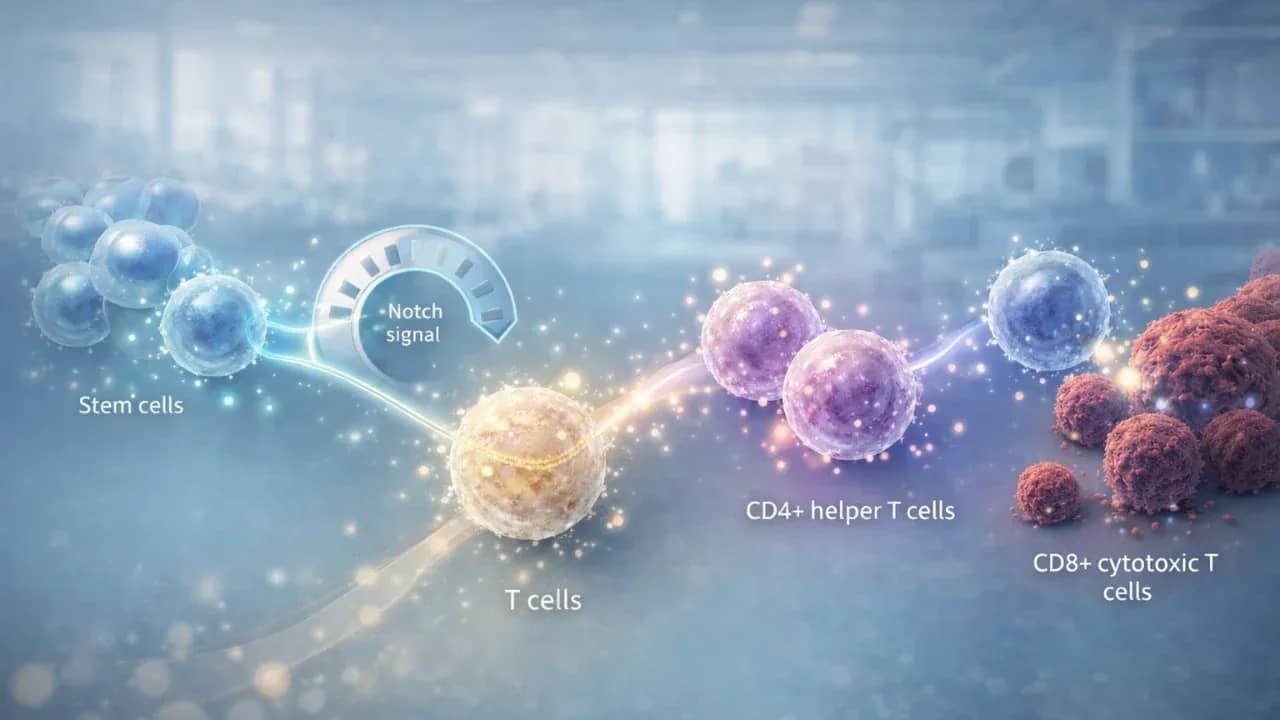
That timing insight overturns a long-standing assumption in immunology. For years, scientists believed Notch signaling simply needed to be switched on to start T cell development. The new research shows it is far more precise than that.
Dr. Ross D. Jones at the University of British Columbia, working with co-senior authors Dr. Megan Levings and Dr. Peter W. Zandstra, discovered that briefly dialing down the Notch signal at exactly the right moment changes what stem cells become. When timed correctly, stem cells are more likely to develop into CD4+ helper T cells, while still retaining the ability to produce CD8+ cytotoxic T cells that directly attack cancer.
This careful timing creates a reliable, repeatable way to generate both types of immune cells at scale. It opens the door to truly off-the-shelf immune therapies instead of slow, patient-specific treatments. The significance of this shift has been highlighted in coverage by ScienceDaily, which framed the work as a key step toward practical, mass-produced cancer cell therapies.
Notch Timing: A Small Window, Big Impact
That Notch signal is not a simple on/off switch; it is a dial. When dialed down at the right moment, progenitors commit to helper T cell fate, yielding a population that can coordinate with killer T cells to mount robust anti-tumor responses. The approach leverages pluripotent stem cells differentiated under tightly controlled Notch cues, offering a reproducible path to both helper and killer lineages for large-scale production.
From Bench to Biotech: Overcoming the Autologous Bottleneck
The timing-tuned protocol directly addresses a stubborn bottleneck: autologous therapies require patient-by-patient manufacturing, driving up cost and wait times. By establishing a robust, scalable differentiation route, the team provides a blueprint for off-the-shelf immune products that could be deployed broadly and more quickly, a narrative echoed by coverage like ScienceDaily and the accompanying research article Tunable differentiation of human CD4 and CD8 T cells from pluripotent stem cells.
Evidence You Can Trust: How It Works
Using precise Notch signaling modulation, the researchers demonstrated consistent generation of helper T cells and functional cytotoxic T cells across multiple pluripotent stem cell lines, with results supported by marker analysis and functional assays. The findings align with the broader immunotherapy discourse and provide a rigorous, scalable route for cell-biomanufacturing, as outlined in the study documented by DOI: Stem Cell and summarized in ScienceDaily’s release.
Where It Takes Us: Real-World Impact
If translated clinically, this timing-tuned strategy could shrink manufacturing timelines and reduce costs for ready-made immune therapies, enabling earlier intervention and broader access for cancer and other diseases. The broader implications extend to the public conversation about immunotherapy, which is widely discussed on consumer-facing health resources like the Cancer Society’s immunotherapy overview.
The era of bespoke, patient-by-patient manufacturing is ending; scalable, off-the-shelf immune therapies are within reach.
Related Reading
MIT researchers developed a dissolvable smart pill that confirms when a patient takes medication, without leaving electronics behind in the body.
Read the Full StoryThe weekly question
From obsession to clarity — one original question every week.
We answer one noisy topic at a time, in full. No daily roundup, no thread bait — just the question, the principles, and the system.