
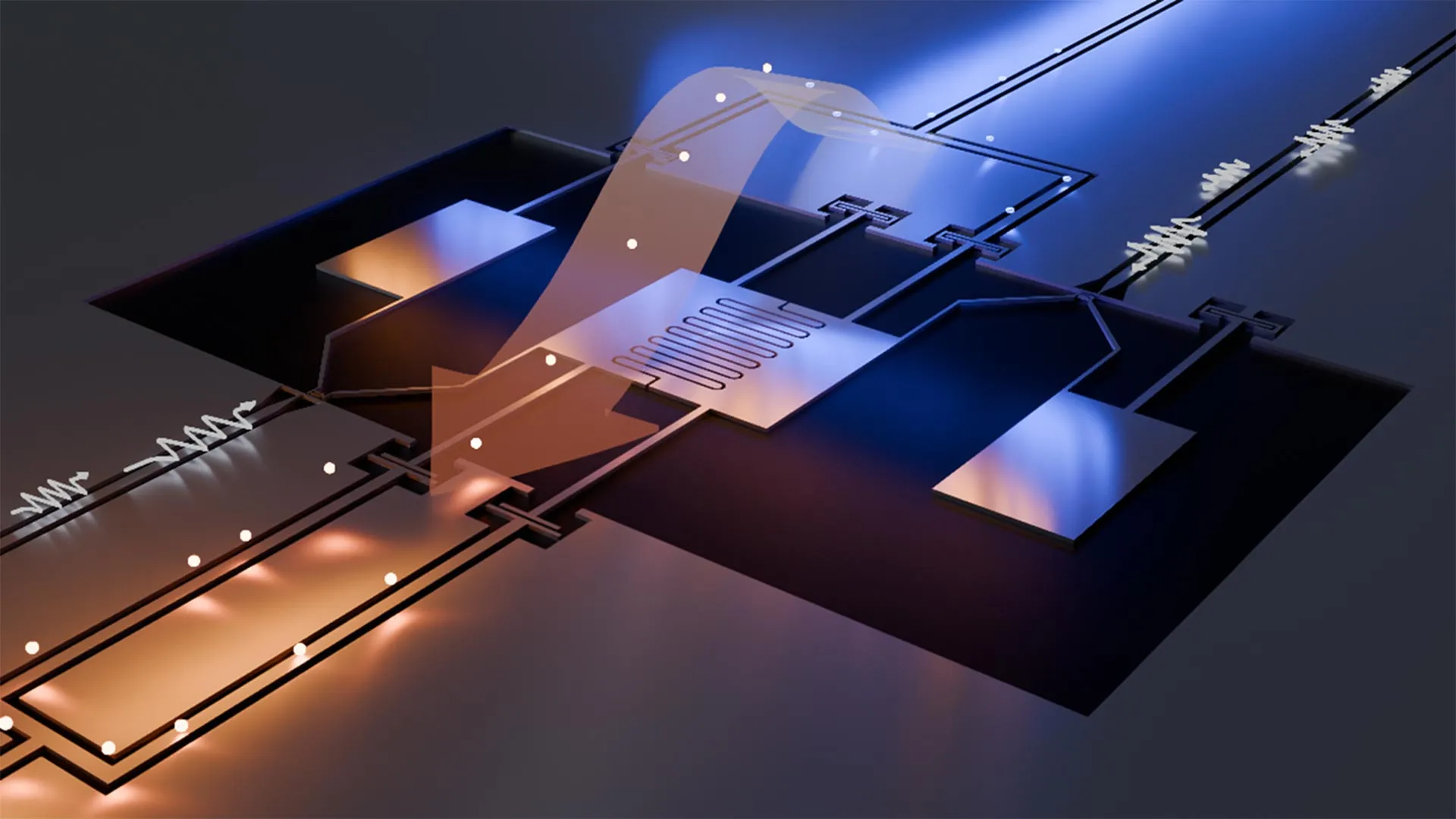
Quantum researchers are embracing a surprising idea: noise, once seen as a problem, can actually help cool quantum chips. In a new study from Chalmers University of Technology, physicist Simon Sundelin and his team built an ultra-small quantum refrigerator that uses carefully controlled microwave noise to remove heat from a superconducting circuit.
Instead of disrupting the system, these random fluctuations push heat in a specific direction, acting like a guided heat current. The result is a tiny engine that manages heat inside the chip itself, without relying on large external cooling hardware. The discovery is explained for general readers by ScienceDaily, while the full technical details appear in Nature Communications.
The Quiet Engine Inside Quantum Chips
At the heart is a nanofabricated superconducting circuit housed in the lab’s Myfab facility. By injecting a tailored spectrum of microwave fluctuations, the device creates a heat current from the qubit toward a colder bath, effectively acting as a tiny refrigerator. The mechanism resembles Brownian refrigeration, where random motion is converted into directed energy transfer.
The team reports human-scale statistics showing controllable heat flow and improved local temperature stability, a step toward preserving coherence in larger quantum processors. The coverage in ScienceDaily captures the practical essence of the work, while the peer-reviewed primary report anchors the mechanism in Nature Communications.
A Noise-Driven Refrigerator: Who and How
Led by Simon Sundelin and colleagues at Chalmers University of Technology, the project demonstrates that adding precisely tuned microwave noise to a superconducting circuit can drive heat from the qubit to a colder reservoir. The approach reframes noise as a resource rather than a drawback, linking to the broader public trend of treating environmental fluctuations as design inputs.
This internal heat management could reduce decoherence and stabilize qubits in scalable architectures, moving beyond conventional cooling methods. The Nature Communications result shows a clear mechanism: a minimal refrigerator harnesses environmental fluctuations to sculpt energy flow inside the chip.
The Road Ahead for Quantum Heat Management
Real-world impact hinges on integrating such refrigerators within larger chips, enabling stable operation at scale, and enabling new thermal budgets for quantum processors. The research suggests nanoscale heat management could lower error rates and extend qubit lifetimes, accelerating progress toward practical quantum devices.
As the field embraces this new design philosophy—noise as a resource—hardware makers and labs like Myfab and others may begin layering deliberate noise profiles into standard fabrication. The era of brute-force cooling is ending; by choreographing noise inside chips, quantum devices may become cooler, quieter, and more scalable—starting now.
- Core finding: Noise can drive cooling in superconducting quantum circuits, turning a traditional problem into a design asset.
- Lead investigator: Simon Sundelin and team at Chalmers University of Technology in Sweden.
- Implication: Internal nanoscale heat management may enable scalable, reliable quantum processors.
Related Insight
AI blood test spots Parkinson’s years early by detecting subtle molecular changes.
Read the full story →