
The United Arab Emirates imports over 85% of its food. That single number is not just surprising. It reveals a serious national vulnerability.
For policymakers and investors, this is more than a supply issue. It is a sovereign risk that depends heavily on global stability. Any disruption in trade could instantly affect food availability across the country.
But what if the solution was not imported at all? What if it was already growing in the UAE’s own waste?
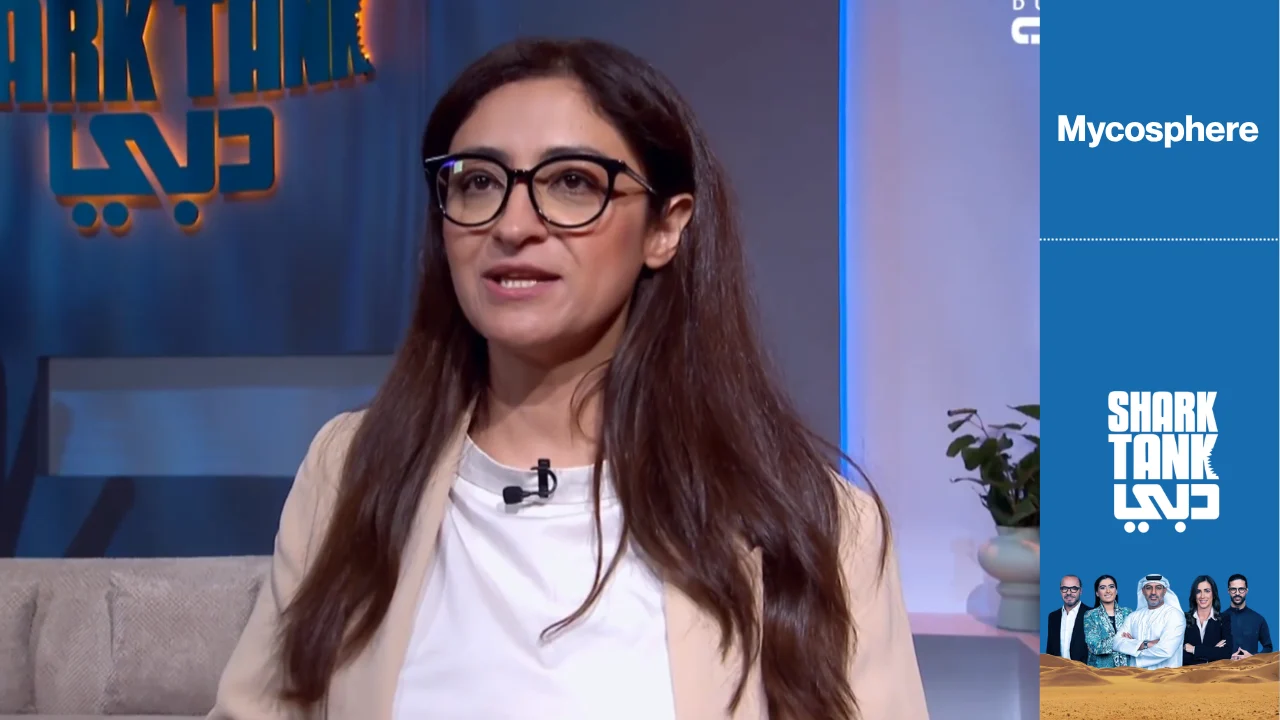
That is exactly where Dima Al-Sarouri begins her story. As the founder of MycoSphere, she believes fungi can transform organic waste into food, materials, and economic value. Her vision is simple but bold. Turn a desert limitation into a biological advantage.
Fast Facts
Founder: Dima Al-Sarouri
Company: MycoSphere
Pitch: 1.6 million AED for 32% equity
Idea: Turning date palm waste into mushrooms and biomaterials
Sales: 200,000 AED in historical sales
Outcome: No deal, but a powerful lesson in focus and execution
The “Double Upcycle” That Changes Everything
At the heart of MycoSphere is a concept Suroori calls the double upcycle. It is not just recycling. It is value creation at two levels.
The process begins with date palm waste. This material is abundant across the UAE and usually discarded. Instead of treating it as waste, MycoSphere uses it as a natural base for growing mushrooms.
Here is where it gets interesting. The fungi feed on this waste and produce high-protein food. But the process does not stop there. The leftover material, now bound with mycelium, becomes a usable substance for industrial applications.
In simple terms, one input creates two outputs. Food and material.
Suroori even demonstrated the flexibility of this system by growing mushrooms on recycled books. That moment surprised many observers. It showed that fungi are not limited to farms. They can adapt to almost any organic substrate.
As she explained during her journey:
“If we can get rid of our waste and grow our food at the same time, we create a resilient future.”
This idea directly answers a key UAE concern. Local production reduces dependence on imports. It also cuts transport costs and carbon emissions.
From Food to Architecture: A Bigger Vision
Most viewers expected a food startup. What they saw was something much broader.
MycoSphere is not only producing mushrooms for consumption. It is also exploring mycelium-based biomaterials for design, construction, and art.
This is where the story becomes unexpected.
Mycelium can be grown into specific shapes using molds. That means it can replace plastics and synthetic materials in certain applications. For architects and designers in cities like Dubai and Abu Dhabi, this opens a new creative frontier.
Suroori is targeting a niche but valuable audience. Creative professionals who want sustainable materials that also tell a story.
At the same time, she is working to change cultural perceptions. Mushrooms are not deeply rooted in traditional Arabic cuisine. That creates a demand challenge.
Her response was clever. She introduced Mushroom Makdous, a fungi-based twist on a well-known Levantine dish.
This move is not just about food. It is about cultural adaptation. It shows that innovation must connect with local habits to succeed.
Shark Tank Dubai Pitch Breakdown
Before diving into the investor reaction, here is a clear snapshot of the pitch:
| Category | Details |
|---|---|
| Founder | Dima Al-Sarouri |
| Company | MycoSphere |
| Industry | Sustainable Agriculture / Biomaterials |
| Ask | 1.6 million AED |
| Equity Offered | 32% |
| Valuation | 5 million AED |
| Sales | 200,000 AED (historical) |
| Core Idea | Turn date palm waste into food and materials |
| Outcome | No deal |
The Moment Everything Changed in the Tank
On paper, the idea sounded powerful. It combined sustainability, food security, and innovation. But inside Shark Tank Dubai, reality hit fast.
The Sharks did not question the science. They questioned the business.
The biggest concern was focus. MycoSphere was trying to do too many things at once. It positioned itself as a research lab, a food brand, and a material supplier. This created confusion about its core revenue engine.
One Shark pointed out a critical issue. Without a clear competitive edge, how could the company compete with cheaper imported mushrooms?
Another concern was cultural demand. Mushrooms are still not widely consumed in the UAE. That makes rapid scaling difficult.
Then came the numbers. With only 200,000 AED in sales, the 1.6 million AED ask felt premature. Investors saw it as funding experimentation rather than scaling a proven model.
This is where the pitch became a lesson.
The “Creative’s Trap” Every Founder Must Understand
What happened to MycoSphere is a pattern many founders fall into. It is known as the creative’s trap.
When you have a powerful idea, it is tempting to explore every possibility. But investors do not fund possibilities. They fund clarity and execution.
MycoSphere had three strong opportunities:
- Food production
- Biomaterials
- Research and development
Individually, each could work. Together, they diluted focus.
For a Shark Tank Dubai audience, this insight matters even more. Investors in the region often look for:
- Clear revenue streams
- Fast scalability
- Market demand validation
Without these, even the most innovative ideas struggle to secure funding.
The Real Takeaway: Innovation Needs Discipline
The MycoSphere story is not about failure. It is about transformation.
Suroori walked into the tank with a bold vision. She walked out with something just as valuable. Clarity.
As Faisal Belhoul highlighted, entrepreneurs enter the tank for two reasons. To get a deal or to learn.
In this case, the lesson was powerful. Innovation alone is not enough. It must be supported by a focused business model.
For the UAE, the question remains open. The country is investing heavily in sustainability and food security. Concepts like biological fabrication may soon move from experimental to essential.
But adoption requires more than technology. It requires market readiness, cultural alignment, and commercial strategy.
Final Thought: Is the UAE Ready for Biological Innovation?
MycoSphere introduced a bold idea at the right time. It connected waste, food, and sustainability into one system.
The challenge now is execution.
For founders watching Shark Tank Dubai, the message is clear. Big ideas win attention. Focused businesses win investment.
And for the UAE, the bigger question still stands.
Are we ready to see fungi not just as food, but as the foundation of a new economic system?
Because if the answer is yes, this story is only the beginning.
Related Reading
Rest Hero’s Shark Tank journey explained.
Read the Full Story