
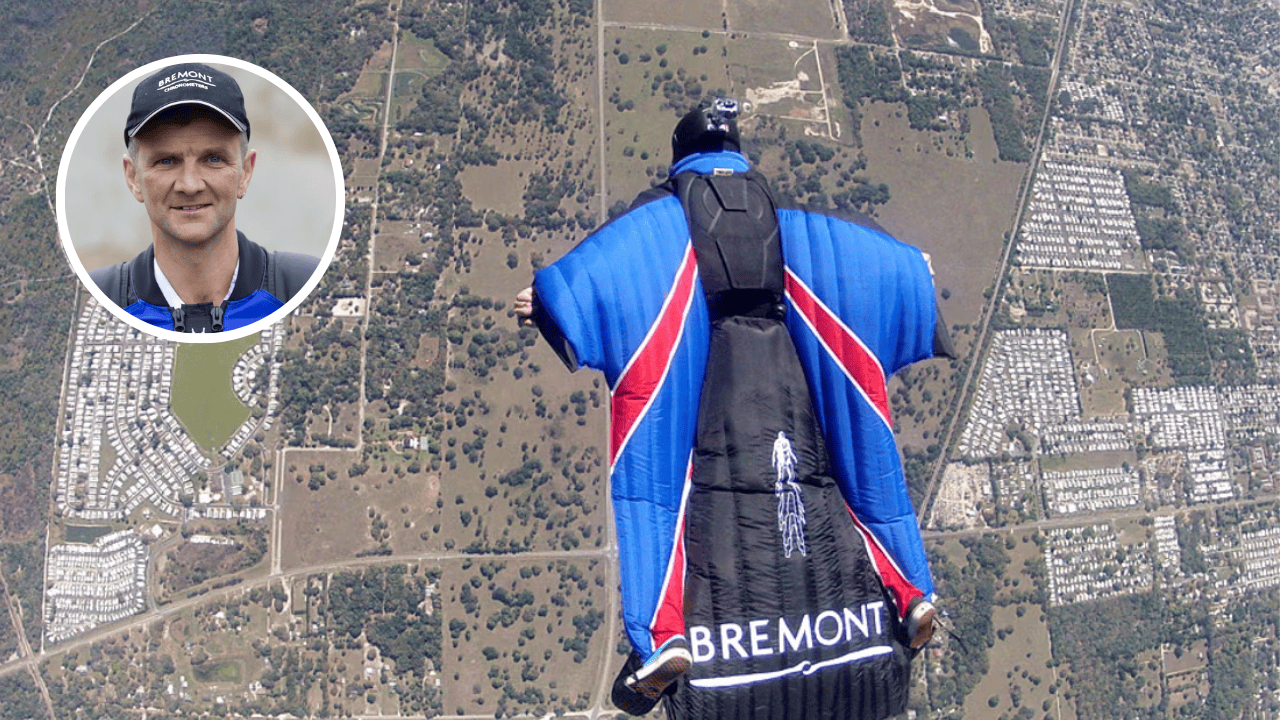
On May 23, 2012, a quiet airfield in Oxfordshire, England, became the stage for one of the boldest human flight experiments ever attempted. British stuntman Gary Connery jumped from a helicopter at 2,400 feet, wearing a wingsuit but carrying no parachute. Instead of pulling a ripcord, he aimed at a runway built entirely out of cardboard boxes. The result shocked the world: he landed safely and walked away smiling.
This was not just a dare. It was a carefully calculated attempt to answer a simple but powerful question: Can a human fly in a wingsuit and land without a parachute?
Fast Facts
- Subject: Gary Connery, veteran British stuntman and wingsuit pilot
- Breakthrough: First known parachute-free wingsuit landing on May 23, 2012
- How: Jumped from ~2,400 ft and touched down on a runway of 18,600 cardboard boxes
- Why it matters: Combined precise aerodynamics with engineered impact absorption to prove a new landing concept
- Safety note: Elite, highly controlled stunt not suitable for public replication
Who Is Gary Connery?
Gary Connery is not an ordinary thrill-seeker. He is a professional stuntman with a long career in blockbuster films such as Batman Begins, Die Another Day, and Indiana Jones. He even doubled for Queen Elizabeth II during the 2012 London Olympics opening ceremony. His background in skydiving and BASE jumping gave him the skills and confidence to try something no one had done before.
How the Stunt Worked
The Setup
- Jumped from: 2,400 feet above Oxfordshire
- Flight speed: about 80 miles per hour
- Runway design: 18,600 cardboard boxes stacked 350 feet long, 40 feet wide, and 12 feet high
The Physics Made Simple
Connery’s wingsuit created lift, allowing him to glide like a flying squirrel. Just before reaching the box runway, he flared his wingsuit, slowing down his speed. The boxes acted like a giant cushion, collapsing in sequence to spread the impact force safely.
Dr. Paul Doherty, a physicist at the Exploratorium in San Francisco, explained at the time: “
The trick is not to stop all at once. Those boxes stretched out the stop over time, and that is what saved him.”
Why This Went Viral
The stunt quickly appeared on YouTube, Sky News, The Guardian, and TIME. The visuals were unforgettable: a man flying without a parachute, then disappearing into a sea of cardboard. Within days, millions of people had watched it online, calling Connery a “real-life superhero.”
The timing also mattered. The jump happened just months before Felix Baumgartner’s Red Bull Stratos space dive, another event that captured global attention around human flight. Connery’s feat tapped into the same cultural curiosity: How far can humans really go?
Could Anyone Else Try This?
The short answer is no. This stunt required decades of training, a specialized wingsuit, government approvals, and a crew of dozens to build the landing runway. For beginners, the safe path is through licensed skydiving schools and wingsuit training programs.
The British Parachute Association requires at least 200 skydives before you can train in a wingsuit. That barrier is in place for good reason.
Challenges and Controversy
Some viewers doubted whether Connery secretly deployed a parachute. Footage from multiple angles proved he did not. Safety experts also raised concerns about how narrow the landing margins were. A slight crosswind could have made the attempt fatal.
Still, Connery himself described the landing as “so comfortable and soft that I knew I had judged it right.”
What Came After
Gary Connery continued working in stunts and remained a public figure in extreme sports. His wingsuit landing is still cited whenever people discuss the limits of parachute-free human flight. Later, in 2016, skydiver Luke Aikins performed a no-parachute jump into a giant net, often compared to Connery’s cardboard runway landing. Connery’s attempt stands as the first successful parachute-free wingsuit landing in history.
The Legacy of a Leap
Gary Connery’s stunt was not just about thrill-seeking. It was a human experiment in courage, calculation, and creativity. By showing that cardboard boxes could cushion what looked like certain death, Connery transformed a daredevil stunt into a viral lesson in physics.
For anyone who has ever dreamed of flying, his story is proof that with enough skill and imagination, the impossible can sometimes be done.