
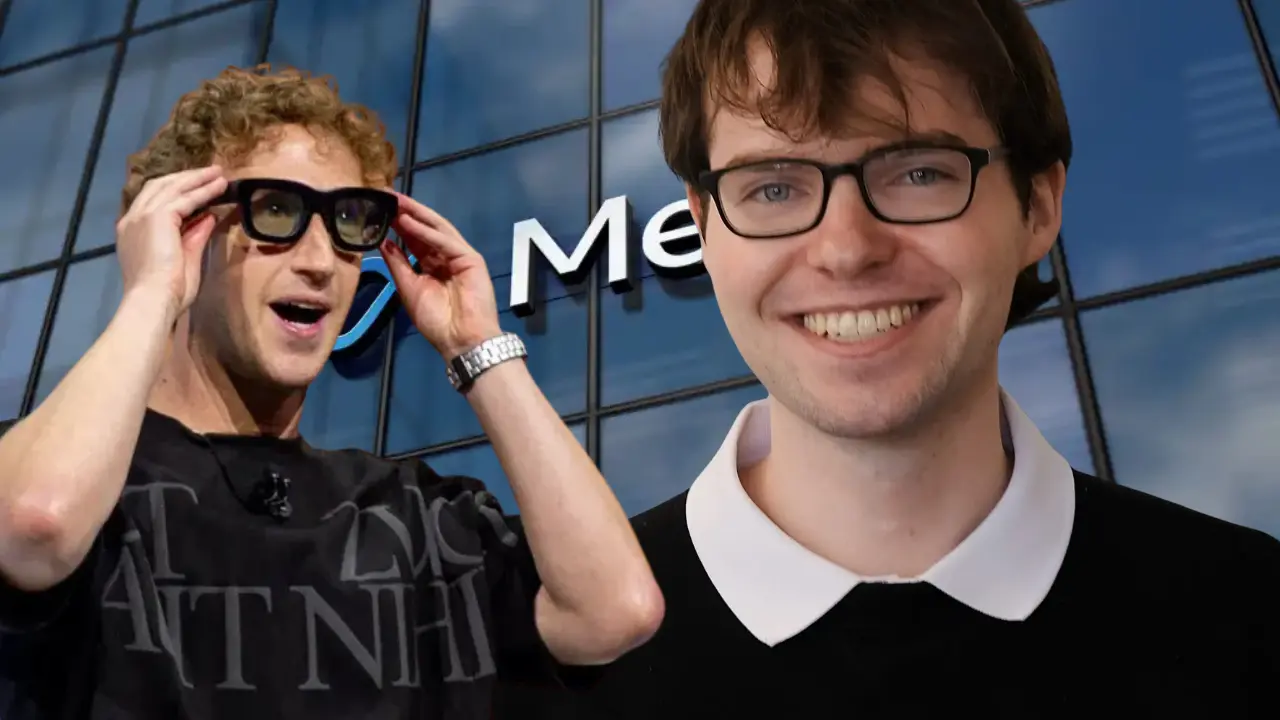
Matt Deitke was just 24 years old when he made a decision that shocked the tech world. He said no to a $125 million job offer from Meta. Most people would never think twice. But Deitke was not most people.
Just weeks later, Mark Zuckerberg himself stepped in. The new offer? $250 million.
This moment became more than just a story about money. It showed how far tech giants are willing to go to win the AI race, and what it really takes to stand out in a billion dollar talent war.
Fast Facts
- Matt Deitke is a 24-year-old AI researcher who co-founded Vercept, an AI agent startup.
- Molmo, his award-winning AI model, processes images, text, and audio.
- Meta initially offered him $125M, which he declined before accepting a revised $250M deal.
- Zuckerberg personally negotiated the new offer, including $100M in year one.
- Meta’s Superintelligence Lab is part of a broader $72B AGI talent war.
Who Is Matt Deitke and Why Is He So Valuable?
Matt Deitke grew up in a suburb of Chicago and showed early interest in technology. He built projects in high school that reportedly caught the attention of universities like Ohio State. His love for artificial intelligence began with experiments in image colorization and deep learning, a story that has become a fan-favorite anecdote among followers of his career.
He enrolled in a PhD program at the University of Washington, focusing on computer science. While one report claims he completed his PhD, most reliable sources indicate that he left the program early to pursue hands-on AI work.
Deitke joined the Allen Institute for AI, where he led the creation of Molmo, a powerful AI model that understands images, text, and even audio. His work earned an Outstanding Paper Award at the NeurIPS 2022 conference, a major honor given to just a few among thousands of submissions.
Molmo won the Best Paper Honorable Mention award @CVPR!
— Matt Deitke (@mattdeitke) June 13, 2025
This work was a long journey over 1.5 years, from failing to get strong performance with massive scale, low quality data, to focusing on modest scale extremely high quality data! Proud to see what it became.#CVPR2025 pic.twitter.com/kSNXB0THJS
In 2023, Deitke co-founded Vercept, a startup building autonomous AI agents. These agents can perform tasks on a user’s screen without being told what to do step by step. One product, called Vy, launched in 2025 as a Mac app. It automates common work tasks using natural language and screen awareness.
With strong investors like former Google CEO Eric Schmidt, Vercept raised $16.5 million. That put Deitke on Meta’s radar.
The Offer That Changed Everything
Meta offered Deitke $125 million to join its new Superintelligence Lab, a team working to build world-changing AI. But Deitke turned it down. He wanted to stay focused on Vercept, believing his startup could make a bigger impact on its own.
That is when Mark Zuckerberg personally got involved.
Zuckerberg met with Deitke and laid out Meta’s vision for building artificial general intelligence, or AGI. After that meeting, the offer was doubled to $250 million, with $100 million available in the first year. The deal included a mix of cash and stock, though most details remain private.
By early August 2025, Deitke accepted the new offer. Some reports suggest he began working with Meta’s AI team even earlier, but the announcement was made public that month. A 24-year-old had just negotiated one of the biggest personal tech deals in history.
Last week, I joined Meta Superintelligence Lab (MSL)!
— Matt Deitke (@mattdeitke) July 21, 2025
This is going to be an exciting ride! 🚀 pic.twitter.com/mZ9yIxn9UN
Why This Story Hit So Hard
Across social media, people shared reactions filled with shock, awe, and even anxiety. Some praised Deitke’s courage and talent. Others compared their own careers and wondered, “Am I already behind?”
MIT economist David Autor summed it up best. “When computer scientists are paid like professional athletes,” he said, “we have reached the climax of the Revenge of the Nerds.”
While direct mentions of impostor syndrome or burnout tied to Deitke are rare, broader discussions in AI communities reflect these emotions. On Reddit and X, people often express the pressure of keeping up with rising expectations in the AI field.
At the same time, others saw Deitke as proof that age does not matter if your ideas are bold and your work speaks for itself.
The AI Talent War: Why Companies Are Spending Billions
The battle for top AI researchers is growing more intense every year.
- Meta’s typical AI salary ranges from $200,000 to $440,000.
- OpenAI and Google offer over $500,000 for senior roles.
- Anthropic and others offer similar amounts, with added equity.
But for top-tier hires like Deitke and Apple’s Ruoming Pang, offers now exceed $200 million. Meta alone is spending over $72 billion on AI infrastructure and talent in 2025.
What makes these offers so big? The goal is to win the race to AGI, AI that can reason, learn, and improve itself like a human. Each new hire could push a company years ahead.
FYI Meta ASI (Artificial Super Intelligence) comp rumors are true! 😏
— Kiana Ehsani (@ehsanik) July 14, 2025
Matt Deitke has left Vercept to join the ASI team at Meta. Matt was one of the important team members in outlining our initial roadmap and he will be missed.😍
Ross, Luca and I and the rest of the Vercept… pic.twitter.com/E04oWr0m6E
School or Startup? What Deitke’s Choice Tells Us
Deitke’s decision to leave his PhD and build a company is part of a growing trend. More young researchers are choosing real-world impact over academic careers.
- PhD path: Offers deep knowledge, mentorship, and research opportunities. But it is long and stressful, often taking 4 to 6 years.
- Startup path: Gives more freedom, faster results, and big financial upside. But it comes with risk and uncertainty.
On forums like Quora and Reddit, people debate these paths often. Some say the PhD route offers more safety. Others believe bold action, like Deitke’s, is the key to modern tech success.
In Deitke’s case, his startup experience likely made him even more attractive to Meta.
What Makes Molmo and Vercept So Special?
Molmo is a new type of AI model. Unlike ChatGPT, which focuses on text, Molmo can understand and reason across text, images, and sound. It was built at AI2 using a custom dataset called PixMo, and it became a benchmark tool for evaluating multimodal AI.
Vercept’s product, Vy, is an autonomous agent. It looks at a user’s screen, understands what is happening, and can perform tasks on its own. It can fill out forms, click buttons, and automate processes with simple voice commands.
While it is early, Vercept is positioned as an alternative to OpenAI’s plugin ecosystem and Google’s Gemini platform. Direct benchmarks are limited, but the product’s funding and adoption suggest early momentum.
Meta’s Bigger Plan: Superintelligence and the Future of AI
Deitke’s hiring is just one part of a much larger story. Meta launched its Superintelligence Lab in June 2025, with the goal of building AI that is smarter than humans. The lab is led by Alexandr Wang from Scale AI and Nat Friedman, former GitHub CEO.
Meta is hiring aggressively from rivals like OpenAI, Apple, and Anthropic. The company has already spent over a billion dollars recruiting top AI minds. Deitke is now one of the most valuable.
Other tech giants are not standing still. Google’s DeepMind, OpenAI, and Anthropic are all pushing toward AGI. The race is on, and no one wants to be left behind.
Final Thought: Talent, Timing, and Taking a Risk
Matt Deitke’s story is not just about money. It is about timing, vision, and the courage to say no, even to $125 million.
He chose to follow his own path, build something new, and wait until the right deal came along. That deal just happened to be one of the biggest ever.
As AI continues to reshape the world, stories like Deitke’s remind us that behind every breakthrough is a bold decision, and someone willing to take the leap.
Would you do the same?
FAQs
Matt Deitke is a 24-year-old AI researcher known for creating Molmo, a leading multimodal AI model. He co-founded Vercept, a startup focused on autonomous AI agents. After initially turning down a $125 million offer from Meta, Mark Zuckerberg personally doubled the deal to $250 million to bring him into Meta’s Superintelligence Lab. His innovative work made him one of the most sought-after AI talents in the world.
Vercept is a startup co-founded by Matt Deitke in 2023. Its main product, Vy, is an AI agent that works directly on a user’s screen to automate tasks like form filling and navigation. Unlike OpenAI’s ChatGPT or Google’s Gemini, which operate primarily through chat interfaces, Vy uses visual context from the desktop environment. It represents a new approach to human-computer interaction using AI.
While rare, multimillion-dollar offers are becoming more frequent in 2025 for top AI talent. Companies like Meta, OpenAI, and Google are offering extraordinary compensation to lead the race toward AGI. Matt Deitke’s $250 million package, and others like Ruoming Pang’s $200 million+, reflect how valuable elite AI researchers have become. However, most AI professionals earn between $200,000 and $500,000 per year.