
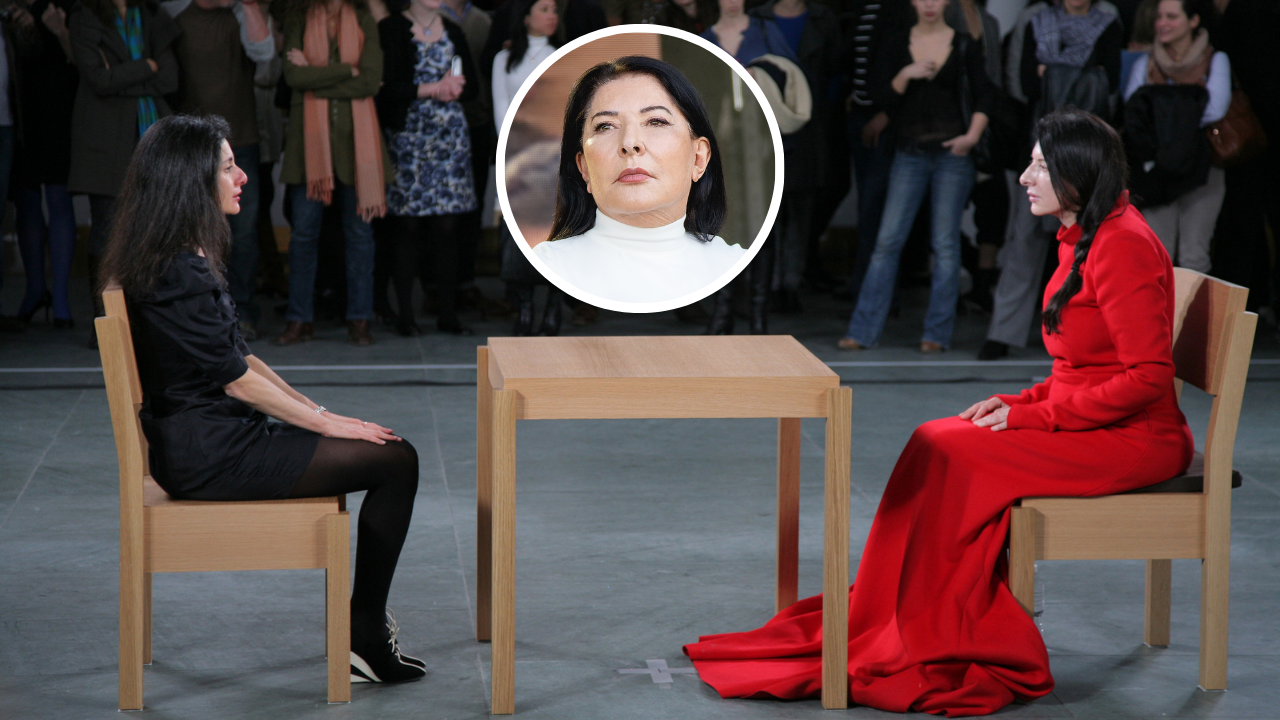
In 2010, inside the busy halls of New York’s Museum of Modern Art, one woman sat completely still. Marina Abramović took a seat at a wooden table and said nothing for 716 hours and 30 minutes. Across from her was an empty chair, open to anyone brave enough to sit and meet her gaze. Day after day, she sat motionless while strangers lined up around the block just to share a few minutes of silent connection.
Fast Facts
- Project: The Artist Is Present, Marina Abramović’s long-duration performance at MoMA
- Duration: 716 hours across nearly three months, with thousands of visitors participating
- What Happened: Silent, face-to-face sitting that sparked strong emotions and widespread online sharing
- Impact: Became a cultural touchpoint and viral moment across YouTube, TikTok, and news outlets
- Why It Matters: Shows how presence and stillness can create powerful human connection
No music, no speech, no movement. Just presence.
It sounds simple, but it was one of the most emotionally powerful art experiences ever performed. Over 1,500 visitors took turns sitting with her, and many ended up in tears. According to a study published on ResearchGate, people described the encounter as “a mirror of their inner world,” one that made them aware of emotions they didn’t expect to feel.
Years later, that same silence found new life online. Clips of The Artist Is Present, especially the emotional reunion with her former partner Ulay, began to spread again on TikTok, YouTube, and Reddit. Millions watched as decades of emotion played out in total silence. The performance had ended years ago, but its emotional impact had just begun.
Who Is Marina Abramović?
Marina Abramović is a Serbian performance artist born in 1946 in Belgrade. She is known as the “grandmother of performance art,” a title she earned after spending more than fifty years pushing the boundaries of body, mind, and endurance. Her career began in the 1970s when she created bold and often painful performances that tested what the human body could endure in the name of art.
Through works like Rhythm 0, where she allowed the audience to use 72 objects on her body, including a loaded gun, Marina explored how far people would go when given freedom and responsibility. But The Artist Is Present was different. It wasn’t about pain or risk. It was about stillness, time, and what happens when two people truly look at each other.
Marina once said, “Art must be disturbing, art must ask questions, art must predict the future.”
In many ways, her 2010 performance did exactly that. It predicted a world hungry for connection in an era drowning in noise.
Inside the 700-Hour Experiment
The setup of The Artist Is Present was simple yet demanding. Marina sat every day during museum hours, dressed in a long gown, under bright lights, in total silence. In front of her, a single chair waited for visitors. They could sit as long as they wanted, but they could not speak or touch her. Cameras captured every sitter’s face while others watched from a distance.
She performed for three months straight without speaking, reading, or writing. She fasted, meditated, and trained to control pain and fatigue. In an interview with MoMA, Marina explained, “The performance is about being 100 percent in the here and now.”
Her preparation was as intense as any athlete’s. She followed strict routines and mental discipline similar to meditation practices. Every moment required focus and self-control. As she sat still, her body hurt, but she treated the pain as part of the art.
Why People Wept
Almost every person who sat with Marina reacted emotionally. Some smiled, but many broke into tears within seconds. Why did silence make so many people cry?
Experts say the answer lies in human psychology. According to art researcher Haley Lader from Boston University,
“People are more likely to become vulnerable in the presence of a woman because of the historical idea that women are caring and motherly figures.”
Others suggest that Marina acted as a mirror. In her own words, “I am just a trigger. I am a mirror that reflects back to you your own emotions.” When someone sat across from her, they weren’t really seeing her; they were seeing themselves, stripped of distraction.
For many, that silence was unbearable. But for others, it was healing.
How It Went Viral Again
Although The Artist Is Present ended in 2010, the internet rediscovered it years later. The emotional reunion between Marina and Ulay went viral on YouTube and TikTok, gathering millions of views. People who had never heard of performance art suddenly found themselves crying over a 10-second clip from a museum that happened more than a decade ago.
A Tumblr page titled “Marina Abramović Made Me Cry” appeared soon after, filled with images of emotional sitters. It became a symbol of how digital culture transforms real human emotions into shared experiences. The performance became a meme, but a meaningful one.
In an age where people communicate through emojis and short videos, Marina’s wordless connection stood out. Her silence became the loudest sound online.
The Conflict Behind the Calm
Even a performance built on stillness faced turbulence. In 2015, Marina claimed that rapper Jay-Z had “completely used” her by adapting her format for his Picasso Baby music video without supporting her institute as promised. Later, her foundation clarified that the donation had been made but was not properly recorded. The controversy highlighted the tension between high art and pop culture.
More recently, a 2023 lawsuit involving MoMA performers reignited debates about boundaries in live art. The case raised questions about safety and consent during public performances.
These moments showed that even in silence, conflict and misunderstanding could find a voice.
Why Her Story Still Matters
Fifteen years later, Marina’s experiment still feels deeply relevant. In a world filled with constant scrolling, noise, and digital chaos, her performance reminds us that connection can exist without words. It challenges the idea that we need to talk to understand each other.
The endurance of her performance has also inspired new generations of creators. Artists now host “eye contact experiments” or mindfulness sessions influenced by her work. Her approach even aligns with modern wellness trends that emphasize being present, mindful, and emotionally aware.
According to MoMA, The Artist Is Present became the most attended performance exhibition in the museum’s history. It remains one of the most-viewed art videos online.
Marina’s silence has become a global conversation about empathy, endurance, and what it means to be human.
Final Reflection
Imagine sitting across from a stranger for ten minutes without saying a word. At first, your mind races. Then, something shifts. You begin to feel seen, vulnerable, maybe even emotional. Marina Abramović did that for 700 hours.
In a time when everyone wants to be heard, she showed us the power of simply being present. Her silence didn’t just break the internet’s heart; it reminded it that hearts still exist.