Kitchen Safe Net Worth 2026 Update
David Krippendorf and Ryan Tseng pitched Kitchen Safe on Shark Tank in 2014 and accepted $100,000 for 20% from Lori Greiner and Nick Woodman — but the deal never closed. The company succeeded anyway, rebranded to kSafe, and reports annual revenue around $5 million. Here is the full net worth update.
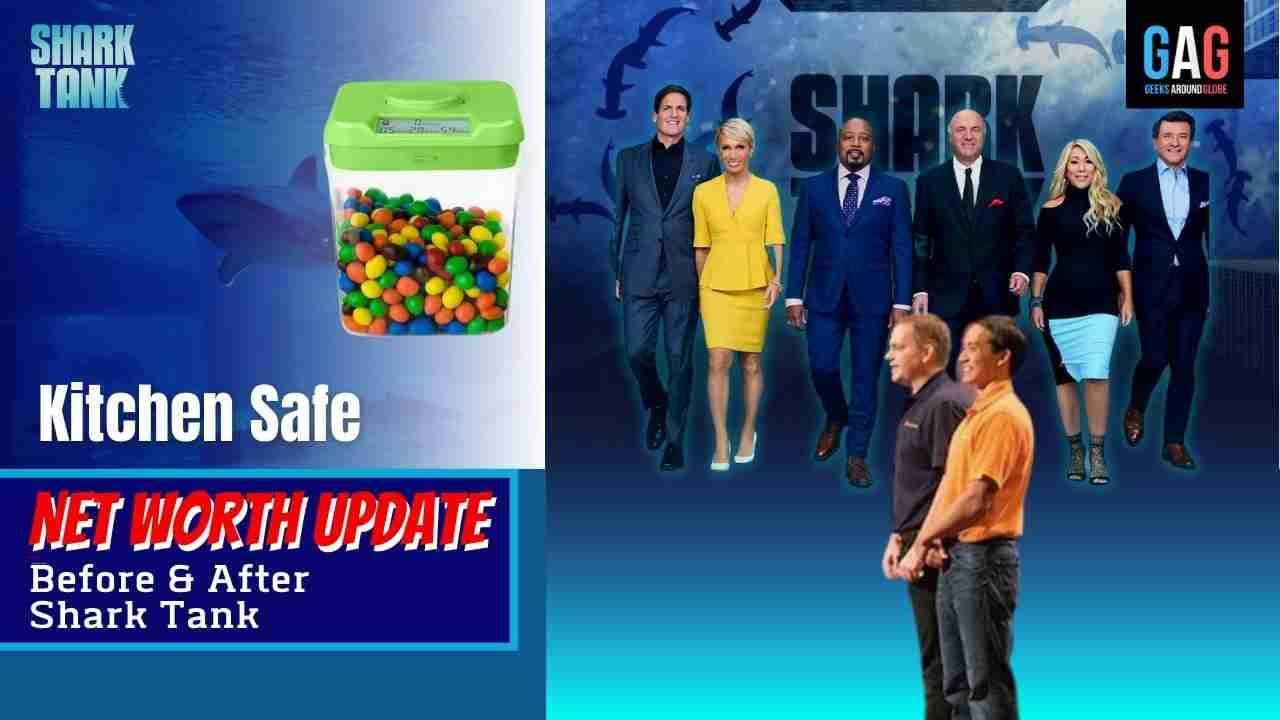
Quick answer: Kitchen Safe is still in business in 2026, now branded kSafe. On Shark Tank in 2014, founders David Krippendorf and Ryan Tseng accepted $100,000 for 20% from Lori Greiner and guest shark Nick Woodman — but that deal never actually closed. The brand grew anyway on TV exposure, reports annual revenue widely cited around $5 million, and remains a real operating company. Its exact net worth isn’t officially disclosed; our conservative estimate is roughly $5 million.
| Company | Kitchen Safe (now branded kSafe) — time-locking containers |
| Founders | David Krippendorf & Ryan Tseng |
| Show | Shark Tank USA, Season 6, Episode 10 (aired Nov 21, 2014) |
| The ask | $100,000 for 5% (~$2M valuation) |
| On-air deal | $100,000 for 20% — Lori Greiner & Nick Woodman (QVC contingency) |
| Did the deal close? | No — called off / never finalized |
| Current status | Active — selling as kSafe in 2026 |
| Reported revenue | Widely cited around $5 million/year |
| Estimated net worth | Not officially confirmed (~$5M conservative; public estimates $4M–$12M) |
| Where to buy | ksafe.com, Amazon, retailers in US/Canada/Europe/Asia |
What is Kitchen Safe’s net worth?
Kitchen Safe (kSafe) is a private company and does not publish audited financials, so there is no official net worth. The most repeated figure online is ~$5 million, which tracks the company’s widely cited annual revenue rather than a verified valuation. Other estimates run from about $4 million to $12 million depending on the revenue multiple used, while some business-data providers list far lower annual revenue (nearer $500,000) — a reminder that none of these 2026 figures are official.
Our read: treat ~$5 million as a reasonable, conservative editorial estimate anchored to reported revenue. The higher $12M figures come from applying a 4x revenue multiple to a ~$3M estimate — plausible but not confirmed. None of these are official numbers.
Is Kitchen Safe still in business?
Yes. The company operates today as kSafe and continues to sell time-locking containers through its website, Amazon, and retail channels across the US, Canada, Europe, and Asia. It is one of Shark Tank’s clearer examples of a brand that succeeded despite a deal that never closed.
Did the Kitchen Safe Shark Tank deal actually close?
No — and this is the part most summaries get wrong. On air, Krippendorf and Tseng accepted a joint offer of $100,000 for 20% from Lori Greiner and guest shark Nick Woodman, tied to a QVC placement contingency. After filming, the investment was never finalized. The founders kept the business and used the show’s exposure to grow on their own terms — a common Shark Tank outcome where the handshake makes TV but the money never lands. For another “no-deal-but-still-selling” story, see The Ave Venice.
What happened to Kitchen Safe after Shark Tank?
The episode was a sales catalyst. Even without the shark capital, demand jumped, and the founders leaned into a broader use case. On Nick Woodman’s suggestion, they renamed the brand kSafe to reflect how customers actually used it — locking away phones, game controllers, medication, and cigarettes, not just snacks. Krippendorf has noted that more than half of owners use it for something other than food.
- Rebrand: Kitchen Safe → kSafe (broader “self-control” positioning).
- Product line: mini, medium, and XL sizes; clear and opaque finishes; multiple colors.
- Distribution: own website, Amazon, and retailers across the US, Canada, Europe, and Asia.
- Revenue: reported around $5 million a year.
The Kitchen Safe Shark Tank pitch recap
Kitchen Safe was funded on Kickstarter in 2013 before the founders brought it to Shark Tank Season 6. Their infomercial-style pitch — asking $100,000 for 5% at a $2 million valuation — had the sharks laughing while demonstrating how a time-lock container helps people resist temptation. Multiple sharks engaged, including a $100,000-for-20% offer from Daymond John, before the founders accepted the joint Lori Greiner + Nick Woodman offer at the same equity with a QVC condition.
Who founded Kitchen Safe?
David Krippendorf and Ryan Tseng founded Kitchen Safe in 2012 and brought it to market via Kickstarter in 2013. Krippendorf came from a business/finance background and Tseng from engineering. Individual founder net worth figures circulating online are not verified — the more defensible number is the company’s reported revenue and the resulting valuation estimate, not personal wealth claims.
Can you still buy Kitchen Safe (kSafe)?
Yes. kSafe is sold on its official website and on Amazon, with availability through retailers in several regions. The lineup covers mini, medium, and XL sizes in clear or opaque versions, so buyers can pick visibility and capacity based on what they’re locking away.
Kitchen Safe / kSafe timeline
| Year | Milestone |
|---|---|
| 2012 | David Krippendorf and Ryan Tseng found Kitchen Safe |
| 2013 | Kickstarter campaign funds the first production run |
| 2014 | Pitch airs on Shark Tank S6 E10; accept $100k for 20% (Greiner + Woodman) |
| After the show | Deal never closes; brand renamed kSafe; sales grow |
| 2026 | Still operating; reported revenue ~$5M; estimated net worth ~$5M |
Frequently asked questions
What is Kitchen Safe’s net worth?
It is not officially disclosed. The most-cited figure is about $5 million (tracking reported annual revenue); broader estimates range from roughly $4 million to $12 million.
Did Kitchen Safe get a deal on Shark Tank?
On air, yes — $100,000 for 20% from Lori Greiner and Nick Woodman. But the deal was contingent on QVC and was never finalized after filming.
Is Kitchen Safe still in business?
Yes. It operates today as kSafe and sells through its website, Amazon, and retailers in the US, Canada, Europe, and Asia.
Why did Kitchen Safe change its name to kSafe?
Guest shark Nick Woodman suggested a broader name because customers use it to lock up phones, game controllers, medication, and more — not just kitchen snacks.
Who founded Kitchen Safe?
David Krippendorf and Ryan Tseng, who launched it via Kickstarter in 2013.
How much does a kSafe cost?
Pricing varies by size, with mini and medium units typically lower-priced than the XL. Check ksafe.com or Amazon for current pricing and stock.
The bottom line
Kitchen Safe is a Shark Tank success story with an asterisk: the televised deal with Lori Greiner and Nick Woodman never closed, but the exposure was enough. The founders rebranded to kSafe, expanded the product line, and built a durable business reportedly doing around $5 million a year. For net worth, treat ~$5 million as the best-supported estimate — not an official figure.
How we verified this update
This update is based on Kitchen Safe’s Shark Tank USA appearance (Season 6, Episode 10, aired November 21, 2014), where the founders asked $100,000 for 5% and accepted a $100,000-for-20% joint offer from Lori Greiner and Nick Woodman contingent on QVC. Multiple post-show reports confirm that deal was never finalized while the company continued operating, rebranded to kSafe, and expanded distribution. Revenue is stated as widely reported (around $5 million) and net worth as an editorial estimate because the company does not publish audited financials. We refresh this page when new verified facts emerge.
RELATED: Lori Greiner net worth · Scrub Daddy net worth update · The Ave Venice net worth update · Biggest Shark Tank deals ever
The weekly question
From obsession to clarity — one original question every week.
We answer one noisy topic at a time, in full. No daily roundup, no thread bait — just the question, the principles, and the system.