
In a market flooded with sugary, artificial snacks, one brand dared to go completely natural. That bold move turned a simple popsicle into a 300 million AED business story.
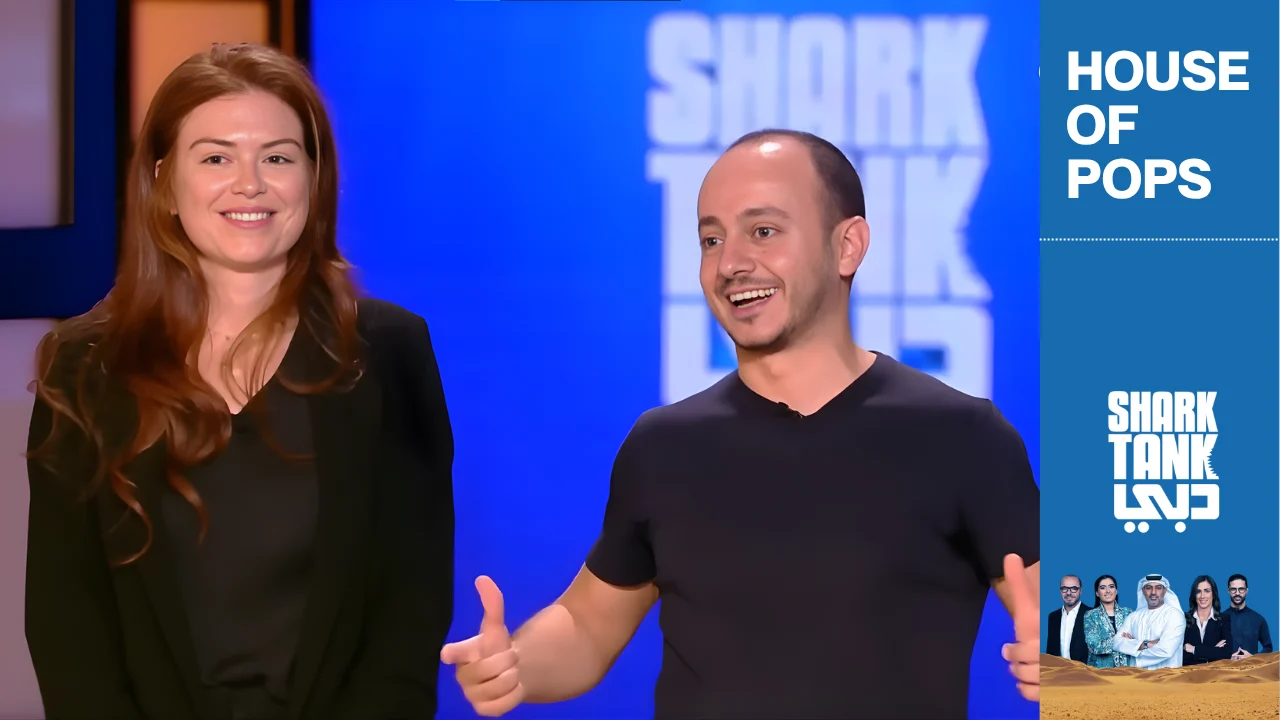
When Mazen Kanaan walked into Shark Tank Dubai, he asked for 10 million AED for just 3% equity. That valuation instantly grabbed attention and raised serious questions.
Was this just hype, or was there something deeper behind the numbers?
As it turns out, House of Pops is not just a frozen treat brand. It is a carefully engineered growth machine built on simplicity, discipline, and smart scaling.
Shark Tank Dubai Pitch Summary
| Company | House of Pops |
| Founders | Mazen Kanaan & Marcela Kanaan |
| Ask | 10 million AED for 3% equity |
| Initial Valuation | 333 million AED |
| Final Deal | 10 million AED for 8% equity |
| Investor | Faisal Belhoul |
| Sales (Current) | 23 million AED |
| Projected Revenue (2026) | 120 million AED |
| Gross Margin | ~70% |
This pitch stood out not just for its valuation, but for how confidently it was backed by real numbers and strategy.
The 5-Ingredient Moat That Changed Everything
Most brands compete by adding more. House of Pops did the opposite. They simplified everything.
Their product contains only five ingredients. No preservatives. No refined sugar. Fully vegan. Even the packaging is plastic-free.
This simplicity is not just branding. It is a powerful business moat.
By controlling a tight ingredient list, the company reduced complexity, improved consistency, and optimized costs. The result is a rare combination in FMCG.
A premium product with a 70% gross profit margin.
This flips the common belief that healthy products must sacrifice profit. Instead, House of Pops proves that simplicity can increase both trust and margins at the same time.
Why Slowing Down Growth Was Their Smartest Move
From 2018 to 2022, the company grew at an explosive 157% CAGR. Most founders would chase that momentum endlessly.
But here is where the story becomes unexpected.
Growth slowed to 17% in the most recent year. At first glance, this looks like a problem. In reality, it is a strategic decision.
Kanaan called it stabilizing the line.
Instead of risking operational breakdown, the company focused on strengthening its foundation. Systems, supply chain, and production capacity were aligned before the next expansion phase.
For investors, this signals maturity. For founders, it delivers a powerful lesson.
Sometimes slowing down is the fastest way to scale safely.
A Distribution Strategy Built for Dubai and Beyond
House of Pops did not rely on one sales channel. Instead, it built a diversified distribution network that matches Dubai’s unique market.
- 300 retail points of sale
- 15 branded kiosks in high-traffic locations
- Partnerships with 50+ luxury hotels
- Placement in Emirates Airlines Business Class
- Expansion into Saudi Arabia, Bahrain, and Kuwait
This strategy does something powerful. It positions the product as both premium and accessible.
Tourists discover it in five-star hotels. Locals grab it on the go. Travelers experience it in-flight.
That multi-channel presence builds both brand prestige and consistent demand.
The Real Endgame: Build to Be Acquired
When asked about competing with giants like Nestlé or Unilever, Kanaan gave a surprising answer.
He is not trying to beat them.
He is positioning the company to be acquired by them.
It’s easier for them to buy me than to compete with me.
This is a classic buy vs build strategy. Large corporations would struggle to replicate House of Pops’ authenticity, supply chain, and brand loyalty.
For them, acquisition is cheaper than competition.
For founders, this reveals a key insight. Not every business is built to dominate forever. Some are built to become irresistible acquisition targets.
The Hidden Engine: A Factory Ready for 7x Growth
One of the most overlooked strengths of House of Pops is its production model.
Unlike many FMCG brands, they own their factory. And that factory is underutilized.
It can produce seven times the current volume without major new investment.
This creates massive leverage.
The company plans to unlock this capacity through:
- Private label manufacturing for other brands
- New product formats like gelato and bites
- Regional franchise expansion
- Increased exports
- Stronger marketing push
Their roadmap targets 120 million AED in revenue by 2026. Each growth stream is clearly defined and backed by existing infrastructure.
This is not speculative scaling. It is calculated expansion.
The Deal That Changed Everything
The final deal closed at 10 million AED for 8% equity with Faisal Belhoul.
But the real value was not just money.
It was structure.
As part of the deal, a three-member board was introduced. This shifted the company from a founder-led startup into a governance-driven business.
That transition is critical for any company aiming for IPO or large-scale acquisition.
The funding is allocated with precision:
- 4 million AED for marketing
- 2 million AED for factory upgrades
- 4 million AED for flagship store expansion
Every dirham is tied to growth.
From Popsicle to Billion-Dollar Vision
House of Pops is no longer just a dessert brand. It is a case study in how simplicity, discipline, and strategy can build a scalable empire.
With projected profits of 42 million AED by 2026, the company is moving toward something much bigger.
As Faisal Belhoul predicted, this could become a billion-dollar company within a decade.
In a region like Dubai, where innovation meets opportunity, this story stands out for one reason.
It proves that even the simplest idea, when executed right, can dominate an entire market.