
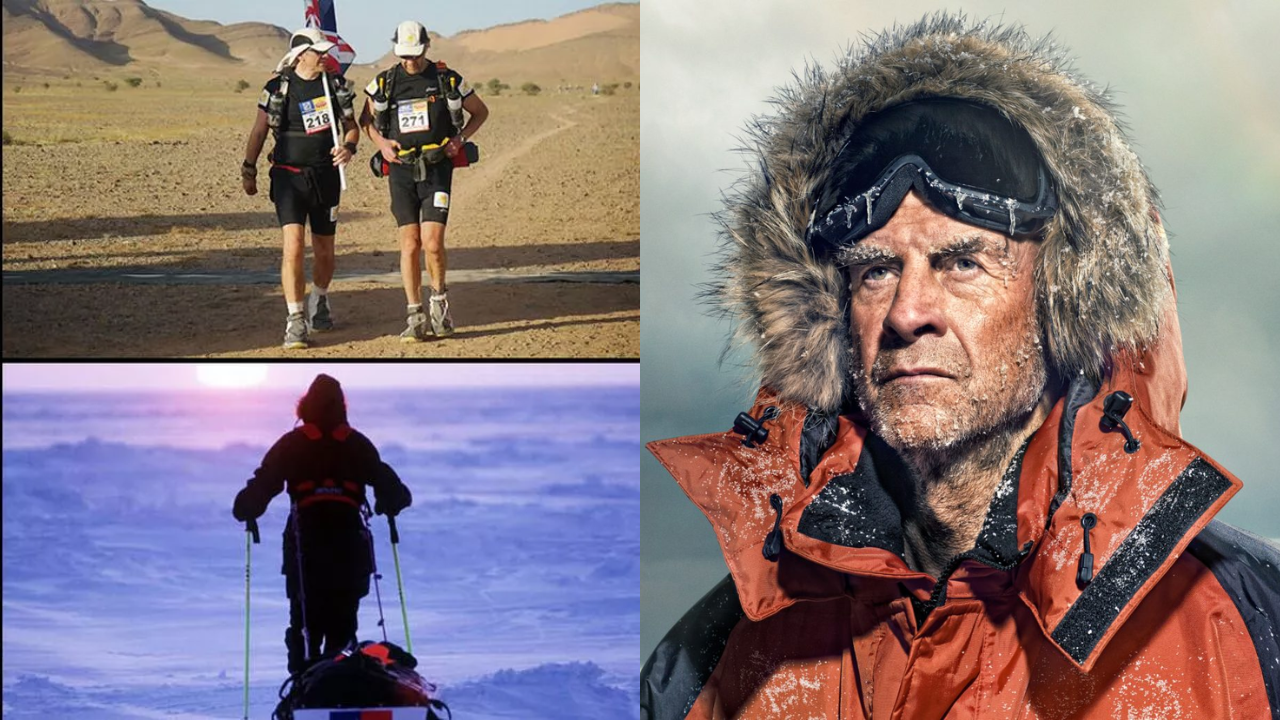
A gray-haired man sits calmly in an interview chair. He smiles, looks at the camera, and says, “I cut off my own fingers with a saw.”
The clip spread fast on TikTok and Reddit in early 2025. Millions were shocked, and thousands called him “the final boss of toughness.” That man was Sir Ranulph Fiennes, often called the world’s greatest living explorer.
Fast Facts
A quick summary you can read in under a minute.
- Subject: Sir Ranulph Fiennes, British explorer and author.
- Signature Feat: Reached both poles by surface travel and crossed Antarctica on foot.
- Record: Summited Mount Everest at 65, then the oldest Briton to do so.
- Viral Moment: Widely shared clip describing how he handled frostbite recovery.
- Why It Matters: A real-world example of endurance that inspires modern audiences.
Who Is Sir Ranulph Fiennes
Fiennes is a British explorer, author, and former soldier. Born in 1944, he has spent most of his life testing the limits of human endurance. He was the first person to reach both the North and South Poles by surface travel, and he crossed Antarctica on foot with Dr. Mike Stroud in 1993.
When he was 65, Fiennes climbed Mount Everest, becoming the oldest Briton to reach the summit at that time. He did it after suffering a heart attack and undergoing bypass surgery. Most people would have retired. He went higher.
The Viral Moment
The recent viral clip came from an old interview where Fiennes described his frostbite injury during a North Pole expedition in 2000. The freezing temperatures destroyed the ends of his fingers. Surgeons told him to wait months for a medical amputation.
Instead, Fiennes picked up a saw in his garden shed and finished the job himself. “I am not a DIY specialist,” he said, “but every time I touched something, it was agony.”
On TikTok, the short version of that quote racked up over 20 million views. Viewers compared him to movie heroes and survival-game characters. The comments were full of disbelief, laughter, and respect.
What Drives a Man Like This
Extreme explorers often describe a strange hunger to find their limits. In an interview with Dr. Mike Stroud, his expedition partner and a medical researcher, Stroud said,
“Ran has an inner drive that ignores pain signals the way a scientist ignores background noise. He is always searching for the next line to cross.”
That mindset explains why Fiennes did not stop after frostbite. He views pain as a test, not a warning. To him, comfort is the enemy of discovery.
Why the Internet Can’t Look Away
Every few months, clips of real-life heroes rise in a sea of AI art and fake stunts. Fiennes stands out because everything he did was real. He used old-school navigation, sled dogs, and grit—not satellites or drones.
Younger audiences who spend their lives online find that authenticity refreshing. Sharing his story gives people a hit of awe and pride in what humans can still do without technology.
Psychologist Dr. David Leary notes,
“When people see genuine courage, they experience moral elevation—the same emotion that makes us want to stand taller and do better.”
That is why clips of Fiennes keep coming back. They remind us of what bravery looks like when no one is watching.
Lessons From the Cold
While his story feels extreme, it carries simple lessons:
- Small discomforts build resilience. A cold shower, an early run, or walking in rain trains your mind.
- Planning saves lives. On expeditions, every supply, every step, and every calorie counts.
- Courage can be quiet. Fiennes rarely brags. He just moves forward.
These lessons apply whether you are hiking a trail or starting a hard project.
What He’s Doing Now
Today, Sir Ranulph Fiennes still gives talks around the world and supports charity expeditions. He has raised more than 20 million dollars for causes like Multiple Sclerosis research and heart disease foundations.
His story continues to inspire a new generation of explorers and creators who believe curiosity is the strongest muscle in the human body.
Final Thought
The next time you scroll past a viral clip of someone doing the impossible, remember this: while most of us worry about losing Wi-Fi, Sir Ranulph Fiennes once lost his fingertips and kept going. His story proves that courage does not age, and real adventure still belongs to those who dare to walk forward.