
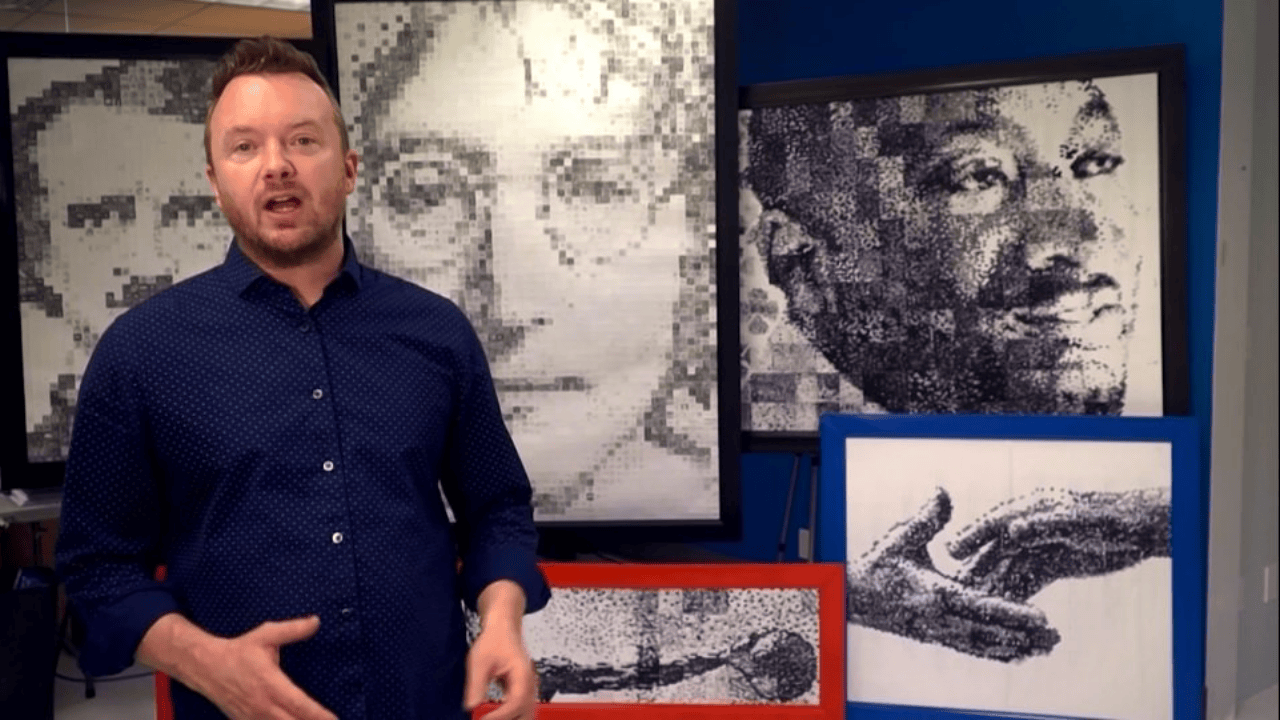
Phil Hansen grew up fascinated by art. As a child, he would sit for hours with a pencil, carefully filling sketchbooks with dots and lines. He practiced pointillism, a technique that uses thousands of tiny dots to form an image. It required incredible precision and patience. For Phil, it wasn’t just art it was therapy, focus, and joy all in one.
But everything changed in his early twenties. One afternoon, while working on a portrait, he noticed his hand trembling. The dots on the page turned into shaky smudges. Days later, the tremor grew worse. His doctor diagnosed him with permanent nerve damage in his right hand. It meant he could no longer draw steady lines. For an artist whose style depended entirely on precision, it felt like the end of his creative identity.
Devastated, Phil put away his pencils and brushes. For years, he avoided art altogether. He tried to focus on other things, but the absence of creativity left an ache he couldn’t ignore. The passion that once filled him with peace now only brought frustration.
He thought he’d lost everything that made him an artist.
Fast Facts
- Project: He Lost Control of His Hand – So He Turned His Body Into Art
- Creator: Phil Hansen, multimedia artist and TED speaker
- Core Idea: Turning physical limitations into creative power through unconventional materials
- Viral Moment: His TED Talk “Embrace the Shake” reached over 6 million views
- Message: Limitations can become the foundation for innovation and self-expression
A Life-Changing Question
Years later, while visiting a neurologist for a follow-up, Phil shared how deeply he missed creating art. The doctor listened and then asked one simple question that changed everything:
“Why don’t you just embrace the shake?”
That sentence stuck in Phil’s mind like a spark in the dark. Until that moment, he had viewed his tremor as a barrier. But now, for the first time, he wondered what if it could be a tool?
This shift in thinking became his turning point. Instead of fighting his limitation, he would make it part of the art itself.
“When I stopped fighting the shake, I realized it could be part of the art.”
Phil said during his TED Talk Embrace the Shake (2013).
Phil started to experiment again. He painted with broad strokes instead of fine dots. He used his entire arm to move paint across a canvas, letting his tremor guide the motion. The shake became not something to hide, but something to explore.
Turning Pain Into Paint
As Phil embraced this new mindset, his art evolved into something entirely new raw, unconventional, and deeply human. He began using everyday materials that most artists wouldn’t even consider. Coffee, dirt, and matchsticks replaced paint. A magnifying glass replaced his brush.
Then, he took things further. Phil started using his own body as a canvas. He painted directly onto his skin, treating it as both medium and message. His most powerful project, titled Influence, featured 30 portraits painted across his torso each one representing a person who had shaped his life. Layer by layer, he covered his body with faces, stories, and colors until the surface became unrecognizable.
When he was done, he peeled off those layers of paint, revealing a shadowy silhouette of himself underneath. It symbolized how the people and experiences around us shape who we become and how letting go can reveal something entirely new.
His video documenting Influence spread rapidly across YouTube and art forums. People were fascinated not only by the process but by the vulnerability of it the idea that someone could turn their pain into paint and literally wear their story on their skin.
According to TED’s public data, Phil Hansen’s talk has been viewed more than 6 million times, and his YouTube channel “Philinthecircle” has reached millions more.
Weird Tools, Real Art
After Influence, Phil’s creativity exploded. Each week, he challenged himself to create something strange, difficult, or temporary. He drew portraits using live worms, carved into bananas with needles, and painted with hamburger grease. He even set things on fire to see what would emerge from the ashes.
The materials were unpredictable and often disgusting, but Phil didn’t care. To him, they represented freedom, the freedom to fail, to experiment, and to accept imperfection.
His art began to carry a deeper message: the process mattered more than the result. Each piece was temporary, existing only long enough to remind viewers that beauty doesn’t have to last forever.
“Creativity isn’t about having no limits. It’s about using what you have and pushing it further,” Hansen said in an interview with Wired.
Source: Wired.com
Phil’s willingness to risk failure made him stand out in a world obsessed with perfection. His art felt alive, human, and unfiltered and people couldn’t stop watching.
The Lesson: Creativity Thrives Under Constraint
At the heart of Phil’s philosophy is a simple truth: limitation fuels creativity.
When you have endless options, it’s easy to feel lost. But when you face a boundary, you’re forced to think differently. That’s where true innovation happens.
Phil often tells students and creators to “think inside the box.” It’s his way of saying that boundaries aren’t barriers, they’re guides. By accepting what we can’t change, we unlock new ideas that wouldn’t exist otherwise.
In one talk, he compared creativity to water finding cracks in a rock. “The harder you press against it,” he said, “the more direction you find.”
In a world obsessed with flawless content and perfect outcomes, Phil’s message stands out. His art is a reminder that failure is not the end of creativity, it’s often where it begins.
What He’s Doing Now
Today, Phil continues to create, teach, and speak. He performs live art demonstrations at conferences and schools, often turning audience suggestions into spontaneous pieces.
His latest series explores text-based portraits, where he collects thousands of words from real people and uses them to build faces, landscapes, or objects. Every word contributes to the final image, showing how collective voices form something larger than themselves.
Beyond the studio, Phil has become a sought-after motivational speaker. He works with companies, schools, and creative groups to teach the same principles that saved his own career — embracing imperfection, finding value in mistakes, and creating without fear.
He’s no longer just an artist who overcame adversity. He’s a living symbol of what happens when you turn weakness into wonder.
Final Thoughts
Phil Hansen’s story is more than a tale of art. It’s a story of transformation of how one man refused to let his body’s limits define his mind’s potential.
He took what was broken and made it beautiful. He proved that the real power of creativity isn’t control, but courage.
Even if life shakes you, you can still create something incredible. All it takes is the willingness to embrace it.
“Art is not about what you see, but how you see it.” – Phil Hansen