
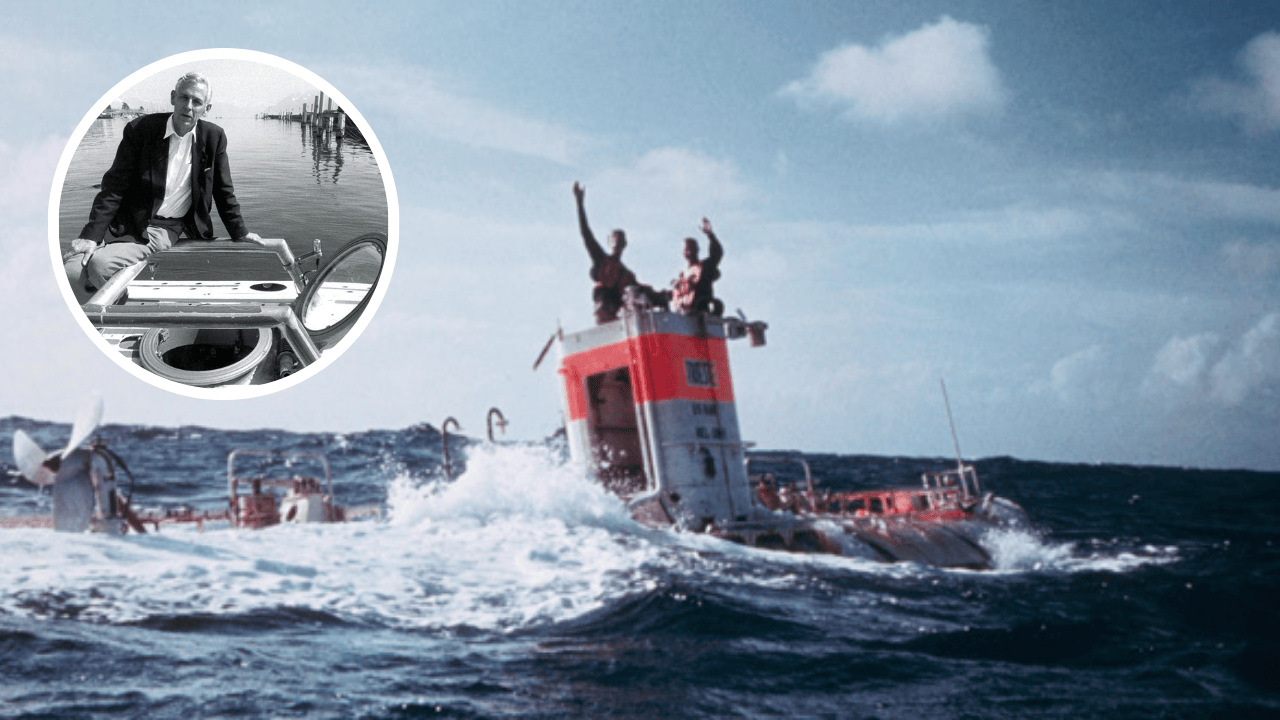
In 1960, when the world was still dreaming about reaching the moon, a Swiss oceanographer named Jacques Piccard decided to explore the opposite direction. Instead of looking up, he looked down. With U.S. Navy Lieutenant Don Walsh, he entered a strange white capsule called the Trieste and descended 7 miles beneath the Pacific Ocean into the Mariana Trench—the deepest known point on Earth.
The pressure down there was over 1,000 times stronger than at sea level, enough to crush steel. Yet, Piccard and Walsh stayed calm as they sank for nearly five hours into total darkness. At one point, a loud crack shook the vessel. The window had fractured, but they pressed on. Finally, they reached the seafloor—something no one had done before.
Fast Facts
- Project: Jacques Piccard’s record-breaking dive to the Mariana Trench in 1960.
- Depth Reached: Approximately 10,916 meters (35,814 feet) below sea level.
- Companion: U.S. Navy Lieutenant Don Walsh aboard the bathyscaphe Trieste.
- Achievement: First humans to reach the deepest point on Earth.
- Legacy: Inspired modern ocean explorers like James Cameron and Victor Vescovo.
The Moment That Changed Science
At the bottom of the trench, the two explorers made a discovery that stunned scientists. They saw small, flatfish-like creatures moving across the mud. This was proof that life could exist even under extreme pressure, changing how scientists viewed Earth’s most hostile places.
Marine biologist Dr. Robert Vrijenhoek later explained, “Finding life there showed that even in the most crushing environments, nature adapts.”
How He Did It Without Modern Tech
Piccard didn’t have computers, GPS, or Google Maps. His father, physicist Auguste Piccard, helped design the Trieste, which used a clever mix of gasoline for buoyancy and iron pellets for ballast. Gasoline is less dense than water and doesn’t compress easily, making it ideal for surviving the ocean’s crushing pressure. When they needed to rise back up, the crew simply released the iron shot.
Their calculations were done by hand, using pencils, rulers, and trust in physics.
The Crack Heard Around the World
During the descent, around 9,000 meters, the Trieste’s outer window cracked. For most people, that would be the signal to abort. But Piccard calmly told Walsh to continue. Minutes later, they reached the ocean floor. That decision made them the first humans to witness the bottom of Earth’s deepest ocean.
This calmness under pressure—literally—earned Piccard global respect as a scientist who combined courage with logic.
Why His Story Went Viral Again
More than sixty years later, Jacques Piccard’s story has resurfaced online. On Reddit and TikTok, people are sharing short clips and posts about how he “dove to the bottom of the ocean before Google Maps existed.” Viewers are amazed at how much he achieved with such simple tools.
YouTube videos and documentaries about the Trieste have gained millions of views, especially around the January anniversary of the dive. Many call him the “original tech explorer”, a man who hacked physics before coding was cool.
A Legacy That Lives On
Piccard’s mission opened the door for future explorers like filmmaker James Cameron, who repeated the dive in 2012, and Victor Vescovo, who has visited the Challenger Deep several times since 2019. Both credit the Trieste as their inspiration. Today, the original craft sits in the National Museum of the U.S. Navy, a quiet reminder of what humans can do when curiosity outweighs fear.
Why It Still Matters
In a world obsessed with AI and space exploration, Piccard’s story reminds us of something simple yet profound: curiosity doesn’t need fancy tools. It only needs courage. While modern explorers use sensors and satellites, Piccard proved that even handwritten notes and determination can push science forward.
As oceanographer Dr. Sylvia Earle once said, “We’ve explored less of our own ocean than we have the surface of Mars.”
Final Reflection
Before Google Maps, GPS, or even personal computers, Jacques Piccard mapped a place no one thought was reachable. His story isn’t just about going deep into the ocean—it’s about how far human curiosity can take us when we decide to go where no one else dares.